How does gratitude turn into generosity?
If you tried the small exercise at the end of the Preface, you pictured one person who made your life better this year and named what they did. Maybe it was a friend who showed up when things fell apart, a teacher who saw something in your kid, or a neighbor who quietly clears your walk every time it snows.
Now notice what came along with the picture. For a lot of people it's a small tug: I should tell them. Or, I wish I could do that for somebody. Nobody asked you to feel that. It showed up on its own, the moment you let yourself remember what you'd been given.
That tug is what this whole program is about, and its name is right there on the cover. It's the overflow.
The Preface was about the problem: an instruction manual for Christmas that tells our hands what to do and skips the heart. This chapter is the plan: what Advent Overflow is, why it's built the way it is, and how it works. I picture it as a simple building, and I call it the "Pillars Process." The roof names what the whole thing is for. The foundation is the one idea everything rests on. And between them stand four pillars, the practices that hold it all up.
The Preface put the whole program in five words: give thanks, then give back. Here is the longer version. The aim of Advent Overflow is to prune the poison from the holidays and practice a new way to celebrate, by leveraging Thanksgiving as the true catalyst for the advent of Christmas and letting it overflow into an ongoing Agape Adventure.
That's a lot for one sentence, so let's take it a piece at a time.
Prune the poison. A gardener prunes a tree so the healthy branches get more of the light. That's the idea here. We keep the music, the lights, the food, the gatherings, and the gifts. We cut the crud that has piled up around them, the kind of thing the six case studies in the Preface described, so the good parts of the season have room to grow.
Practice a new way to celebrate. Practice is the right word. We won't get this right the first year, and my family is still working on it every December. What we're after is a rhythm you can repeat each year and slowly get better at.
Leverage Thanksgiving as the true catalyst. A catalyst is whatever gets a reaction going. The Preface already made the case for this piece: a season of giving thanks sits right in front of the season of giving, and most of us skip it. So Advent Overflow starts on the first Thursday of November and spends the month giving thanks. December then gives back, one theme at a time: Generosity, Hope, Peace, Joy, and Love.
Overflow into an ongoing Agape Adventure. This is the part of the sentence that reaches past January 4. Agape is one of several Greek words for love. It's the one the first followers of Jesus reached for most often to describe the kind of love he taught and practiced: love that gives itself for someone else's good, whether or not anything comes back. A life shaped by that kind of love is the adventure I mean. Nobody can hand it to you in nine weeks. What we can do is aim the whole season at it.
That's why Love is the last theme of the program and why its celebration lands on New Year's Day. It's also why, on the tree your family will build this season, the first four themes each add a layer of green, and Love is the star at the very top. The program starts with one overflow, gratitude spilling over into generosity. It's designed to end with another: a whole season of receiving and giving, spilling over into a love that keeps going after the decorations come down.
Every building rests on something. This one rests on the sentence the program is named after: generosity is the overflow of gratitude.
The Preface introduced it, and now it's time to unpack it.
It started with a question I couldn't shake. Every December I saw a lot of what I'd call expected giving: gifts bought because the party required them, exchanges with price limits, lists to shop from. And I kept wondering whether any of it was really generosity. Giving isn't generous just because it's giving. I can make myself spend money on someone, but that doesn't mean my heart wants to. The generosity I admire most is the kind that doesn't need any credit at all. So the real question became: how does a person get a heart that wants to give?
Some Things You Can Only Cultivate
Here's where I landed. Some of the things we want most in life can't be controlled directly. You can't decide to feel generous any more than you can decide to feel happy. You can cultivate them, though, by practicing something you can control. In my experience, happy is the overflow of healthy. Generosity works the same way.
The picture that helps me most is a tree. Think of your life as a tree whose purpose is to bear good fruit, the good you leave behind in the world. The roots, the trunk, and the branches are already in place, and they don't change much from one year to the next. What changes every season are the leaves, and they matter more than they look. Leaves are how a tree catches sunlight, and that energy is what eventually goes into the fruit. A tree with very few leaves won't grow much fruit, no matter how much it might want to.
So our work goes into the leaves. The way I put it: we control our practices, and we cultivate our produce. The leaves are the practice, and the fruit is the produce. Any time I use the word overflow, I'm really talking about fruit.
There's one more thing about fruit that I really like. Of everything a tree makes, fruit is the part meant to be eaten by someone else. It's how the tree gets its seeds carried off to become a forest. The tree doesn't eat its own apples. Good fruit, by its very design, is for others, which makes it about as good a picture of generosity as I know.
I didn't come up with the picture of a person as a tree. I got it from Jesus, and I think he got it from texts that were already ancient in his day. The very first song in Psalms, ancient Israel's songbook, describes a person who lives well as "a tree planted by streams of water, which yields its fruit in season and whose leaf does not wither."
Jesus picks up that picture near the end of the Sermon on the Mount, his most famous teaching. How do you know a good tree from a bad tree? By its fruit. "Every good tree bears good fruit," he said, and "by their fruit you will recognize them." He said it about people who claimed to speak for God, and the question underneath is one we still ask: how do I know whose advice to follow? Test the tree. If a person's life produces good fruit, they're worth listening to.
A few lines later, Jesus switches from trees to houses: "Everyone who hears these words of mine and puts them into practice is like a wise man who built his house on the rock." The rain comes down, the rivers rise, the wind blows, and the house stands. The way I read it, he's inviting people to test his tree, taste his fruit, and then build on what he taught by putting it into practice. I want to be a tree that produces good fruit, and I want to build a house that lasts. Both pictures tell me the same thing: my life will grow whatever I practice.
Gratitude Is the Leaf
If generosity is the fruit we want in December, gratitude is the leaf we can tend in November.
Gratitude is a practice of attention. As the Preface put it, it's noticing what you got instead of what you did not. With our kids, I say it as a rhyme: I'll focus on what I got instead of what I did not. That's something a person can actually do. You can point your attention at the people who made your year better. You can write it down, and you can say it out loud. You can choose where you look, and over time, where you look shapes what you feel.
When gratitude runs deep, something happens that nobody has to force. Think back to the person you pictured. When someone gives us a gift that truly changes our life, the thanks doesn't just sit there. We want to pay it forward, to do for someone else what was done for us. Great gratitude grows genuine generosity. That's the overflow.
This is why the program works on the heart first. Instead of trying to control anyone's giving, we're trying to compel it, and then we trust the fruit to follow.
You Can't Give What You Don't Have
Two more ideas sit under the foundation, and they say the same thing from two directions.
The first is plain: you can't give what you don't have. Nothing overflows from something empty. That's why this program starts with receiving. Before anyone is asked to give anything in December, we spend a whole month noticing what we've already been given. The Preface pointed out that Christmas itself begins with receiving a very good gift. The program is built the same way.
The second is a chain of three related words: grace, gratitude, graciousness. All three grow from the same family of Latin words, gratia and gratus, which carried the ideas of favor, goodwill, and thanks. Grace is a good gift you didn't earn. Gratitude is noticing it. Graciousness is what you become when you've noticed enough of it: a person who gives the way you were given to. Grace comes in, gratitude sees it, and graciousness passes it on.
In the same teaching where Jesus talked about trees and houses, he also talked about eyes, and it's a good picture of this chain. "The eye is the lamp of the body," he said. "If your eyes are healthy, your whole body will be full of light. But if your eyes are unhealthy, your whole body will be full of darkness. If then the light within you is darkness, how great is that darkness!" Today a lamp plugs into the wall and runs on what seems like an endless supply of power. The lamp Jesus's listeners pictured was much closer to what we'd call a candle: a small clay dish that fit in your palm, filled with olive oil, with a wick lying in a spout at one end. It made light by burning up its fuel. Where this translation says "healthy" and "unhealthy," Jesus's words speak of a good eye and a bad eye. In his world, a good eye was a common way of describing a generous person, and a bad eye described a stingy one. The saying doesn't make clear whether he pictured the light coming in through the eye or shining out of it, but I think the picture works both ways. Grace is the light. Gratitude is the eye, the part of us that notices the gift and lets it in. Graciousness is a body full of that light, and generosity is the same light shining back out that same eye. It's one light the whole way through, and our part is to catch it, carry it, and pass it on.
That little saying has helped me see my own eyes as the place where generosity starts or stops. Jesus set a generous eye against a greedy one, and I've come to think a generous eye starts out as a grateful one. A grateful eye notices the good it has already received. A greedy eye notices what it still doesn't have. It's the same question from the Preface: am I noticing what I got, or what I did not? Whatever my eyes keep noticing is what fills me up, and that's the light I have to work with. A grateful eye fills me with bright light, and a greedy eye fills me with the kind Jesus called darkness. Only one of them comes back out as generosity.
If the foundation names what we can't force, the pillars are the practices we can actually do. There are four, and each has a short job description: see it, receive it, celebrate it, give it.
Decorate: See It
What we see every day tends to shape what we think about. Every December our homes fill up with visual reminders of the season, but what they point to isn't always something we chose on purpose, and some of them might even fuel greed by accident. Advent Overflow borrows that same instinct and intentionally points it toward gratitude.
At the center of it is one tree on your wall. In November it's the Thanks Giving Tree, a paper trunk that slowly fills with leaves and photos of the people and things you're thankful for. On November 30 it gets cut down to a stump, and in December it grows back as the Giving Tree, an evergreen built one layer at a time. (The name has nothing to do with Shel Silverstein's children's book. It comes from the season itself: first the Thanks Giving Tree, then the Giving Tree, because giving thanks comes first and giving back follows.) Same trunk, same wall, all season long.
The leaves on that wall are the leaves I've been talking about. Each one carries a person's name on the front and a thank-you on the back, turned toward the wall until the day it's read. In December, paper ornaments take over for the leaves and do the same job on the Giving Tree: a name on the front and a thank-you on the back. You'll get the full instructions for the "how" in the Prepare chapter. For now, remember the "why": we decorate so the gratitude stays right in front of our faces.
Saturate: Receive It
The first three days of every week are for receiving. To saturate something is to soak it until it can't hold any more, and that's the goal for these days: to soak in what we've been given until it starts to spill over. They're quiet days, with nothing to build and nothing to buy. You read a short entry, spend a few minutes noticing, and write down what you noticed. In November, those notes wait for the weekend, when they become leaves on the tree. In December, the writing moves up: on each of these three days you write ornaments of thanks and hang them on the Giving Tree, so November's practice of gratitude carries straight through the season of giving.
Each daily entry follows the same shape: heart, head, hands. It begins with a picture for the heart, usually a short story, because a story can reach the heart before an argument can. Then comes the point, one idea for the head to hold. Last comes the practice, one small action for the hands.
The three days also look in three directions, which we call the three C's. Day 1 is Core, the people under your own roof. Day 2 is Community, the people within your reach, from neighbors and teachers to the person who delivers your mail. Day 3 is Cosmos, the gifts beyond anyone's grip, like breath, healing, and the sunrise. Core comes first because the people we see every day are the easiest ones to take for granted.
Cosmos is a word chosen so everyone can come to the table. If you believe in God, this is where God belongs. If you don't, or you're still working out what you believe, Cosmos belongs to you just as fully. It holds all the gifts none of us could have made for ourselves. None of us built the world we get to live in, but every one of us gets to wake up in it.
Celebrate: Celebrate It
The fourth day of every week is a celebration. Gratitude felt alone tends to stay small. Shared around a table, it grows.
Each celebration follows a simple shape of its own: remember, rejoice, ready. We remember by saying out loud, together, what the last few days turned up. We rejoice with something worth celebrating, like a favorite dish, a round of applause, or the moment the notes on the tree finally get read. And we get ready for the days of giving ahead.
In November the celebrations land on Thursdays, so we call them Thankful Thursdays, and Thanksgiving is the biggest one of all. It's also the morning your family finally takes down the notes with their own names on them and reads what everyone wrote. In December, that same moment comes around every week, including Christmas morning and New Year's Day, and the notes are read by the light of a candle the family lights together.
Participate: Give It
The last three days of every week are for giving. This is where the overflow shows up in real life.
In November, the giving is thanks. These are the days you write your notes and put them on the tree, one day for each of the three C's. Before the month is over, many of those notes will be in the hands of the people they're about.
In December, the giving widens into three currencies. Day 5 is for giving your time. Day 6 is for giving your resources, meaning money or something you own. Day 7 is for giving your words.
Put the pillars in order and every week runs the same way: three days to receive, one day to celebrate, three days to give. That's the process on repeat: grace comes in, gratitude notices it, and graciousness gives it away.
The whole season has the same shape at a larger scale. November receives, and December gives. Five words hold both: give thanks, then give back. You'll practice that move each week until January 4. The repetition is on purpose, since it's how a practice turns into a habit.
That's the map: an aim worth reaching for, a foundation that holds, and four pillars you can start building this week.
What's left is the story underneath it all. Tomorrow's chapter tells the original story this program is trying to retell, along with one you probably already know by heart.
Until then, hold on to the person you pictured. You'll need them soon.
Hello, my wonderful story friends! Last time, Ricky Raccoon dreamed up the Great Big Present Swap, and Mr. Moose and Mr. Monkey became his Official Sign-Up Helpers. Today they’re signing up everybody in Learning Land.
Have you ever picked an apple right off a tree? Let’s go see who’s waiting at the apple tree.
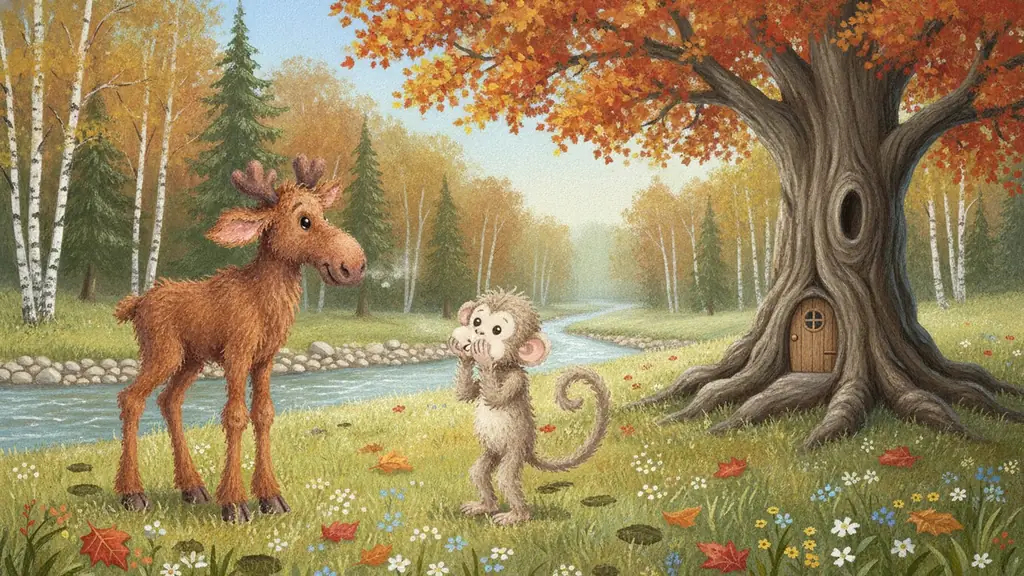
The morning was cold and bright. A thin white frost covered the grass, and every blade sparkled. When Mr. Moose breathed out, a little cloud puffed from his nose.
“Look,” said Mr. Monkey, puffing too. “We’re making clouds.”
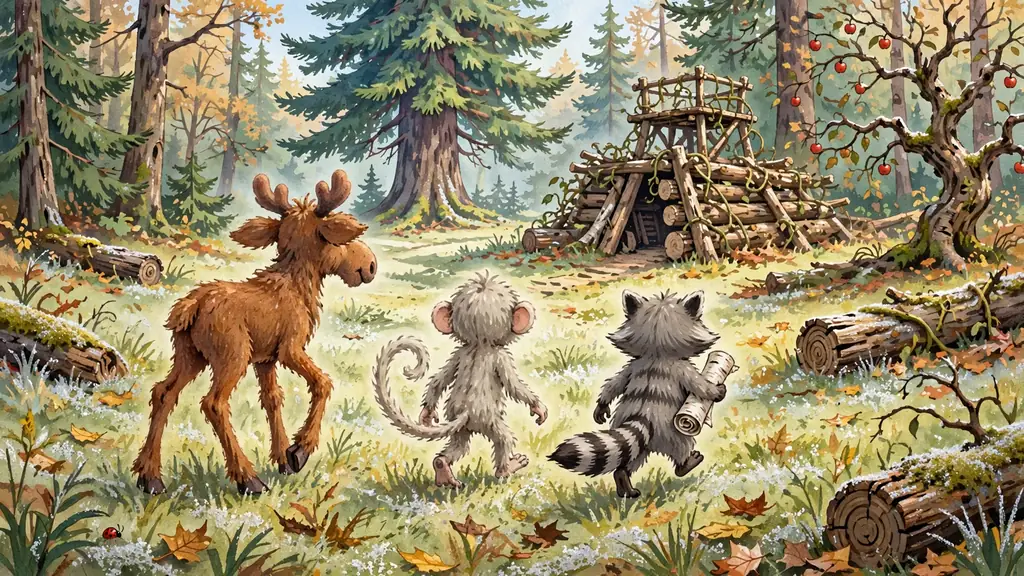
They met Ricky at the edge of Sunny Square and walked next door to Learning Land, crunching across the frosty grass. At the entrance stood the giant old pine called Pilgrim Point. Past it was Fort Friendship, with its logs and vines and its lookout on top.
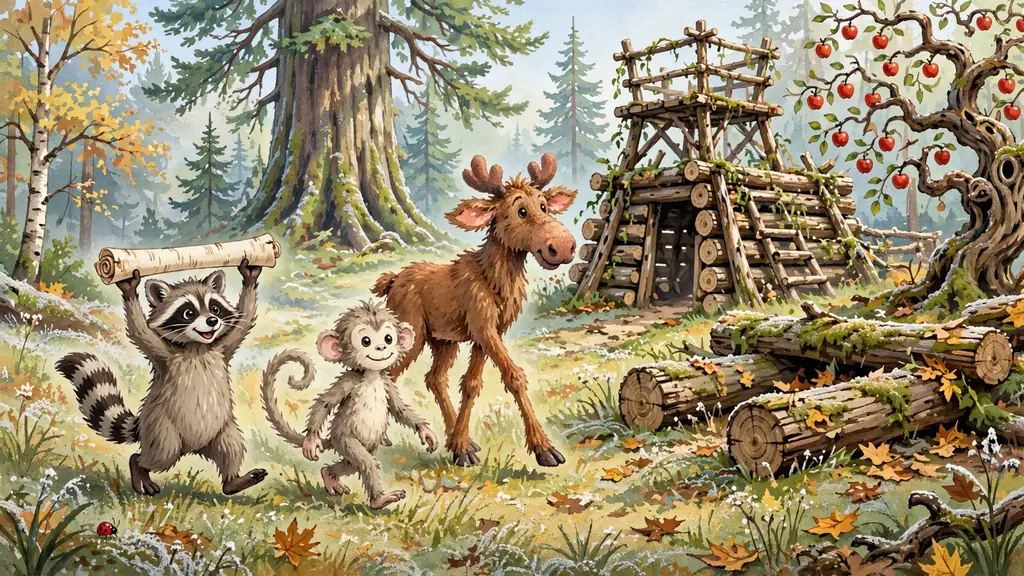
Beside the fort lay Discovery Den, all mossy logs and crinkly leaves. In front of the big flat Story Stone sat the Listening Log. And right next to Discovery Den grew an old, crooked apple tree, its branches hanging low with shiny red apples.
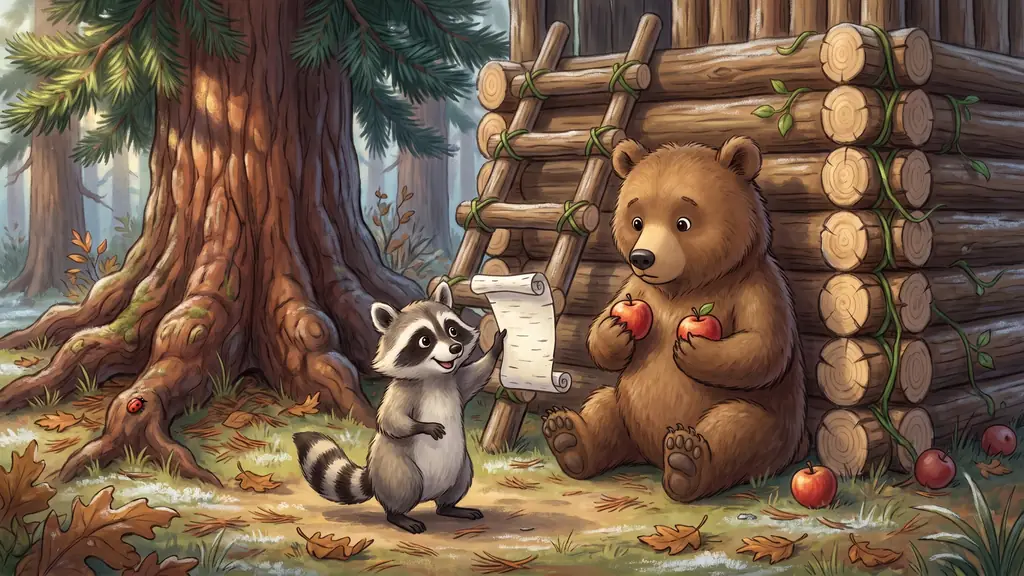
“Signing up!” called Ricky, waving his bark roll. “Everybody’s signing up for the Great Big Present Swap!”
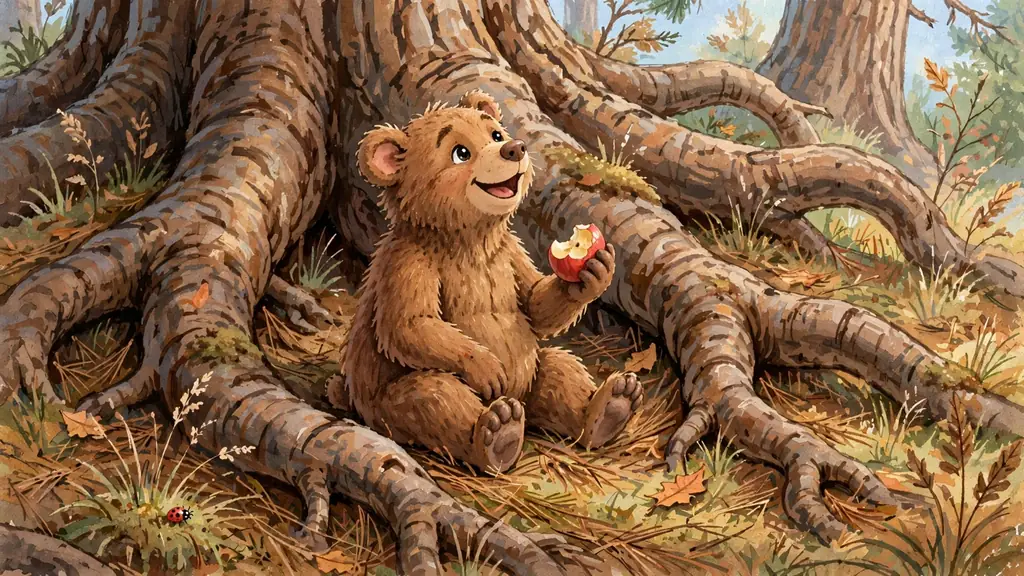
The first somebody was Bruno Bear, sitting at the bottom of Fort Friendship with an apple in each paw.
“What do you wish for, Bruno?” asked Ricky.
Bruno thought. “Honey,” he said. “And a nap. And honey.”
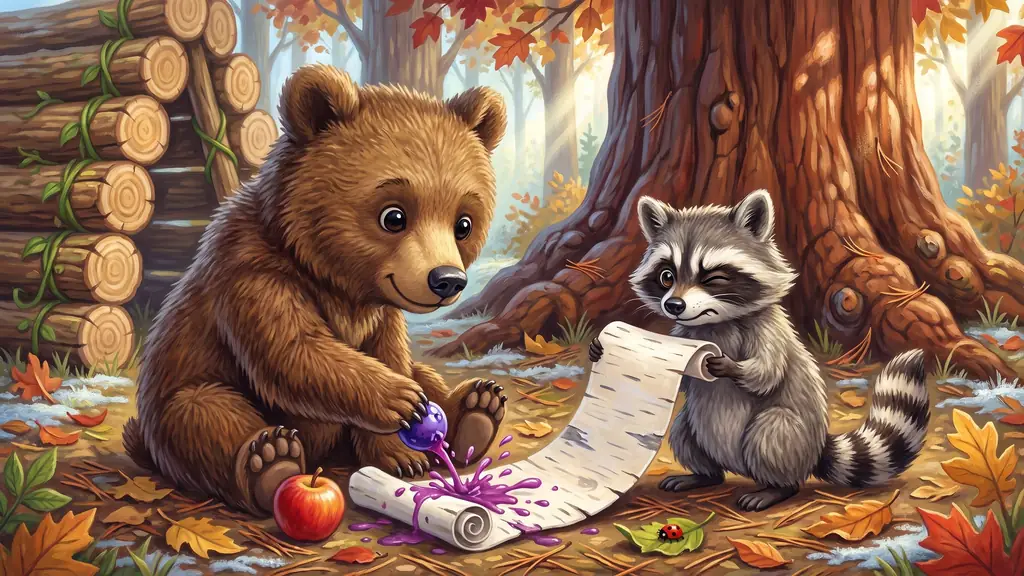
Ricky handed him a fat purple berry. “Write it down. Gently.”
Bruno held the berry very gently, in his very big paw. Then he pressed it to the bark. SQUISH. Purple juice went everywhere. When he lifted his paw, there was a giant purple paw print covering half the list.
Ricky stared at it. “That’s a big wish.”
“It’s a big paw,” said Bruno.
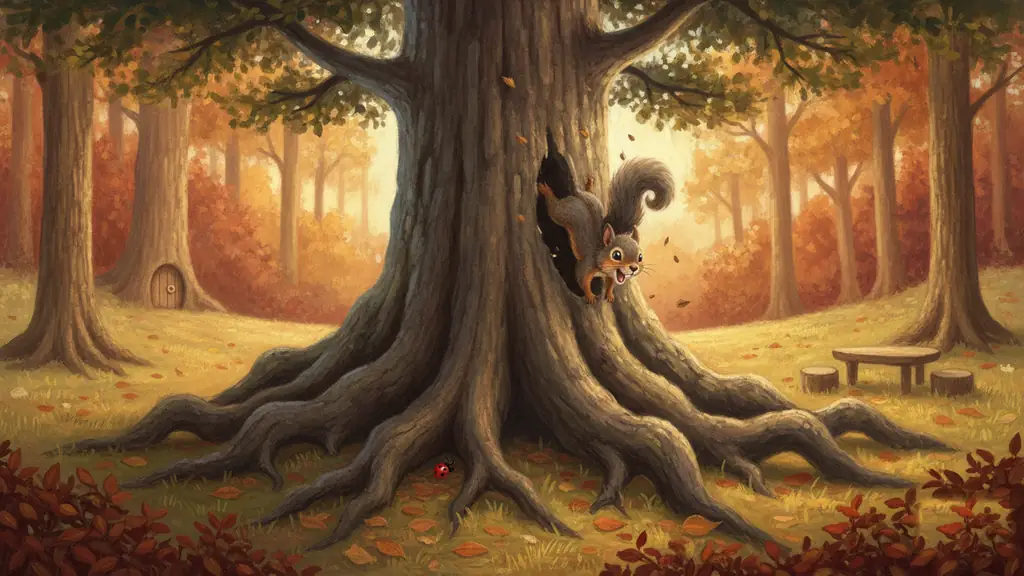
Just then, a fluffy tail whipped down the trunk of Pilgrim Point. It was Sammy Squirrel. “Sign me up! Sign me up! My wish is a joke nobody’s ever heard! Here’s one! What do you get when you cross a pig and a pine tree?”
And she zipped right back up the tree before anybody could answer. From way up at the top came her voice: “A PORKY-PINE!” Then she was gone.
Bruno stopped chewing. “A pig…” he said slowly. “With pine needles…” He looked up at the pine. “Porky… PINE! Haw haw haw!”
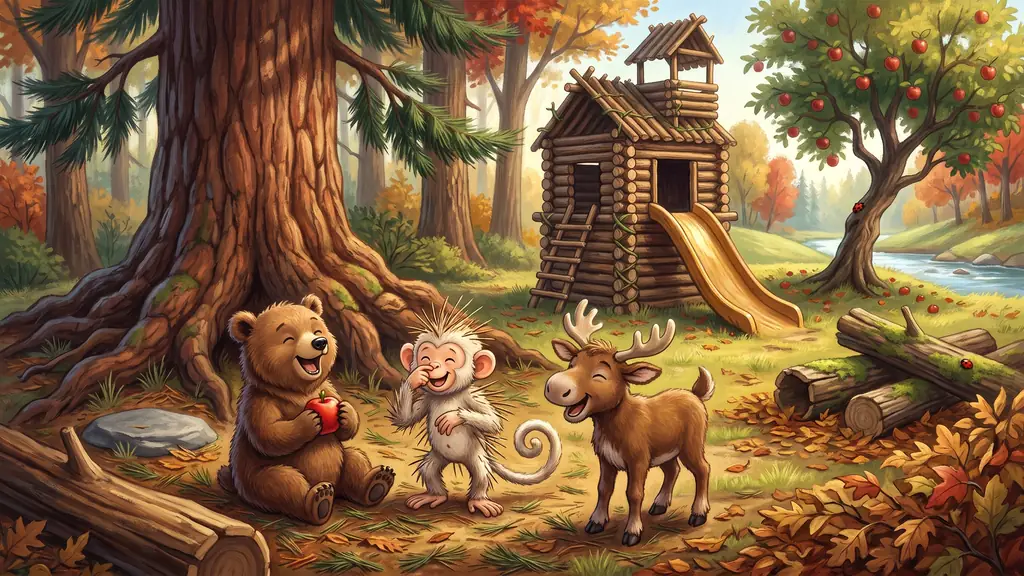
Mr. Monkey grabbed a pawful of pine needles and stuck them all over his back. He wiggled his nose. “OINK,” he said. “I’m a porky-pine.”
“Hee hee hee,” he added, because the needles tickled.
“Ha-ha-ha!” laughed Mr. Moose.
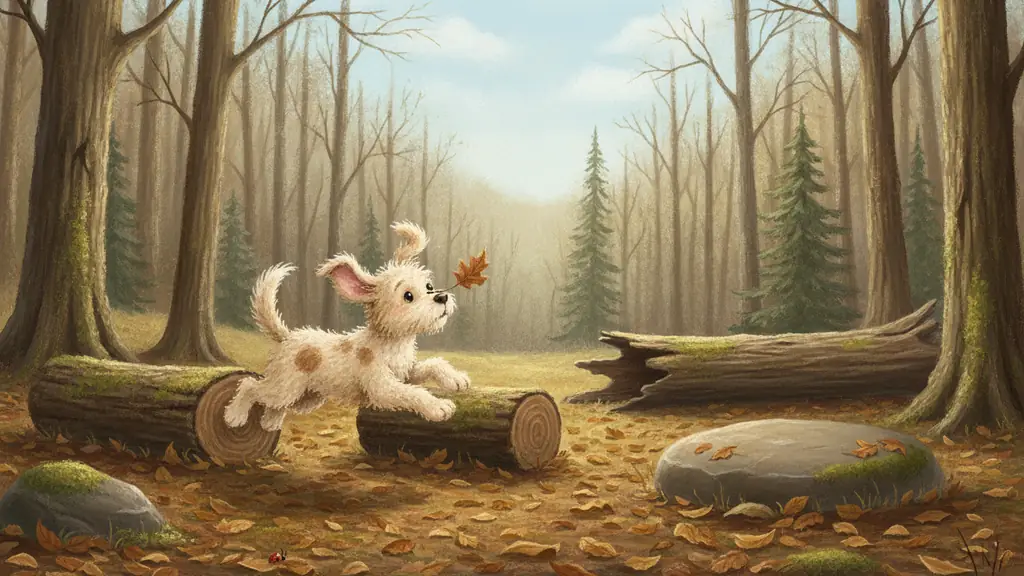
Then something came bounding out of Discovery Den. It was Dottie Dog, ears flapping, tail wagging, with a leaf stuck on her nose.
“Hi! Hi! Hi! What are you doing? Can I do it too?”
“You can sign up for the Swap,” said Ricky. “What do you wish for?”
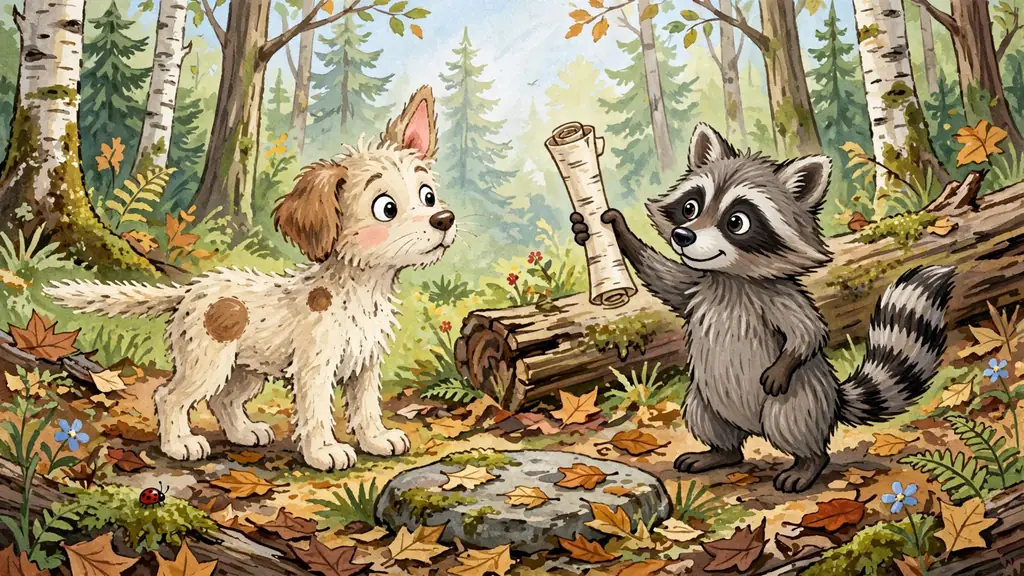
“A stick that throws itself!” said Dottie. “So I can play fetch all day, even when everybody’s tired!”
Ricky started to write it down. Dottie’s eyes followed the bark roll. It was long. It was round. It was very, very stick-shaped.
Dottie’s tail stopped wagging. Then it started again, twice as fast.
“Is that…” she whispered. “A STICK?”
“No, it’s the…” said Ricky.
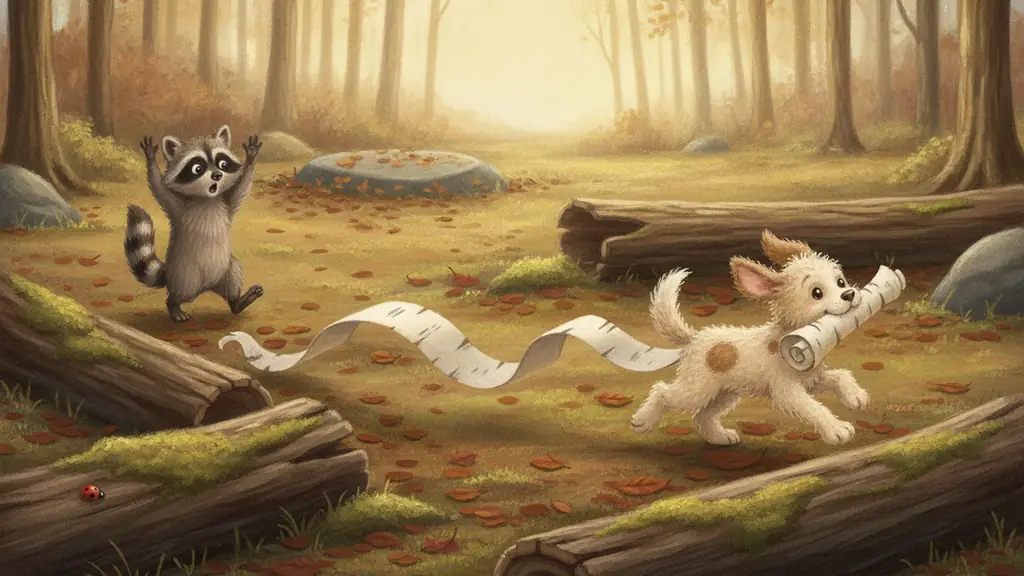
“FETCH!” Dottie grabbed the end of the bark roll in her teeth and took off.
The bark unrolled behind her like a long white tail. She ran over the mossy logs of Discovery Den. She ran around the Story Stone. She ran across the Listening Log and back again. Then she ran around Bruno. Once. Twice. Three times.
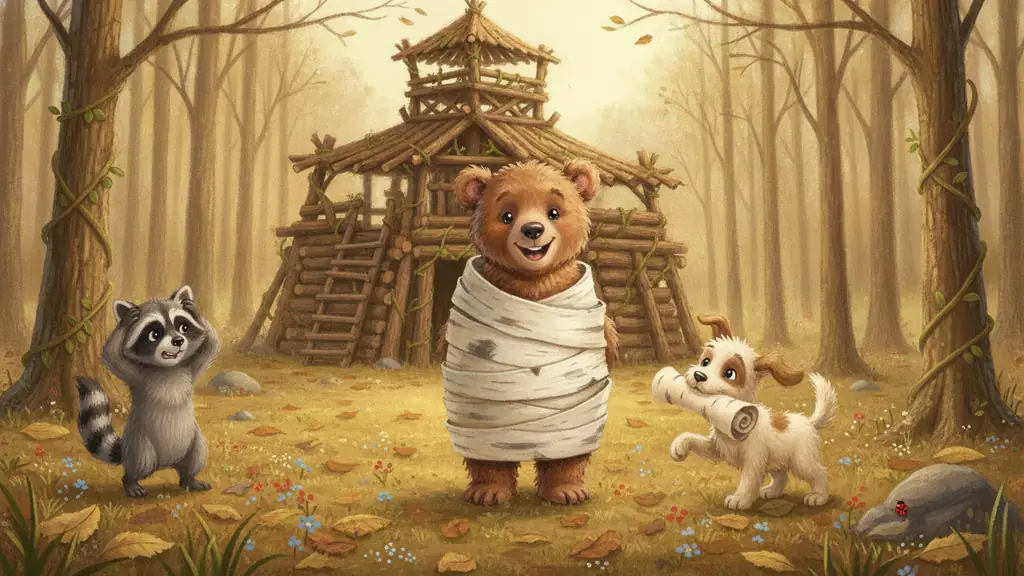
When she stopped, Bruno was wrapped from his toes to his chin in birch bark, with only his ears poking out of the top.
Bruno looked down at himself. “Am I a present?”
“Rule fifteen!” cried Ricky. “No presents that are Bruno!”
“Haw haw haw!” went Bruno, and the bark wiggled when he laughed.
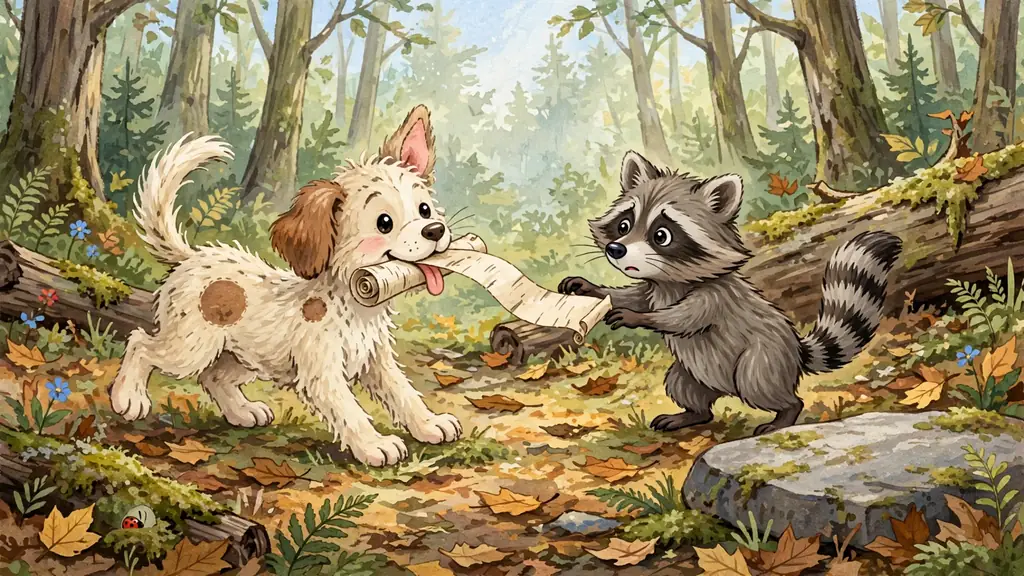
Dottie had the end of the list in her mouth, and her whole back half was wagging. Ricky reached for it. Dottie danced backward. He reached again. She danced away again, faster. It was the best game she had ever played.
“Dottie, please,” said Ricky. His whiskers drooped. “It might tear.”
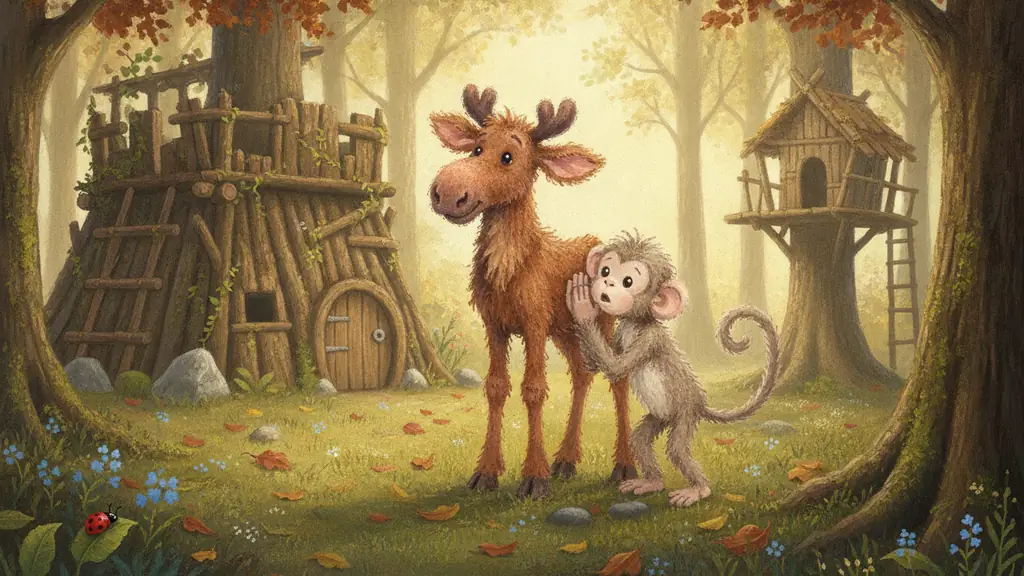
Mr. Monkey felt it right in his chest. Ricky looked so worried about his list. And Dottie looked so happy. She wasn’t trying to be naughty at all. She just loved fetch more than almost anything. Mr. Monkey didn’t want either one of them to be sad.
“Mr. Moose,” he whispered. “What do we do?”
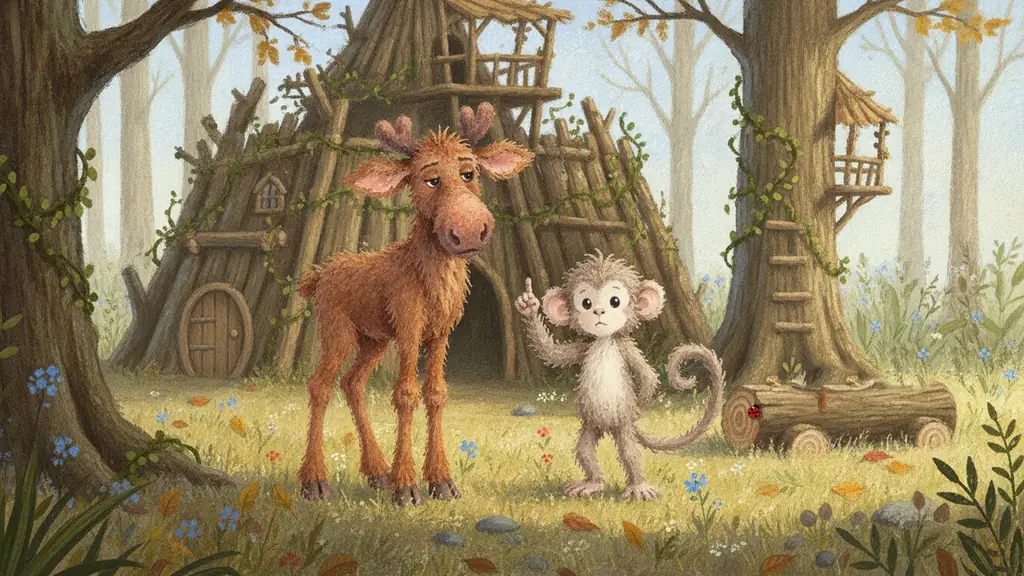
Mr. Moose thought it through. Chasing Dottie only made her run more, because chasing was part of fetch. “Dottie doesn’t want the list,” he said slowly. “She wants something to chase. So what does Dottie love even more than a stick?”
Mr. Monkey’s eyes lit up. “A BETTER stick!”
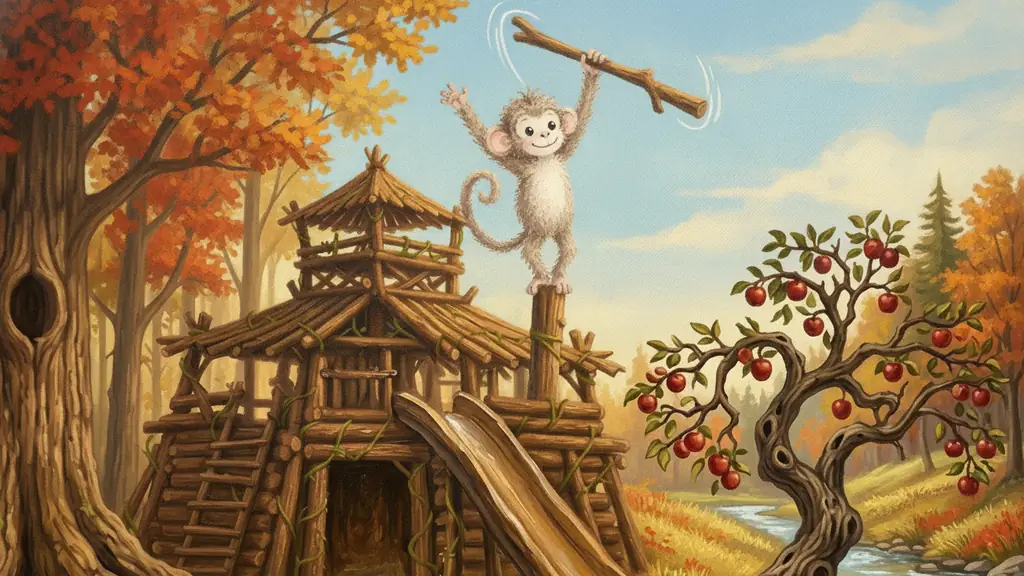
“And she wished for one that throws itself,” said Mr. Moose.
Mr. Monkey found the longest, knobbiest stick at the bottom of Fort Friendship. He scrambled up the vines to the lookout, held it over his head, and called out, “Dottie! Look up here! It’s a stick that throws ITSELF!”
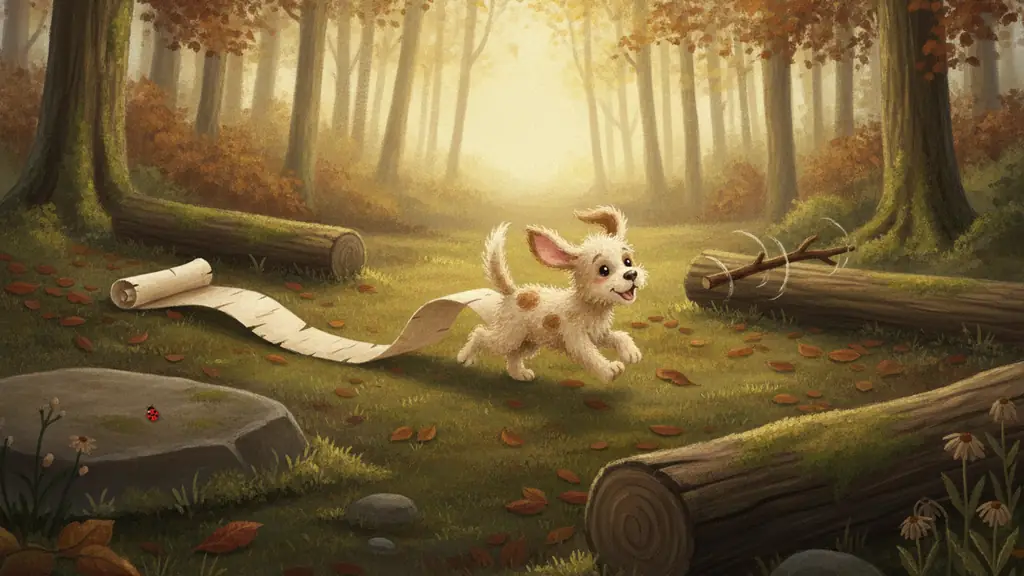
He flung it as far as he could. It sailed over Discovery Den, spinning end over end.
Dottie dropped the list. “IT THREW ITSELF!” And she was gone, galloping after it.
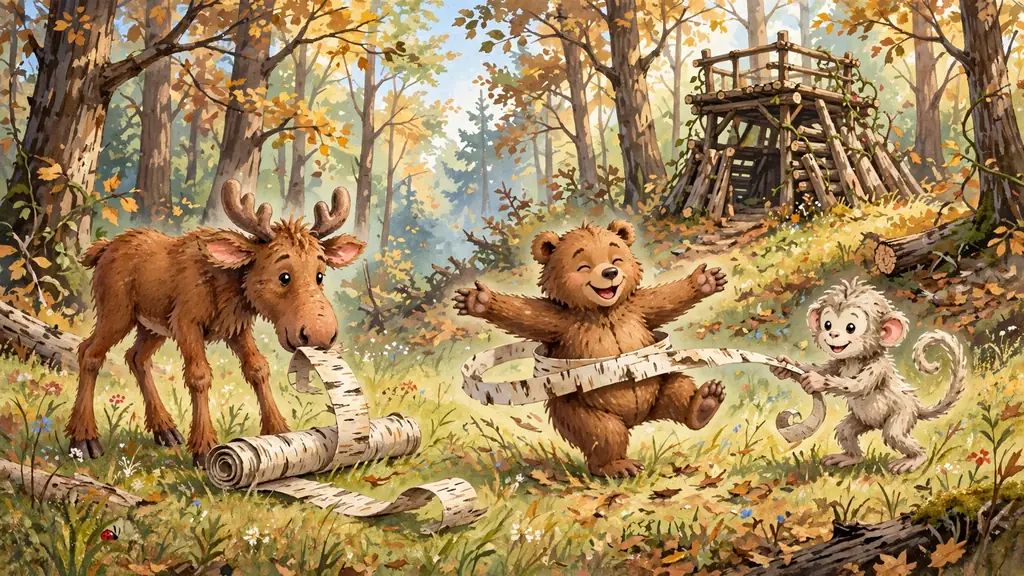
Mr. Moose put one hoof gently on the end of the bark, so it wouldn’t blow away. Then he rolled it up with his nose, around and around, slowly and carefully, all the way to Bruno. Mr. Monkey slid down the vines and helped unwind Bruno, who turned in circles like a spinning top until he was free.
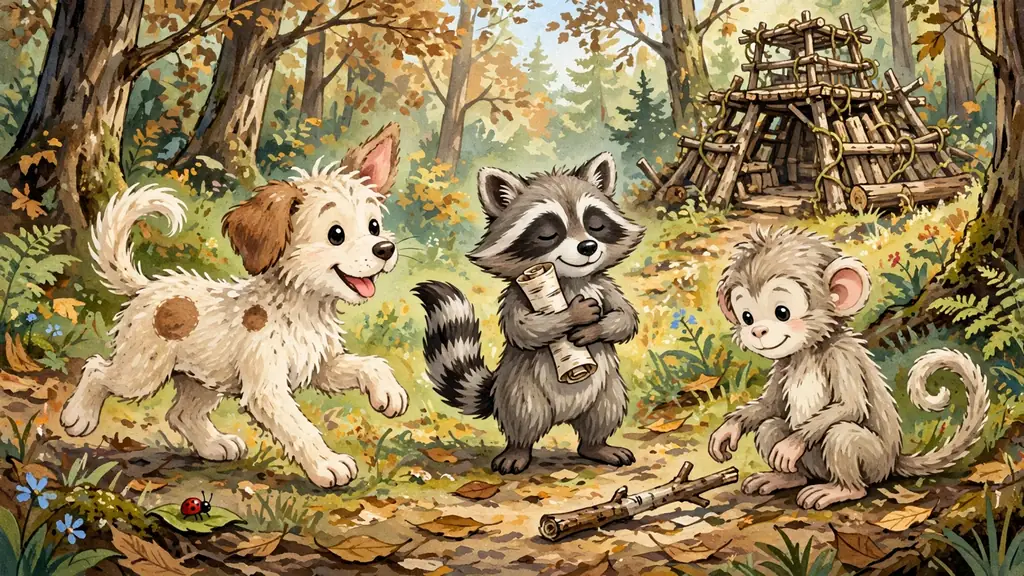
Ricky hugged his list. “Not one rip,” he said.
Dottie came trotting back with the stick in her mouth and her tail going in happy circles. She dropped it at Mr. Monkey’s feet. “Again?”
“Again,” said Mr. Monkey, and he threw it again, just for her.
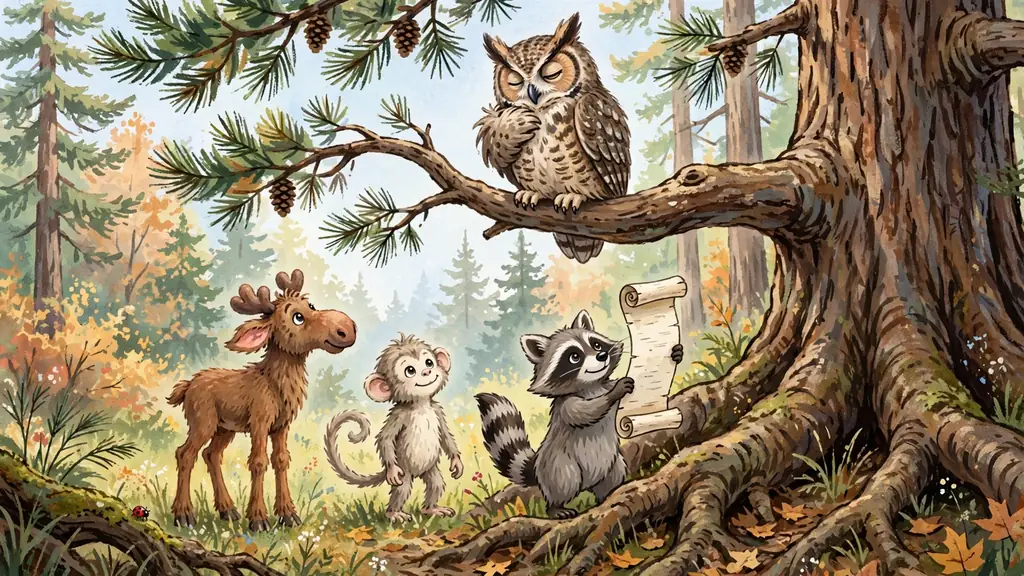
Then they climbed the roots of Pilgrim Point. Orion Owl was sitting on his branch, fluffing his feathers before his midday sleep.
“Orion,” said Ricky, “what do you wish for? For the Swap.”
Orion blinked his round golden eyes, slowly. “Hoo,” he said. “Before I wish for anything, look down at that apple tree.”
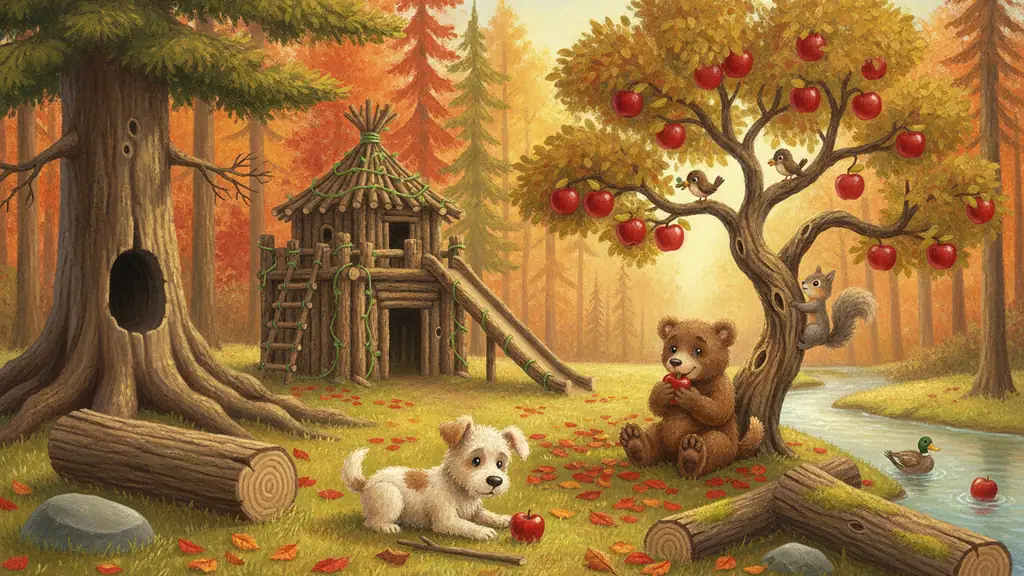
They looked. Bruno had wandered over and was munching an apple. Two little birds were pecking at one on a branch. Sammy zipped up the trunk and zipped back down with an apple almost as big as she was. Dottie was lying in the grass with her stick, chewing the stick and sniffing an apple, as if she couldn’t decide.
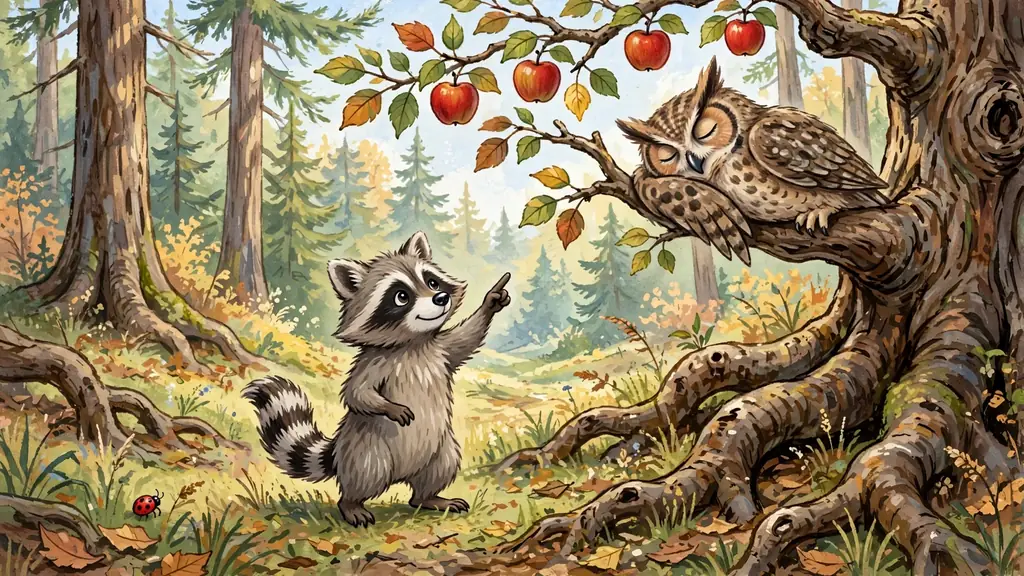
“That tree has made more apples than anyone in the woods,” said Orion. “Who do you suppose they’re for?”
Then he tucked his head under his wing and went to sleep.
“For the tree,” said Ricky. “It made them. They’re its apples.”
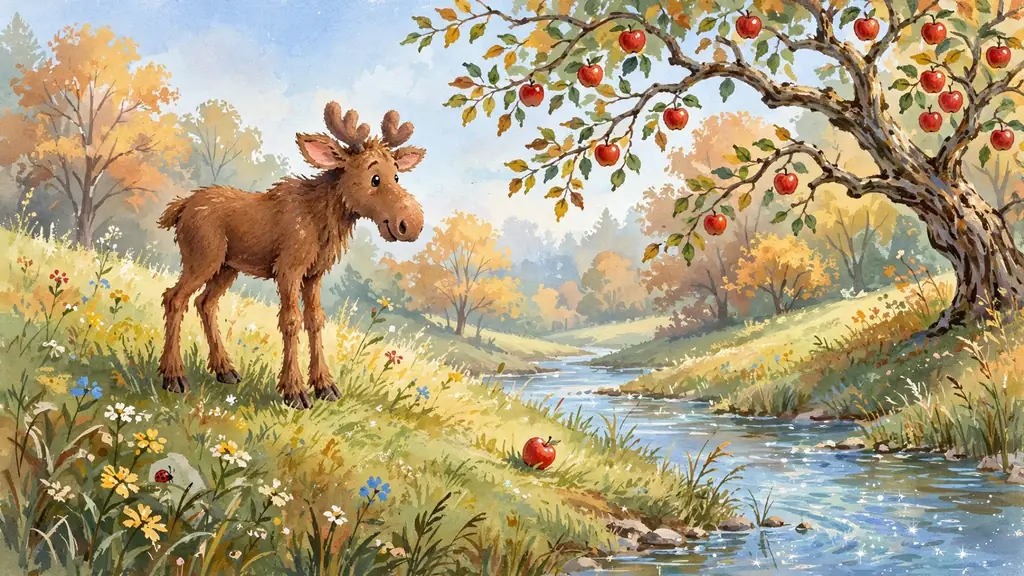
Mr. Moose didn’t say anything. He watched the apple tree for a long time. Bruno ate an apple. A bird ate a little bit of an apple. One apple fell off a branch, thup, and rolled down the hill to the river, where a duck nibbled it.
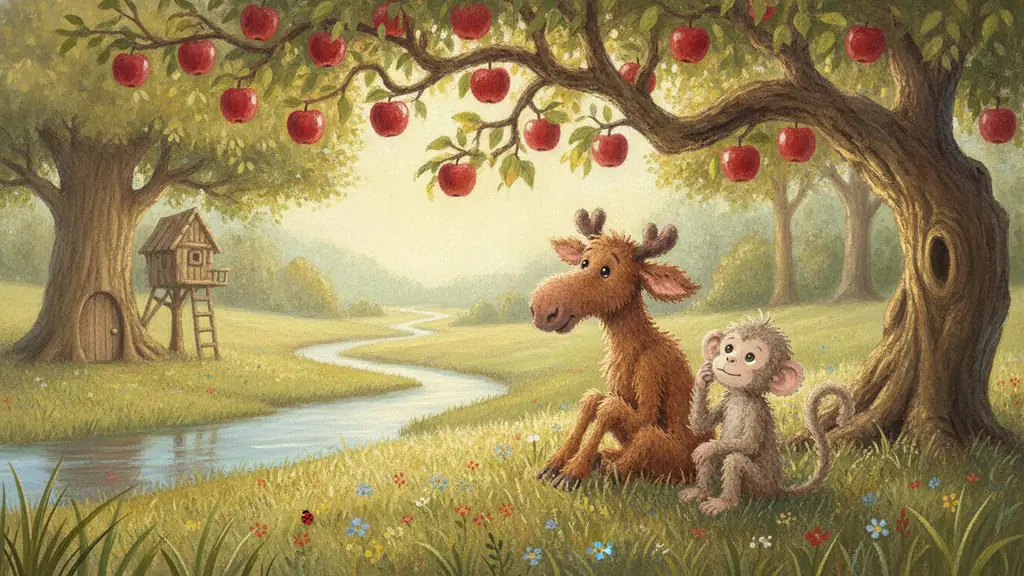
“Mr. Monkey,” said Mr. Moose. “The tree never eats one.”
“It can’t,” said Mr. Monkey. “It doesn’t have a mouth.”
“Every single apple goes to somebody else,” said Mr. Moose.
Mr. Monkey looked at the tree. “And it didn’t even make a wish list.”
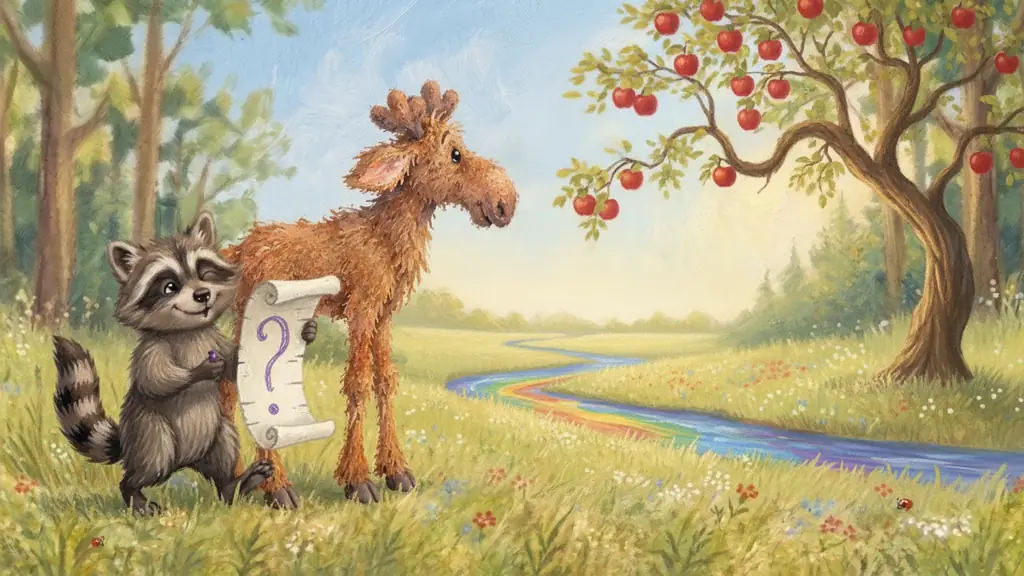
Ricky looked at his list. He looked at the tree. He started to say something, and then he didn’t. Under Orion’s name, he drew a great big question mark. “I’ll ask him later,” he said.
“I want to be an apple tree,” said Mr. Monkey.
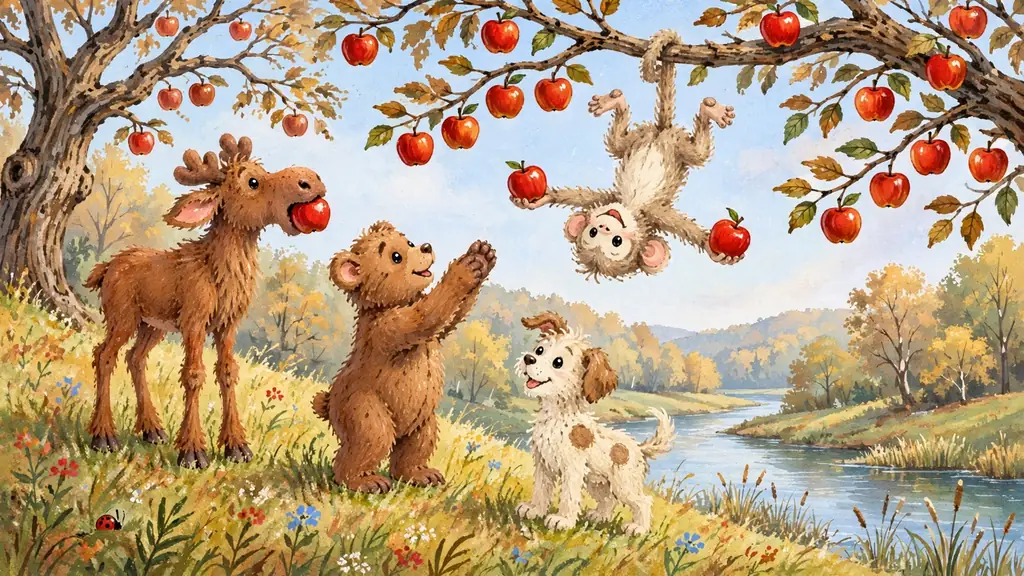
He climbed onto a low branch, wrapped his tail around it, and hung upside down with his arms stretched out like branches. Mr. Moose put an apple in each of his hands.
“Who wants an apple from the Monkey Tree?” called Mr. Monkey.
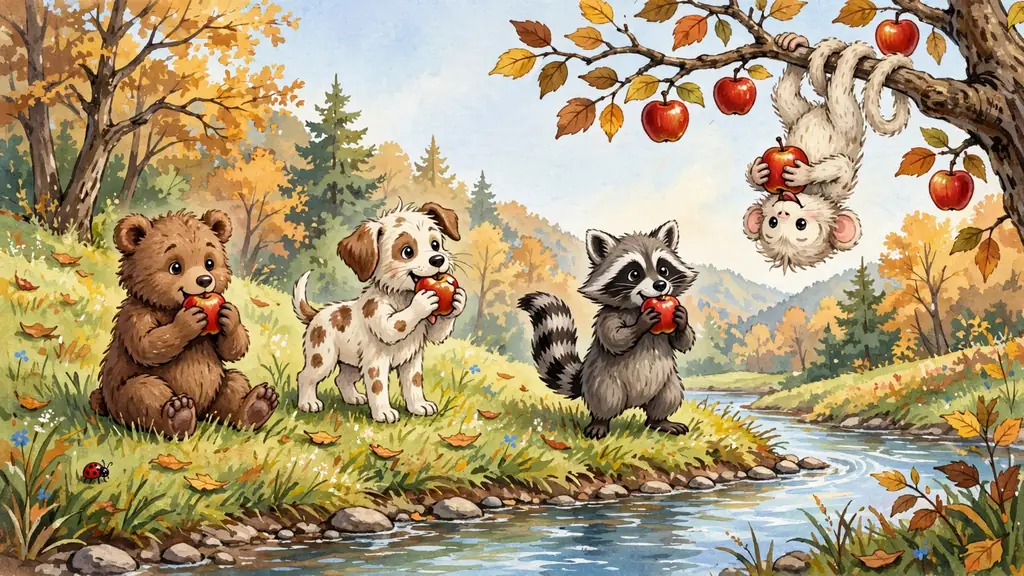
Bruno took one. Dottie took one. Ricky took one. Mr. Moose put two more in Mr. Monkey’s hands, and those got taken too. Soon there was only one apple left, in Mr. Monkey’s right hand. He looked at it. His tummy rumbled.
“Can a Monkey Tree eat one?” he asked.
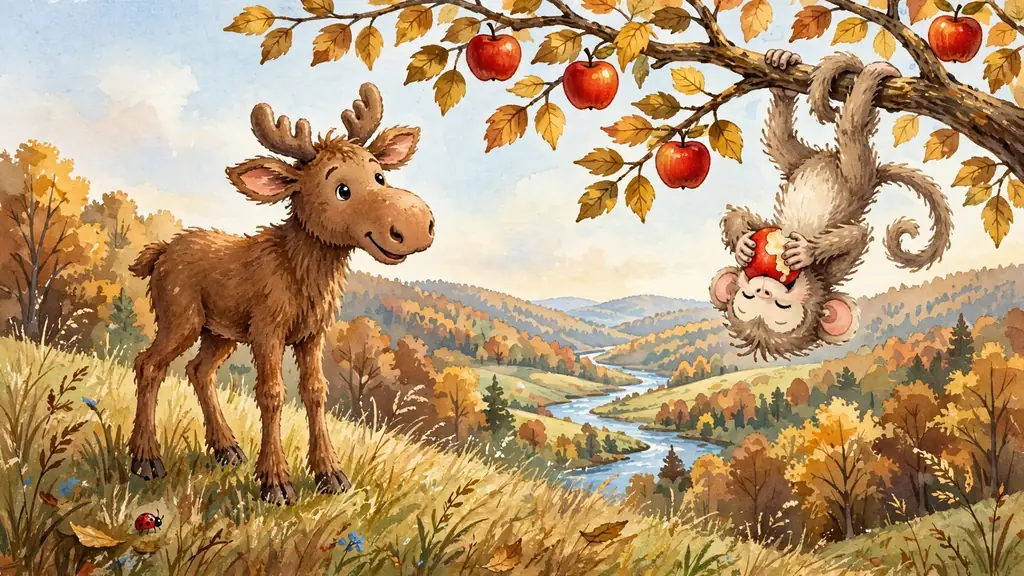
“A Monkey Tree gets one,” said Mr. Moose.
“Hee hee hee!” Mr. Monkey took a big, crunchy bite, still hanging upside down.
When the sun was high and warm, they headed back to Sunny Square. Ricky counted. “Eleven names! And one question mark.”
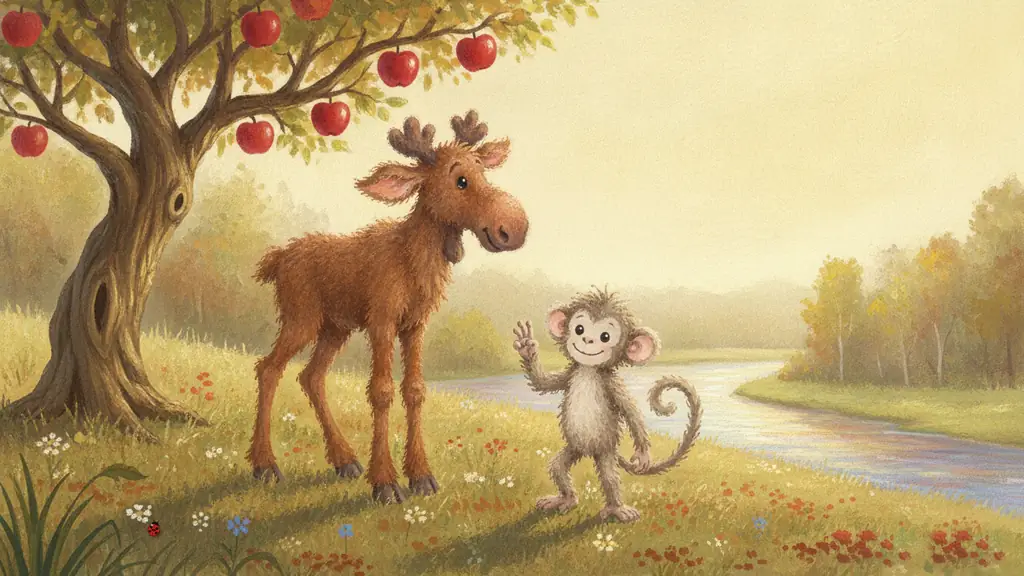
“What a day!” said Mr. Moose. “Bruno made a giant paw print. Sammy told a joke about a porky-pine and ran away. Dottie played fetch with Ricky’s list and turned Bruno into a present. Mr. Monkey threw a stick that threw itself. And the apple tree gave away every apple it had.”
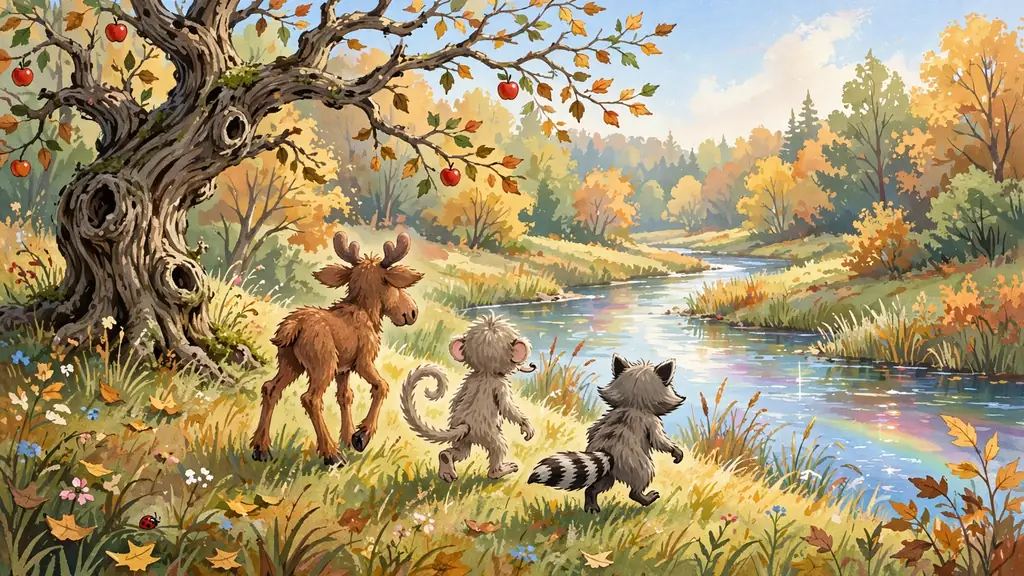
Mr. Monkey whistled, and Mr. Moose hummed, and together they sang:
We are better together,
Moose and Monkey forever.
And in Learning Land, the old apple tree stood in the sunshine with its branches a little lighter, waiting for whoever came next.