What is Christmas really about?
Most of us grew up with at least one of two Christmas stories. In one, a green, grumpy creature sneaks down from his mountain and steals Christmas from a town called Whoville. In the other, a rich, greedy old man named Ebenezer Scrooge gets a string of ghostly visitors in a single night. Dr. Seuss gave us the Grinch in 1957, Charles Dickens gave us Scrooge in 1843, and between the books, the cartoons, the Muppets, and Jim Carrey playing both of them, it's hard to get through childhood without meeting at least one.
Here's what both stories have in common: a heart problem. Dr. Seuss tells us the Grinch's heart was two sizes too small. Scrooge's never gets measured, but when two gentlemen stop by his office on Christmas Eve collecting money for the poor, he sends them off with a line that's been quoted ever since: "Are there no prisons?" His point was that the poor already had prisons and workhouses, so they weren't his problem. The request was polite, the cause was good, and he still said no; being asked nicely didn't change him. And when the two of them finally do change, nobody has handed either of them a better set of rules. Their hearts change, and then their hands follow. The Preface called our problem an instruction manual for the hands, and two of the most famous Christmas stories we have say what that manual leaves out: it has to start in the heart.
That night, before any spirit arrives, Scrooge's dead business partner, Jacob Marley, shows up dragging a chain of cash boxes and padlocks to tell him he still has "a chance and hope." Consider this chapter my Marley visit. (Hopefully less frightening. I'll leave the chains out of it, although the Preface was probably my version of rattling them.) I don't think you're Scrooge. People who pick up a book about gratitude or generosity usually aren't. But he and the rest of us have one thing in common: some of what's right in front of us has gotten hard to see. I don't remember the spirits lecturing Scrooge. They showed him things that weren't obvious to him, right up until they were. So three Christmases are going to visit you, in the order Dickens used: past, present, and yet to come.
Dickens's first spirit takes Scrooge back to a Christmas party thrown by his first boss, a big, cheerful man named Fezziwig, who clears the desks out of his warehouse, brings in a fiddler, and turns the place into a dance floor. When the spirit shrugs it off (Fezziwig only spent a few pounds), Scrooge gets heated. The happiness Fezziwig gave, he says, "is quite as great as if it cost a fortune." Then he goes quiet and says he'd like a word with his own clerk, Bob Cratchit, whom he pays poorly and keeps working beside a fire so small it barely counts. That's the first crack in Scrooge. Nobody has scolded him into anything. He has remembered something he was given, and the remembering makes him want to give.
Scrooge's first spirit took him back to a fond memory. Ours goes back further, to the oldest Christmas there is, the one behind the nativity set on a grandparent's mantel and the kid in a bathrobe playing a shepherd. It's also where the holiday gets its name. The earliest record of the English word, from 1038, is "Christ's Mass," a feast celebrating the birth of Jesus. And Christ was never Jesus's last name. It comes from the Greek christos, which translated the Hebrew mashiach, or messiah, and both mean "anointed." In ancient Israel, a new king was anointed with oil poured over his head, a bit like a coronation, so "anointed" came to mean a king God had chosen. By Jesus's day, "the anointed one" was how many people talked about the king God had promised. Every "Merry Christmas" names the birth of a king.
Israel had been waiting for that king for a long time. Matthew, one of the writers who told Jesus's story, opens his account with a family tree built in three sets of fourteen generations: Abraham (Israel's founding father) to King David (you know, the "David and Goliath" David), David to the exile in Babylon, and the exile to Jesus. The exile gets its own hinge, as big as David's, because that's where the story broke.
About six hundred years before Jesus, the Babylonian empire conquered Jerusalem and carried many of its people away, and the kings from David's family stopped ruling. Israel's prophets, the people the nation trusted to speak for God, said one of David's descendants would take the throne again someday. Babylon gave way to Persia, Persia to Greece, and Greece eventually to Rome, and no king from David's family ever sat on that throne again. Some people had probably given up on the promise, but many who were still watching pictured a strong king who would throw off Rome and give Israel back its place of honor.
Only two of the four early accounts of Jesus's life tell how he was born, Luke's and Matthew's, and they tell it very differently. The shepherds and the manger are only in Luke's, and the star and the magi are only in Matthew's. The nativity set merges them into one scene, but I'd rather let each writer tell his own. Some readers take them as history, and for them, two separate tellings that agree on the core (Mary and Joseph, Bethlehem, a child from David's family) carry more weight than a single account would. Others read them as true fiction, stories whose truth doesn't depend on whether a camera could have recorded them. Either way, I read them as the original good-gift story, and you can hear its echo in Scrooge's story and the Grinch's. In each one, a great gift arrives that nobody earned, but only a few people have eyes ready to see it. The ones who see it take it into their hearts, and it changes them. Those changed hearts start to give without anyone forcing them to. The Premise already gave a gift like that a name: grace.
Try a thought experiment with me. Each of us has a sense of what’s good and what’s bad, and most of us agree on far more of it than we disagree on. Now imagine that whatever makes good things good could be a person, and that person decided to give the world a gift. What would you expect the gift to look like? I think many of us would expect a gift wrapped in one of what I call the “Four Ps”: power, pleasure, plenty, or pride. They’re the kinds of gifts we tend to think will make our lives better: more control, more comfort, more capital, or more claps. Luke and Matthew each answer that question with a story, and both of them have a name for that giver: God. The gift in their stories comes wrapped in none of the Four Ps, which makes it easy to miss. That’s why everything hangs on the first part of the good-gift pattern: having eyes that see the gift. Whether a person could see the gift had a lot to do with what that person’s heart was expecting to find. So let’s read each story on its own and watch what God gives and who sees it.
Luke tells his story like a connect-the-dots page. He sets down one detail after another, and if you follow them in order, a picture appears. God sends a messenger to a young woman named Mary. "You will conceive and give birth to a son," she's told. God will give that son "the throne of his father David," and "his kingdom will never end." Then Mary sings about what kind of king this will be: "He has scattered the proud in the thoughts of their hearts; he has brought down the mighty from their thrones and exalted those of humble estate." (ESV) Before the baby is even born, Luke has told us the story will run upside down, and that it starts in the heart.
The baby is born in Bethlehem, there's no room, and his mother lays him in a manger (a feeding trough for animals). Anyone waiting for a king would have looked in a palace, and this one is laid where the animals eat. I don't think that's an accident.
Luke gives this king a royal announcement and sends it to shepherds working the night shift. A messenger appears to them: "I bring you good news that will cause great joy for all the people. Today in the town of David a Savior has been born to you; he is the Messiah, the Lord." There's that word again: Messiah, the anointed king God had promised. The sign is "a baby wrapped in cloths and lying in a manger," a pretty plain wrapping for a gift from God, especially when the gift is a king. Suddenly the sky fills with an army from heaven, praising God and announcing "on earth peace." The shepherds hurry to Bethlehem, find the baby, and spread the word, and everyone who hears it is amazed. Meanwhile, Luke says, Mary "treasured up all these things and pondered them in her heart," and the shepherds head back to their sheep praising God. Nobody asked them for anything. They saw the gift, they took it in, they praised God for it, and they passed it on.
Luke adds one more dot. Forty days after the birth, Mary and Joseph bring the baby to the temple in Jerusalem, the center of Israel's devotion to God, and offer a pair of birds. Under Israel's law, that was the offering for families who couldn't afford a lamb. The king's own family is poor. An old man named Simeon, who had spent years waiting for God to comfort his people, takes the baby in his arms and says, "This child is destined to cause the falling and rising of many in Israel, and to be a sign that will be spoken against, so that the thoughts of many hearts will be revealed." He isn't even walking yet, and already Luke is telling us this gift will show what's in people's hearts.
Put those dots together (a song, a feeding trough, a few shepherds, two birds) and the picture is an upside-down kingdom. The greatest is treated like the least, the least are treated like the greatest, and the people with the least are the first to see it. There's a second line of dots running through the same story, and every one of them is a heart. Mary sings about the proud "in the thoughts of their hearts," she ponders everything "in her heart," and Simeon says this child will reveal "the thoughts of many hearts." In Luke's picture, who sees this king comes down to what's in a person's heart. Years later, when Jesus's followers argue about which of them is the greatest, he has a little child stand beside him and puts the picture into words: "it is the one who is least among you all who is the greatest."
Matthew lays out a different set of dots. A messenger comes to Joseph in a dream and tells him to name the child Jesus. (Joseph gets three of those visits in the night, plus a fourth dream that's only a warning. Scrooge, if you're counting, gets a warning and then three visits.) Then Matthew adds a second name, from an old promise by Isaiah, one of Israel's prophets: "they will call him Immanuel" (which means "God with us"). That name is Matthew's first dot. Some time after the birth, magi arrive in Jerusalem from the east. They were probably stargazing advisers from Persia, and they weren't Jewish. They ask, "Where is the one who has been born king of the Jews?" King Herod, who ruled the Jewish people only because Rome let him, is disturbed, "and all Jerusalem with him." He calls in the chief priests and the teachers of Israel's ancient writings, and they know the answer right away: Bethlehem, a few miles down the road. Matthew makes sure we know that King Herod and the religious leaders knew where the Messiah would be born, and yet he never tells us they went to see. The only people who went weren't even Jewish.
The foreigners keep going. When the star stops over the place where the child is, Matthew says they were overjoyed. They go into the house (not stable), see the child with his mother, Mary, bow down, and open their treasures: gold, frankincense, and myrrh.
Put Matthew’s dots together (a name that means “God with us,” foreigners following a star, a capital city disturbed, experts who stay home) and the picture is an unexpected gift: God himself, given through Israel to the whole world. The people with every reason to recognize this king missed him, and the people who came the farthest, with no idea what Israel’s king was supposed to look like, found him. In Matthew’s picture, the ones who find this king are the ones whose hearts are willing to go looking, however far away they start. It’s the oldest promise in Israel’s story coming true. Matthew’s family tree starts with Abraham, and God had told Abraham that “all peoples on earth will be blessed through you.” On his last page, Matthew comes back to it. The grown Jesus sends his followers to “make disciples of all nations,” and he promises, “surely I am with you always, to the very end of the age.”
Two writers, two pictures, and underneath both, the same four moves. In Luke's, shepherds see a sign, go and find the baby, spread the word, and head back praising God. In Matthew's, foreigners see a star, rejoice when it stops, find the child, bow down, and open their treasures. The order shifts a little between the two, but both have all four: they see a good gift, they receive it, they celebrate it, and they give. Nobody has to make them. It's the same shape as Scrooge's long night and the Grinch's morning on the mountain. And it's the shape of every week in this program, from the first Thursday in November to January 4: a few days to receive, a day to celebrate, a few days to give, and all of it starting with what we see.
The hard part, in both stories, is that first move. A lot of people missed the gift. The people waiting for a different kind of king were looking right past him. I think that's because expectations aim the eye. The Premise talked about how whatever my eyes keep noticing is what fills me up, and if my heart is set on power, pleasure, plenty, or pride, I can stare right at a better gift and never see it. Simeon had warned that many would speak against this child, and Luke shows how far that went: even while Jesus was dying on a Roman cross, the rulers sneered, "Let him save himself if he is God's Messiah." Right to the end, they were waiting for a different kind of king.
The Preface said the story at the center of Christmas is about a gift that was exactly what people needed, even though it wasn't what many of them expected. This is that story. And the gift was a person, God with us, which may be why the best gifts still come in person.
Look at what came with it, too. Simeon had spent years in hope, waiting for God's comfort, and the first night brings a promise of "great joy" and peace on earth. Hope, peace, and joy, three of the five things your family will practice in December, are all there in Luke's first pages. Generosity is the gift itself. And love isn't named that night at all. I like that. I think love is what a gift like this frees us to do. It's the overflow.
That's the oldest Christmas: a gift nobody could have bought, given in person, and seen mostly by people whose hearts weren't set on something else. Now let's visit the one we're standing in.
Dickens's second spirit takes Scrooge to his clerk Bob Cratchit's house, the poorest in the story and maybe the happiest. The Cratchits don't have much, but they see what they have, and they make a feast of it: a small goose, a pudding that has to stretch, and a little boy named Tiny Tim at the table. Then Bob raises a toast to the boss who pays him so little: "Mr. Scrooge, the Founder of the Feast!" It's the same shape as Luke's family with the pair of birds. The people with the least have the most to give, but the richest man in the story can't enjoy a thing.
Now ours. Imagine a parent wrapping the last gift at eleven at night, with a list on the fridge: names down the left side, dollar amounts down the right. In another house, a group text has been running since Tuesday. Twenty-five dollar limit. Name draw. Somebody wants to know if a candle counts. In a third, a grandmother is standing in a store aisle holding a sweater, trying to remember whether her grandson already owns one. She buys it anyway, plus a gift card, just in case. (None of these families is real, but I'd bet you know at least one.) Come January, each house has a small pile by the front door of things headed back to the store.
Nobody in these houses is greedy. They're tired, careful, and a little anxious, and every one of them is trying to give. Most of the weight comes from expectations: what we're supposed to spend, who's supposed to get something, what we're each hoping to unwrap. The giving is sincere. It just keeps landing on people who already have what they need, and I think a lot of us can feel that, even if we'd never say it out loud. And look where all that effort goes. Nearly all of it lands on the last move. We skip straight to the giving, with hardly any seeing, receiving, or celebrating first, which is exactly what an instruction manual for the hands would tell us to do.
In Luke's telling, the first Christmas had almost nothing, and the gift was easy to see for anyone who went looking. Ours has almost everything, but the gifts have gotten hard to see. The Preface called it the Comfort Constant: whatever we have long enough, we stop noticing. Scrooge's office was full of money, but he couldn't see a thing. I also think that uneasy feeling is good news. Some part of us knows this isn't quite it, which might be why we keep watching Scrooge and the Grinch find a better way, every single December.
Dickens's last spirit never says a word. It only points, and finally it leads Scrooge to a neglected grave with his own name on the stone. Before he'll go any closer, Scrooge asks, "Are these the shadows of the things that Will be, or are they shadows of things that May be, only?"
It's our question too, and when I ask it, I'm thinking about my own kids and the kids they might have someday. Here's the shadow I'd most like to avoid. They learn December the way most of us did, and they grow up thinking generosity is an obligation, owed to the people on a list and nobody beyond it. Some years they count the pile, notice it's a little smaller than last year's, and are disappointed without knowing why. Then they become the grown-ups up at eleven at night, still paying off last December and wondering whether there's enough for the bills, because they've come to believe that what they buy is what they're worth to the family. They roll their eyes at a season that looks like one long sales pitch, a little more Scrooge every year. When their own kids ask what Christmas is about, the most honest answer they can come up with is presents and stress. And one December, when I'm an old grandpa calling to invite them over for a Christmas gathering, I can hear the hesitation before they answer. They love us. One more celebration just feels like too much. That's what the season turns into when giving is the only move left.
Will be, or may be? I think it's may be. Scrooge answers his own question: if a person changes course, "the ends will change." The spirit only shows him what to avoid. The hopeful picture comes after he wakes up.
Scrooge wakes up laughing, "as light as a feather," so grateful to still have time that he can hardly stand it. Then watch his hands. He sends the prize turkey to the Cratchits without saying who it's from, whispers a donation that stuns the gentleman he turned away, and knocks on his nephew's door for the Christmas dinner he has refused for years, and stays.
The last time anyone asked Scrooge to give, he pointed them toward the prisons. This time nobody had to ask. What changed was what he could see. Once his eyes could see what he'd been given, he became grateful. Once he was grateful, his heart changed. And once his heart changed, he couldn't have kept his hands closed if he tried. The Grinch goes the same way. The moment his heart grows, he brings everything back down the mountain and carves the roast beast himself. Two of the most famous Christmas stories we have end the same way the oldest one does: someone sees a gift, the heart changes, and the hands follow. And by that afternoon, Scrooge's gift was himself, which is exactly how the first Christmas gave its gift.
So here's the Christmas morning I hope we can hand down. A grandchild is grown and telling a friend about December at her grandparents' house. (She's made up too.) She remembers a tree on the wall with her name on a few of the pieces, and reading them out loud by candlelight. She remembers who got thanked, who came to the table, and what her family did for someone else that year. She couldn't tell you one gift she received. She could tell you what was written about her.
None of us can force that future, any more than Scrooge could force his own heart to change. You can't force fruit; you can only feed the root. Marley's whole job was to show up, tell the truth, and let Scrooge know there was still a chance and hope. That's what I want to hand you. The real visits happen over the next nine weeks, a few minutes at a time, at your own kitchen table, and every one of them starts the way the first Christmas did, with learning to see. Tomorrow is Prepare: a calendar, some supplies, and a bare brown trunk taped or pinned to your wall. Before then, think again about the person you pictured at the end of the Preface. Their name is going on one of the first leaves.
Hello, my wonderful story friends! Last time, Dottie played fetch with Ricky’s list, and the old apple tree gave away every apple it had. Today the Official Sign-Up Helpers head along Rainbow River, and they hear about a treasure.
Have you ever looked so hard for something that you walked right past it? Let’s go treasure hunting in Wanderful Woods.
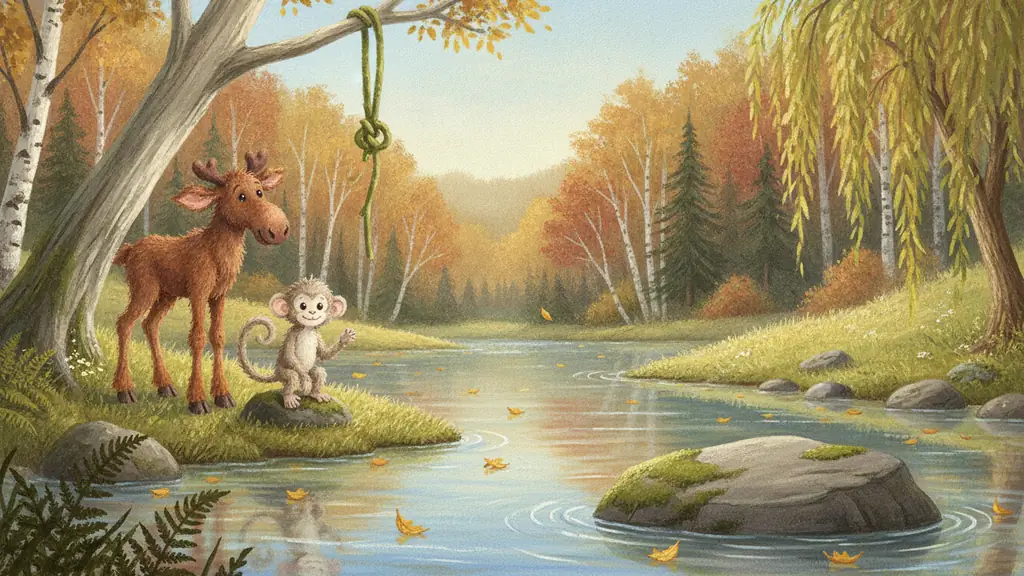
Rainbow River was busy this morning. All along its banks, the trees were dropping yellow leaves, and the leaves were floating on the water, turning slow circles as they drifted by.
Mr. Moose and Mr. Monkey were waiting for Ricky at the river bend when Sammy Squirrel came zipping down a tree.
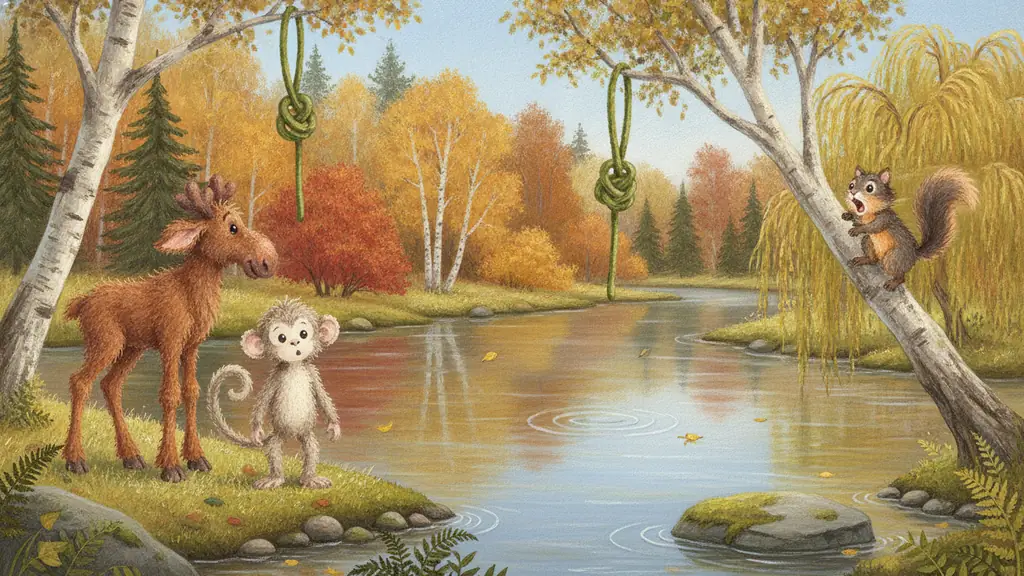
“Did you hear? Did you hear? There’s a golden treasure up the river! It only comes once a year! Right at the end of the day! Tessie told me!”
And she zipped away again.
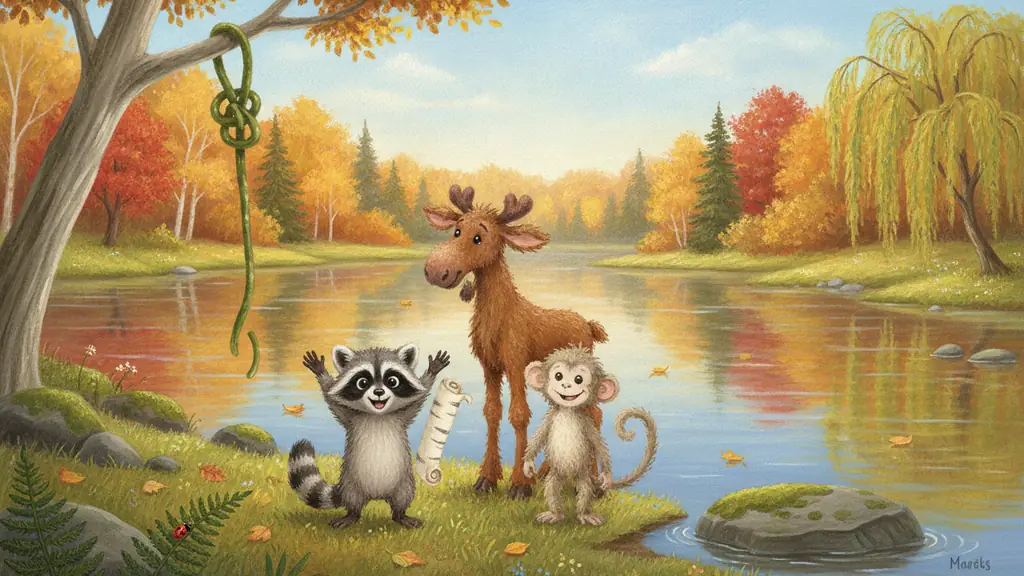
Ricky came running up just in time to hear the last part. His eyes went as big as acorns. “A GOLDEN treasure? That would be the best Swap present in the whole history of presents!”
“It has to be pinecone-size,” said Mr. Moose. “Rule two.”
“I’ll bring a pinecone-size piece,” said Ricky. “Come on! We can sign everybody up on the way.”
So off they went, upriver.
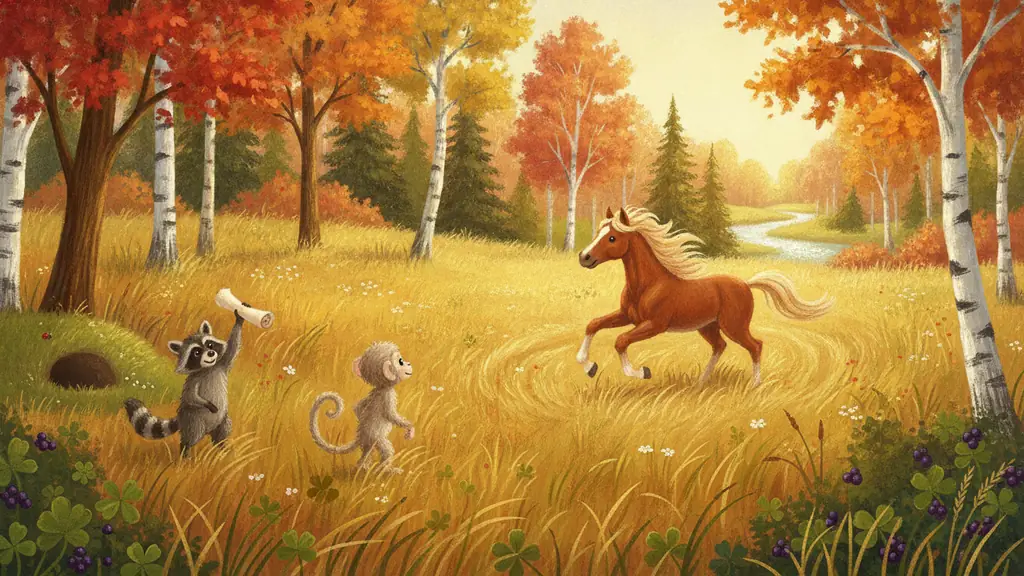
In Munching Meadow, they found Hazel Horse galloping circles through the last of the tall grass.
“Hazel!” called Ricky. “What do you wish for? For the Great Big Present Swap?”
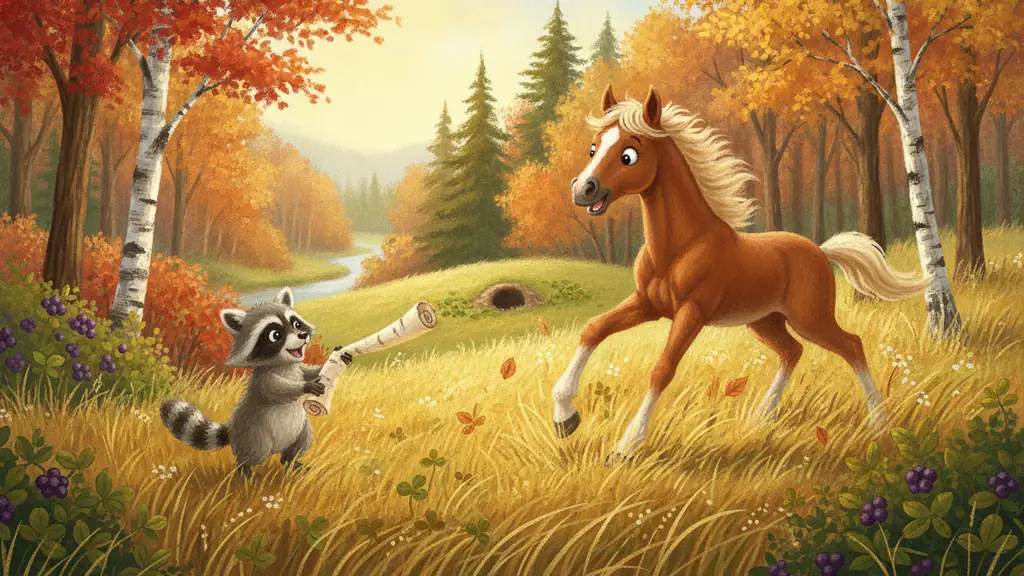
Hazel skidded to a stop. “The great big present WHAT?”
“Swap,” said Ricky.
“SWAMP?” Hazel’s ears shot up. “A Great Big Present SWAMP? I LOVE swamps! I’ll go find one!”
And before anybody could say a word, she was galloping off toward the far side of the meadow, her tail streaming behind her.
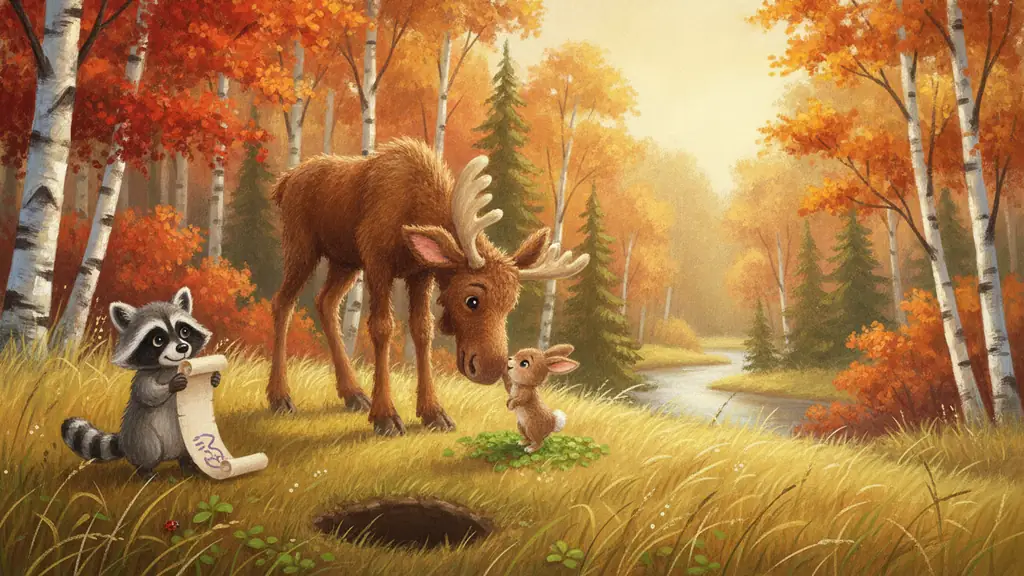
Ricky looked at his list. Very slowly, he wrote: Hazel. Wish: unknown. Gone to find a swamp.
By the clover patch, a pair of long ears poked out of a burrow. It was Benji Bunny. When Ricky asked for his wish, Benji’s nose twitched. He hopped up close to Mr. Moose and whispered something into his big, soft ear.
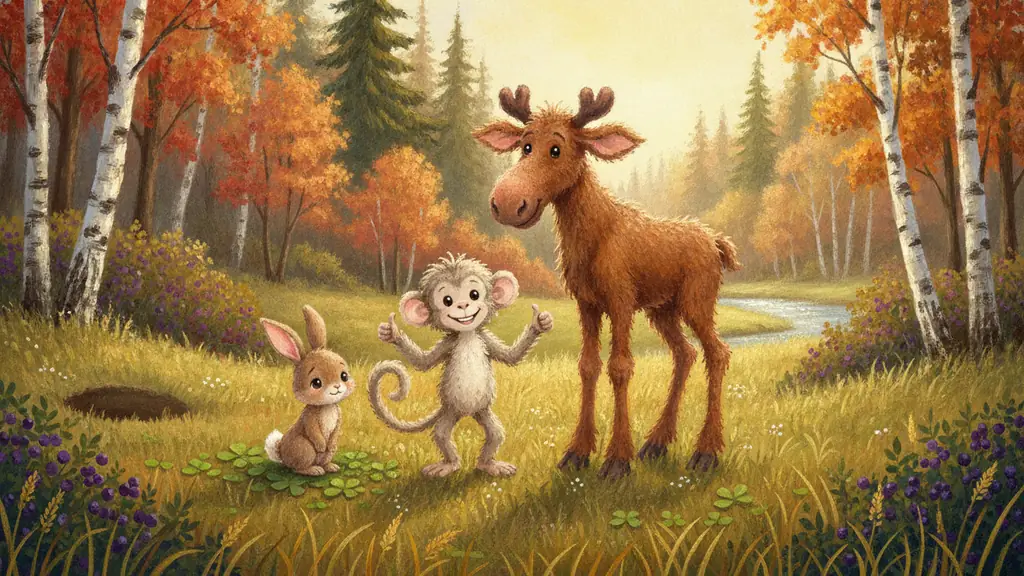
“Benji wishes,” said Mr. Moose gently, “for somebody to sit next to at the Thankful Feast.”
“ME!” said Mr. Monkey. “I’ll sit next to you!”
Benji’s ears turned a little pink. “Hee hee,” he said, very quietly.
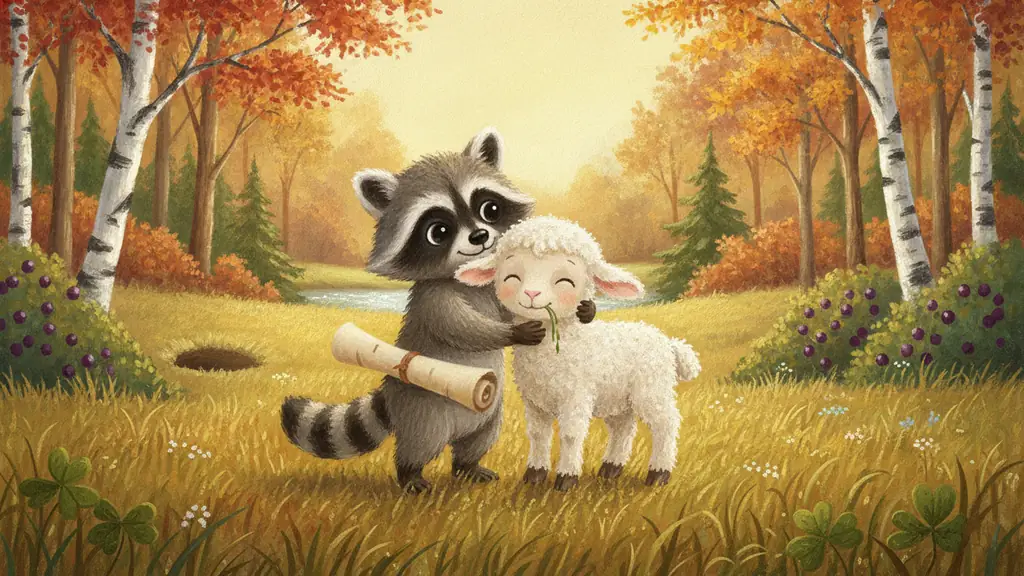
At the edge of the woods, Shiloh Sheep was nibbling grass. He thought for a long time about his wish. “I wish,” he said at last, “that nobody gets left out.”
“That’s rule four!” said Ricky. He hugged Shiloh. “You’re my favorite.”
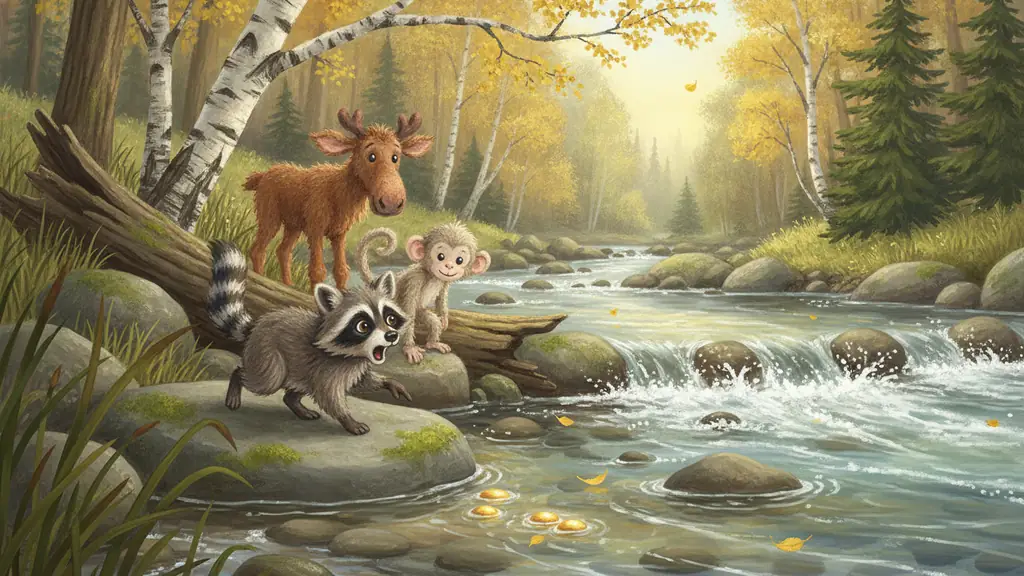
Then the river began to get louder. The water hurried over smooth stones, splashing and singing, rush-a-rush, plish-a-plish. They had come to Whispering Water Way.
“Treasure time,” said Ricky.
He looked under rocks. He looked behind logs. He looked in the reeds. And then he gasped. Down in the shallow water, a little pebble was shining gold. And there was another one. And another!
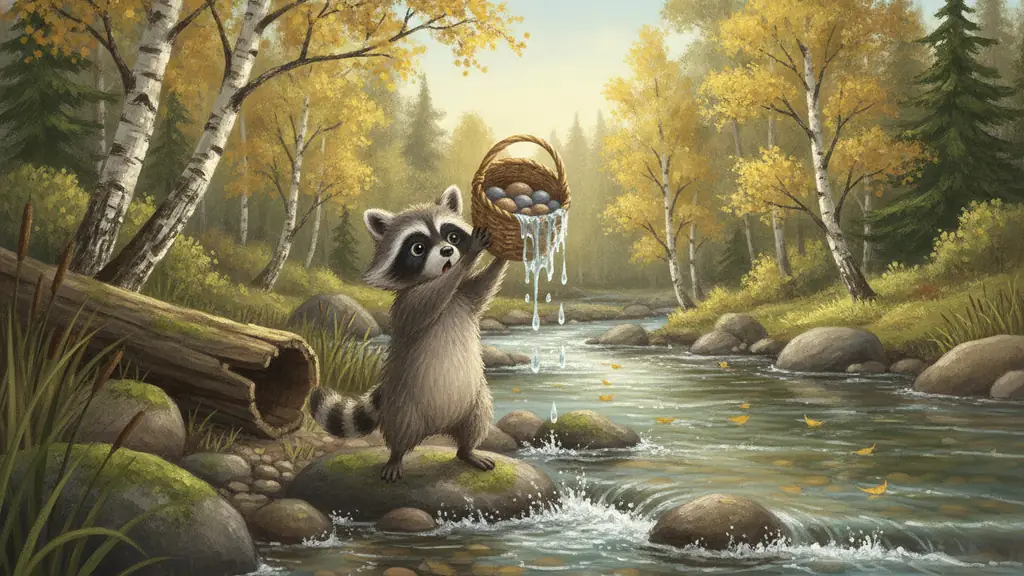
“GOLD!” Ricky scooped them into his basket, pawful after pawful. “I found it! I found the golden treasure!”
He held up the basket. The sun was warm. The water dripped out. And as the pebbles dried, the gold went away. One by one, they turned plain and grayish-brown, the same as every other pebble.
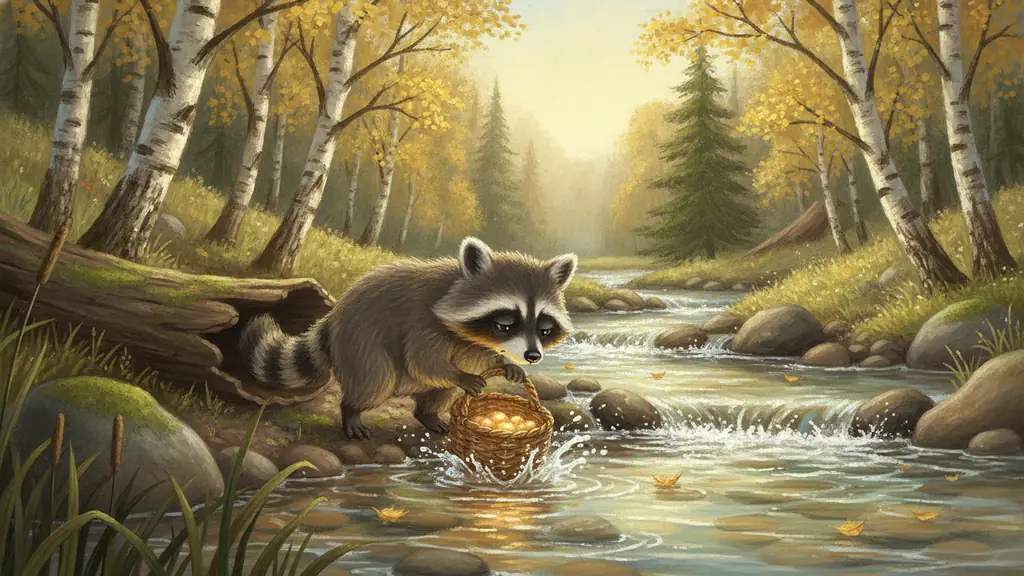
Ricky stared into the basket. “Hey.”
He dipped the basket back into the river. Gold again! He lifted it out. Brown again. He dipped it. Gold. He lifted it. Brown.
“I know,” said Ricky. “I’ll carry it home in the water.”
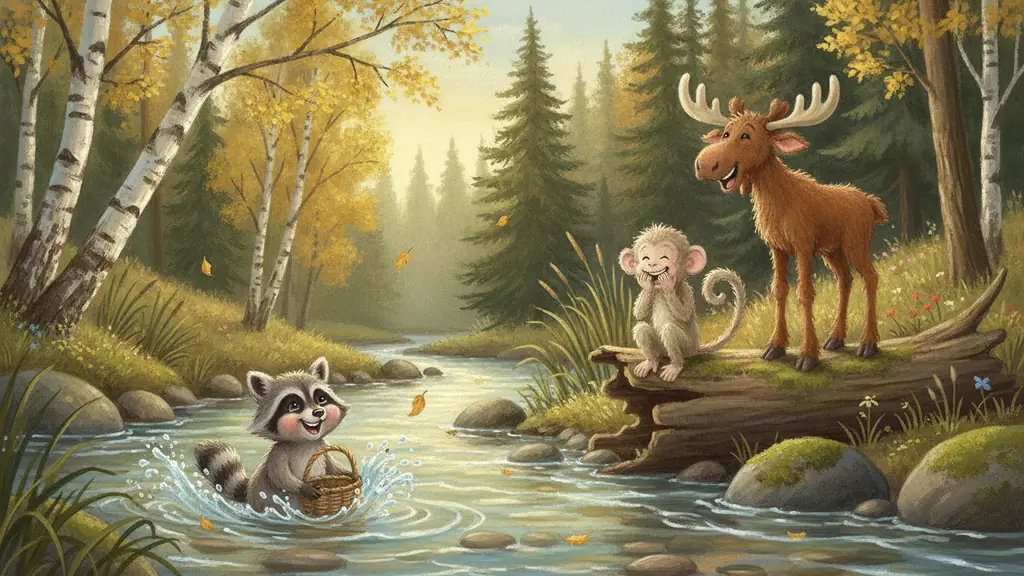
So Ricky walked up the river holding his basket under the water, bent over, wading deeper and deeper so the pebbles would stay gold. The water came up to his tummy. Then his chest. Then his chin.
“Ricky,” said Mr. Moose. “Your ears are getting wet.”
“Glub,” said Ricky.
“Hee hee hee!” went Mr. Monkey.
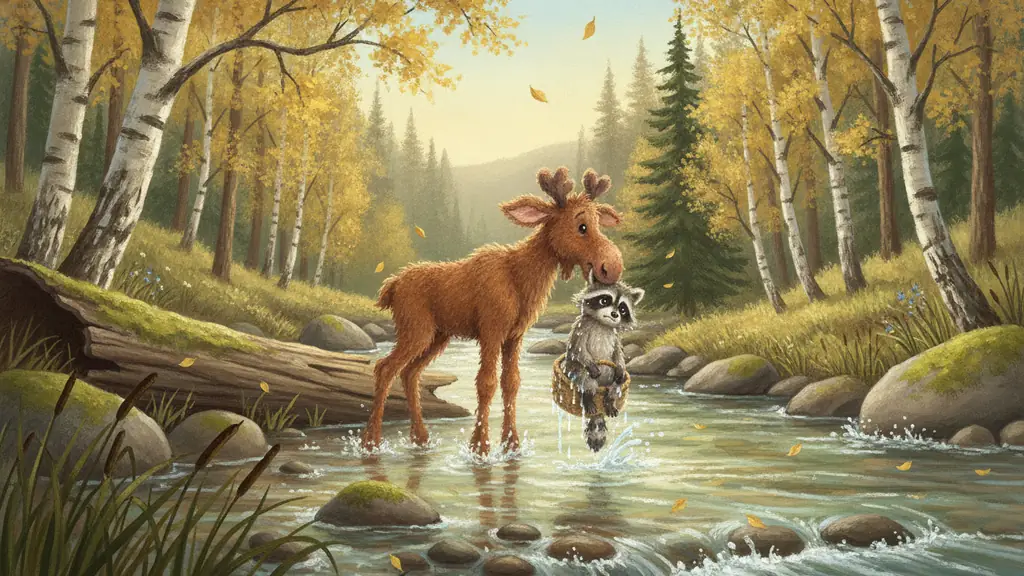
“Ha-ha-ha!” went Mr. Moose. He waded in and lifted Ricky out by the scruff, dripping, basket and all.
Just then, here came Hazel, trotting back along the bank. She was covered in mud from her hooves all the way up to her knees, and there was a lily pad on her head.
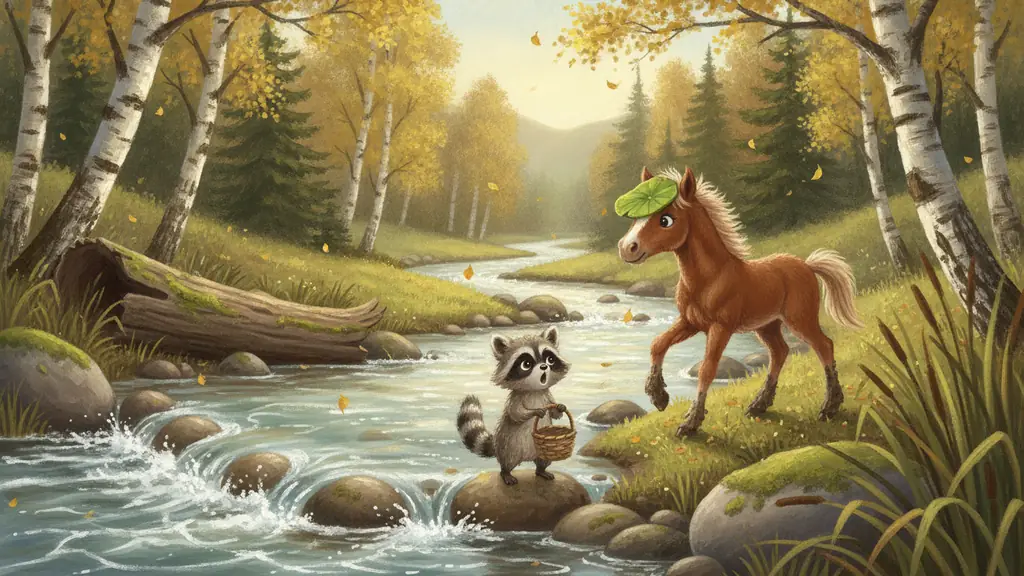
“I found a swamp!” she said proudly. “Where do the presents go?”
Ricky opened his mouth. Then he closed it.
Hazel looked down at her muddy legs, and at the lily pad flopping over one eye. “Hee hee hee… SNORT!”
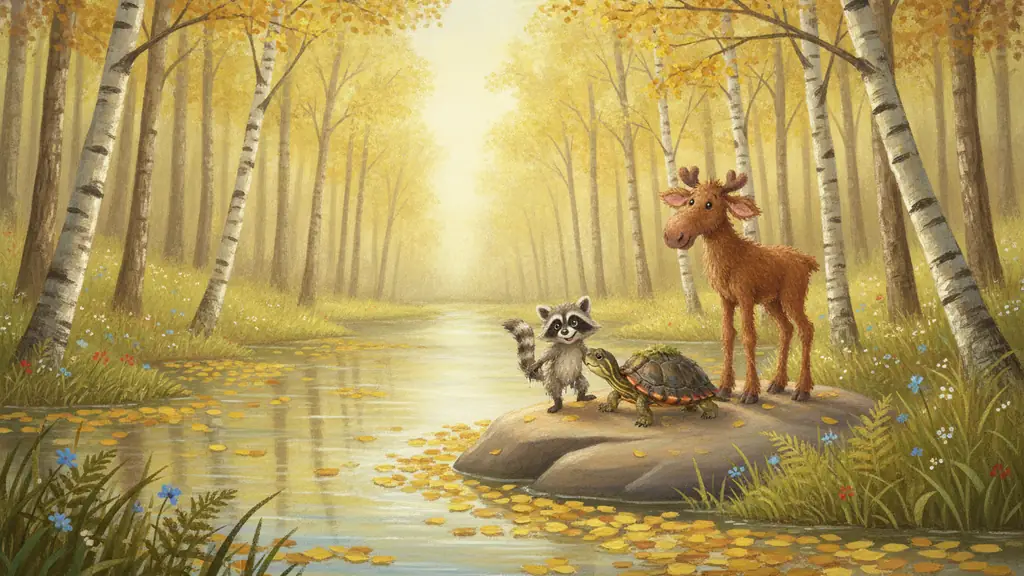
Past the noisy water, the river went quiet again. And there, on her warm, flat sunning rock, sat Tessie Turtle.
“Tessie!” Ricky ran up, still dripping. “Sammy said you know about the golden treasure! Where is it?”
Tessie turned her head, slowly. “Oh,” she said. “It’s here.”
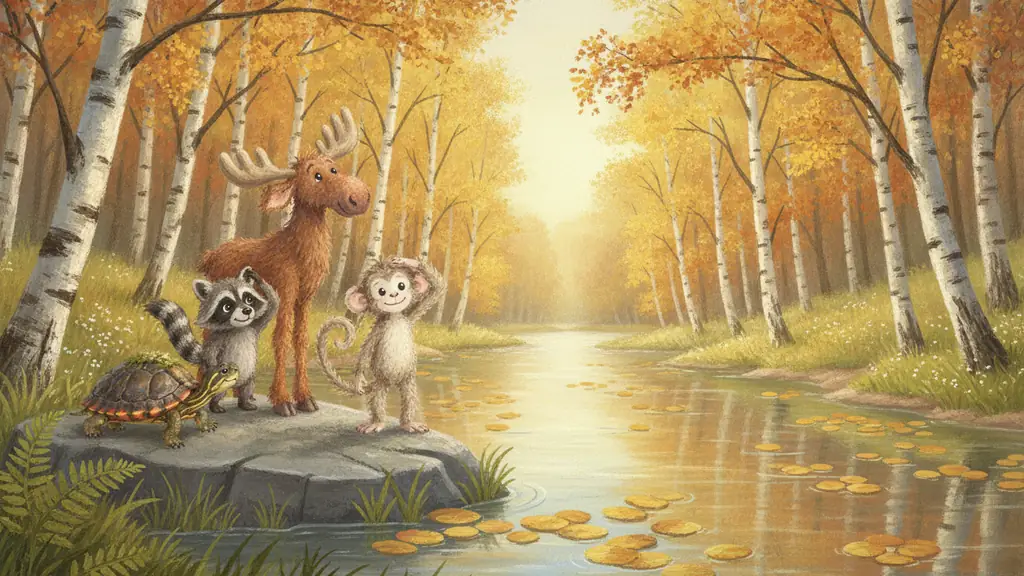
Everybody looked around. There was the river, full of floating yellow leaves. There were the trees. There was Tessie’s rock. There was no treasure anywhere.
“Where?” asked Ricky.
“Here,” said Tessie.
Ricky decided to ask an easier question. “What do you wish for? For the Present Swap?”
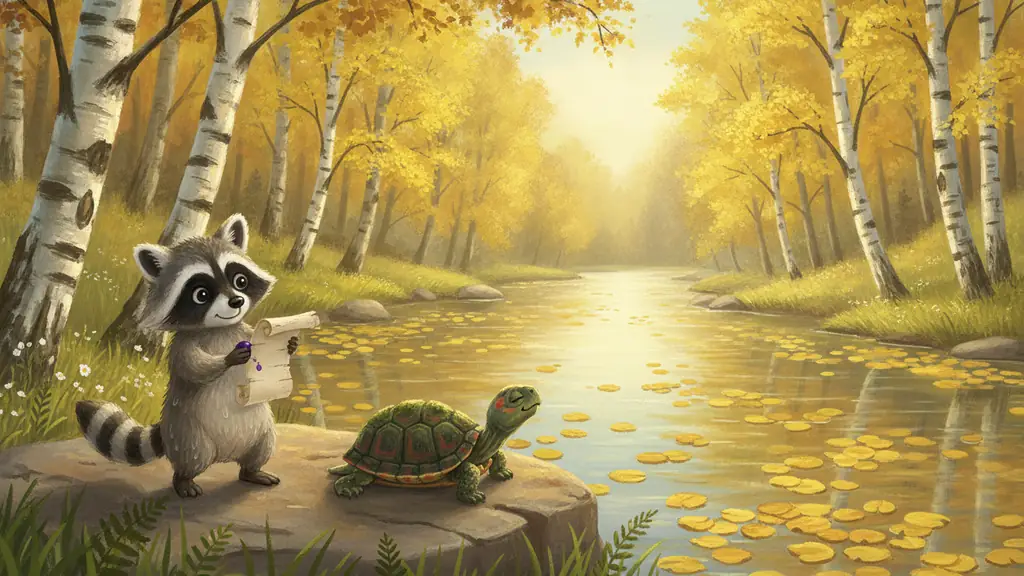
Tessie looked out at the water for a long time. “I wish,” she said, “for this.”
Ricky wrote down THIS?
Then Tessie asked a question of her own, very slowly, the way she said everything. “Ricky… what… is a present… for?”
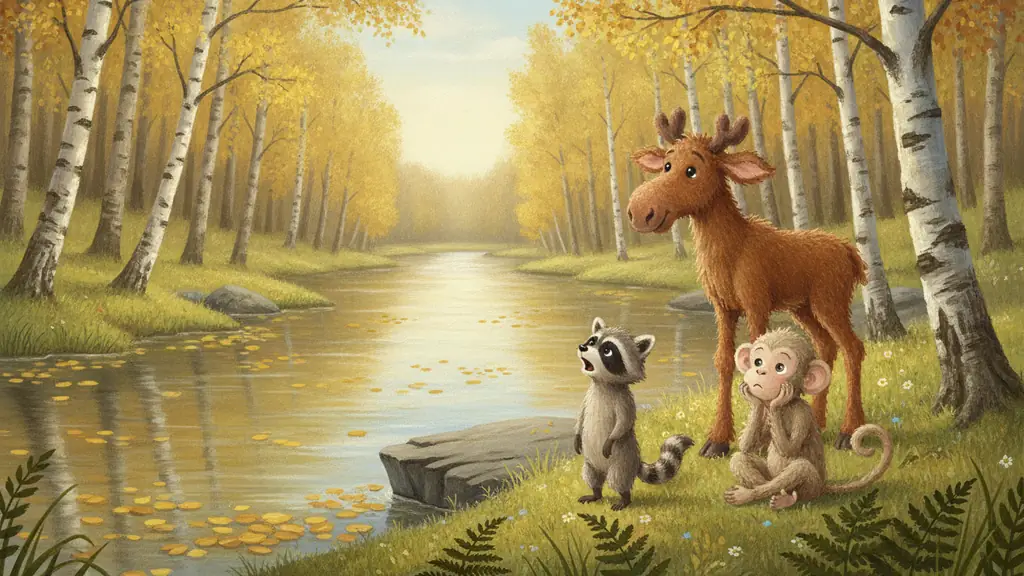
Ricky opened his mouth to answer. Then he closed it. He looked at Mr. Moose. Mr. Moose didn’t know either. Nobody knew. The river went plish-a-plish while they all thought about it.

The sun was getting lower. Ricky sat down on the end of Tessie’s rock, wet and droopy. “I wanted to find the golden treasure,” he said. “I wanted to bring the best present of all. And there isn’t any treasure. Just leaves and wet pebbles.”
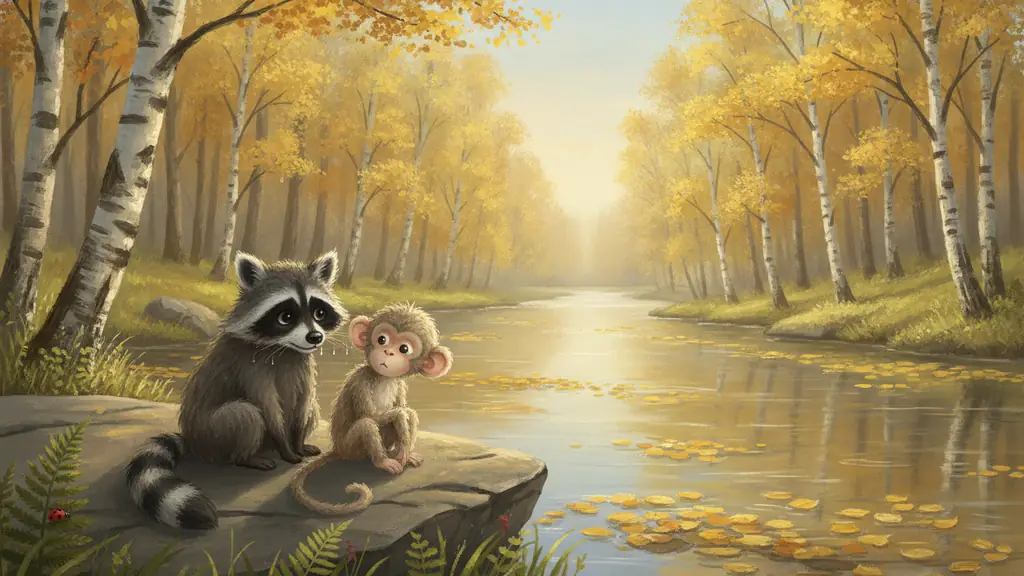
Mr. Monkey felt it in his tummy, the sinking feeling of looking all day for something and not finding it. He sat down right next to Ricky, close, so their shoulders touched.
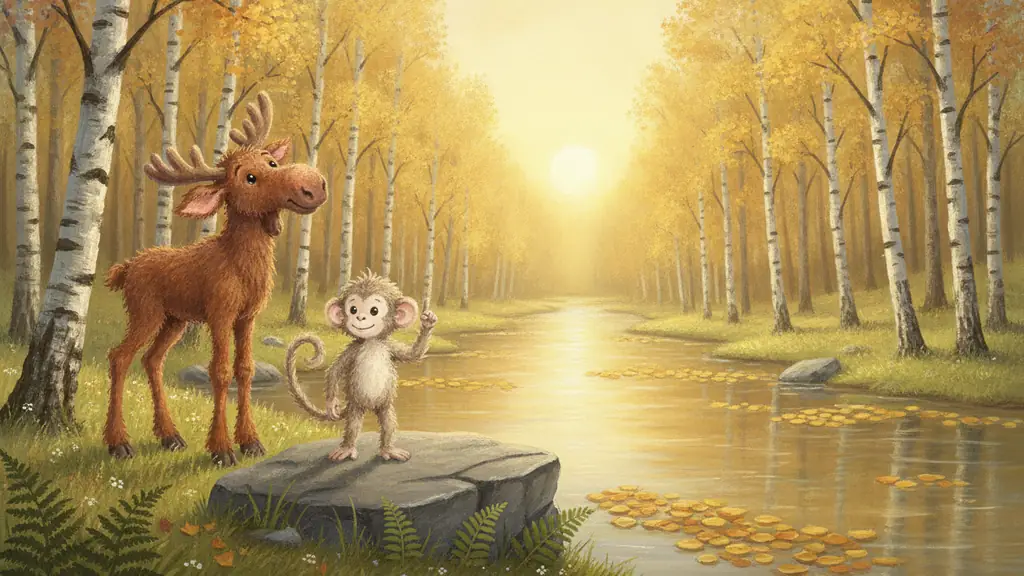
Mr. Moose was thinking. Sammy had said at the end of the day. And Tessie said it’s here. Not over there. Not under a rock. Here.
“Ricky,” said Mr. Moose slowly. “What if the treasure isn’t somewhere else? What if it just isn’t time yet?”
“The end of the day,” said Mr. Monkey.
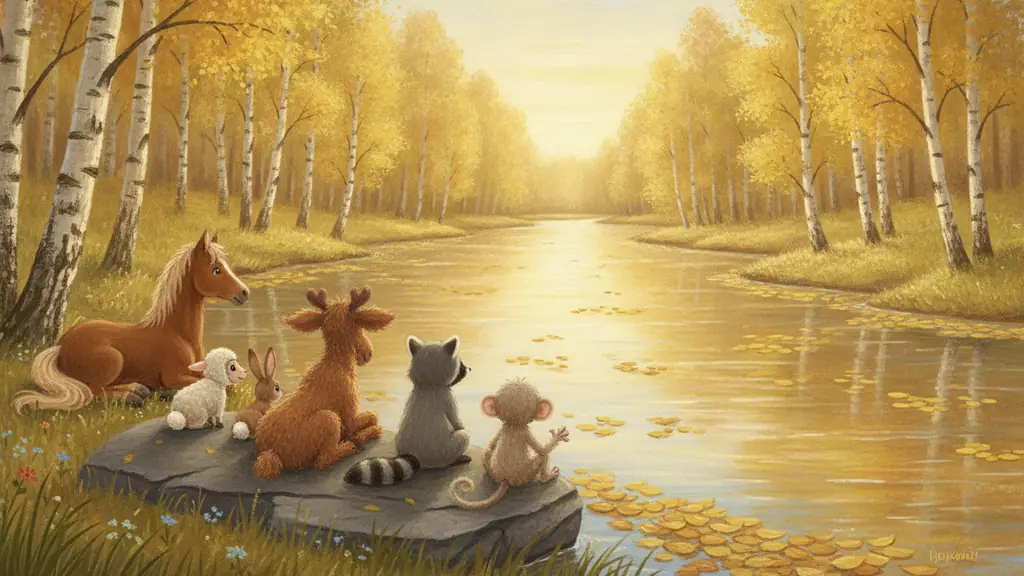
“So we wait,” said Mr. Moose. “Right here. Together.”
Waiting was hard for Mr. Monkey. He wiggled. He counted his toes. He counted Mr. Moose’s toes. Benji and Shiloh came up the bank to see what everybody was doing, and they sat down too. Hazel lay down in the grass with her muddy legs out straight. And they all waited, at Tessie speed.

Then the sun sank down until it was shining straight up the river, low and orange, right between the trees.
Benji’s ears stood up. “Look,” he whispered.
The light hit the water. Every yellow leaf floating on Rainbow River lit up at once, glowing gold, hundreds and hundreds of them, from one bank all the way to the other. The whole river turned into a shining, sparkling, slowly moving road of gold. Even the mist over the water glowed. Even Hazel’s muddy legs shone gold.

“I’m a golden horse,” Hazel whispered.
Nobody else said anything at all.
Then Ricky jumped up. “The treasure!” He grabbed his basket and scooped a big basketful of shining gold right off the river. He held it up high over his head. Water ran out of the bottom. Splortch. A pile of soggy wet leaves slid out and landed right on top of his head.
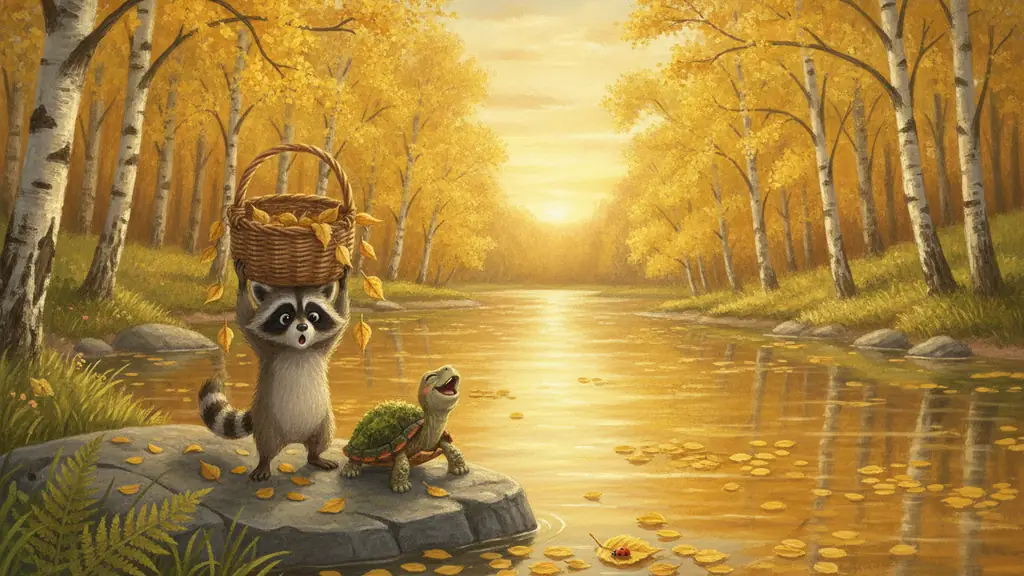
Ricky stood there with leaves hanging over his ears. “It’s just leaves,” he said.
“Heh… heh… heh,” laughed Tessie, very slowly.
“You can’t carry it home,” said Tessie when she was done. “You can only look at it.”
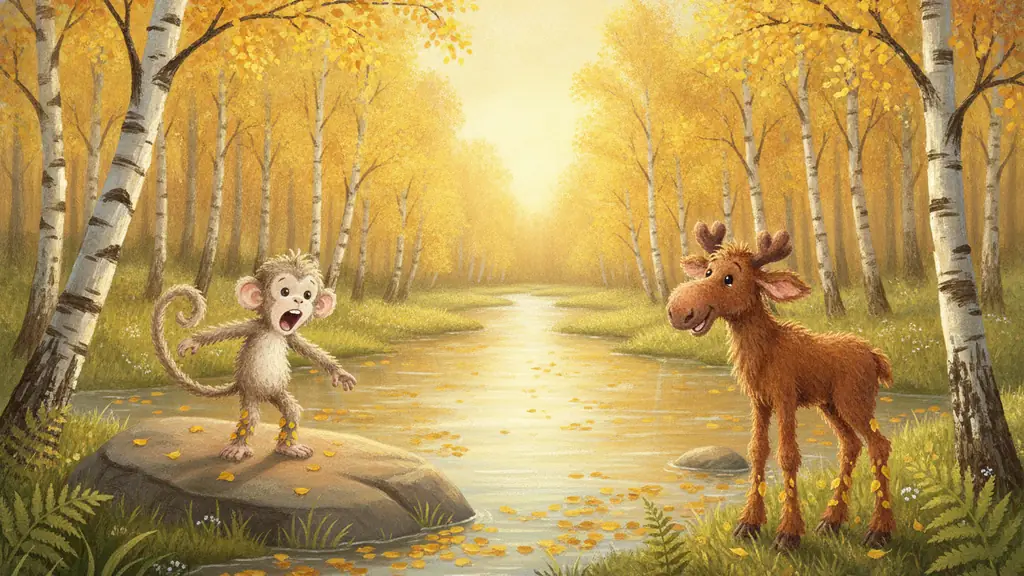
So they looked. They looked until the sun slipped behind the hill and the gold faded back into the river.
“Most years,” said Tessie, “everybody walks right through it.”
Mr. Monkey looked down at his legs. They were wet up to his knees from wading upriver all day. Wading through yellow leaves.
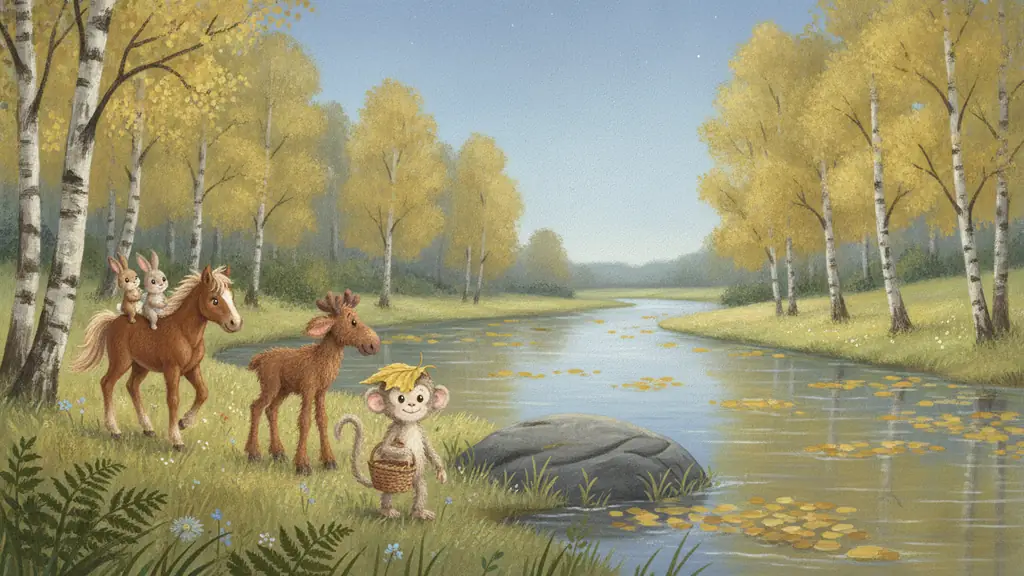
“Mr. Moose,” he said. “We walked through it ALL DAY!”
“Ha-ha-ha!” laughed Mr. Moose. “We did.”
They headed home in the blue evening, Hazel carrying Benji and Shiloh on her back, Ricky carrying an empty basket and wearing a leaf hat.
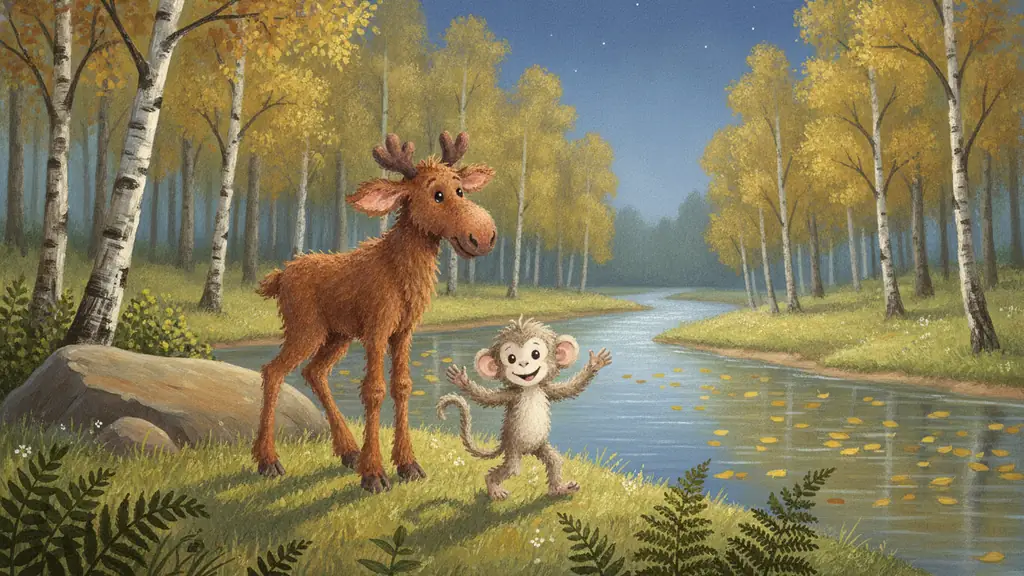
“What a day!” said Mr. Monkey. “Hazel went looking for a swamp and found one. Ricky carried his treasure under the river and got wet ears. Tessie said the treasure was here, and it WAS here. The whole river turned gold, and we can’t even take it with us.”

Mr. Monkey whistled, and Mr. Moose hummed, and together they sang:
We are better together,
Moose and Monkey forever.
And behind them, Rainbow River kept on carrying its yellow leaves home through the dark, waiting for tomorrow’s sun.