What happened to Christmas?
Maybe you can remember a Christmas that felt the way Christmas is supposed to feel. School let out, the lights went up, the music was playing everywhere you went, and for a couple of weeks the whole world seemed to slow down and get cozy.
The pieces are all still here: the lights go up, the playlists come out, the family gathers, and the gifts get opened. And yet a lot of us reach the end of December more tired than joyful, a little lighter in the wallet, and wondering why the season doesn't feel the way it used to. Maybe you haven't been able to put your finger on why. For a long time, I couldn't either.
Christmas has been my favorite time of year my entire life. When I was nine or ten, a babysitter asked me what my favorite kind of music was. She meant rock or country or R&B, but I didn't know that was what she was asking, so I gave her the obvious answer: Christmas music. She laughed, and I had no idea why. It was by far my favorite.
It showed up again in high school. I think it was my sophomore year, maybe junior, when my graphic design class was assigned to make a business card for the job we might have someday. I had no idea what I wanted to do with my life, so I asked myself what I actually liked most. The answer came quickly. My business card said "Christmas Fan," with a snowman on it and my phone number underneath. It's pretty funny looking back. It was also completely sincere.
That never really went away. To this day, when I buy Christmas lights, I pull out every bulb and then rebuild the strand in a red and green pattern. I spend early December hunting down the new Christmas albums to see whether any of my favorite artists recorded a version I like, and my Christmas playlist gets bigger every year. I enjoy the feel of the season, too: being home when it gets dark early, cozied up with the music on and some kind of craft on the table.
A lot of that probably goes back to being a kid. Christmas break meant the schedule changed, the weather changed, the food changed, and even the shows on TV changed. Everything was different, in a good way. There were family gatherings, and as a young kid I enjoyed every one of them, even when there were several in a row. It felt like one long celebration. And of course there were the gifts. As a kid, it was almost impossible to avoid the question running through your head all December: What am I going to get? What am I going to get?
Around that same time in high school, I started wanting to be on the other side of the gifts. I didn't have much money, so buying something for everyone was never an option. What I did have was a mom who is super crafty. She was always coming home from Michaels or Craft Warehouse, and our house was full of supplies. One year I found a set of simple snowflake ornaments with six strands you could fill with beads, and I realized that with enough colors, I could make each one for a specific person. My friend who cheered for the Oregon Ducks got green and yellow. My friend who was an Oregon State Beavers fan got black and orange. Everybody got the same gift, but every snowflake was made for somebody. On the last day of school before Christmas break, I handed each of my friends the one I had made for them.
I liked it so much that the next year I had to figure out what the new gift would be, and that started a tradition. One year it was magnets with a personalized picture on each. My nephew really likes Panda Express, so his magnet was the Panda Express logo. Silly, cheap, and completely his. Years later, some of those magnets are still on people's fridges, which is pretty cool.
As I got older, the projects grew a little. One year I asked everyone in my immediate family, about six of us, to give me one word that described each of the others. Then I painted a canvas for each person in a color I knew they liked and wrote on it the words the rest of the family had chosen for them. I got to hand my mom a canvas and tell her, "These are the words that came to people's minds when they thought of you." I enjoyed making those, and they meant a lot to the people who received them.
None of these gifts cost much. Nobody needed an ornament, and I knew it. The point was that each person would know I had put time and thought into something, and that I had been thinking about them specifically when I made it. That was when I first felt what the old saying, attributed to Jesus, is getting at: "It is more blessed to give than to receive." A more modern paraphrase that captures my personal experience, The Message, says it this way: "You're far happier giving than getting." What happens in your heart when you give a good gift does more for you than what happens when you get one. That feeling became one more thing I liked about Christmas.
Then I grew up. I got married, got a job, and eventually had a stable income and a more stable life. I started seeing the world through an adult lens, and Christmas got harder to enjoy. A lot of what I had enjoyed about it didn't seem to be there anymore, and some things I had never noticed became impossible to miss.
The gatherings were the first place I noticed it. I could sit through an entire Christmas gathering and never hear anyone mention Jesus or the story of his birth. It had become an event we called Christmas, and the event had rules. There would be food. There would be some kind of gift exchange. And before anyone showed up, there would be a conversation about how we were doing gifts this year. Is everybody buying for everybody? One gift each? A name drawing?
The gathering itself came with a set of expectations, too. We did it at your house last year, so this year it's supposed to be at ours. One family can only stay for thirty minutes, and another expected everyone to stay for two hours. Why didn't you come earlier? Why couldn't you spend the whole day? Somebody always ended up grumpy. For some people, the feast wasn't even fun, because it meant a lot of work. More and more, the day seemed to revolve around what the gathering was supposed to be.
The biggest thing I started to see was harder to put into words. Here in America, a lot of us have more than enough. And every December, people who have more than enough spend their money buying things for other people who also have more than enough. I'll come back to that one.
The longer I thought about it, the clearer it became what was actually wrong. The problem wasn't the people. It wasn't the families. It wasn't the gatherings. It was the instruction manual.
Many of us inherited an instruction manual for Christmas. Nobody handed it to us on paper, and most families never read it out loud, but most of us know the rules of the game. Get something for everyone you'll see. Make a list so people know what to get you. Keep things fair and even. Don't show up empty-handed. Make sure nobody at the party feels left out.
This is the game most of us were given, and I played it for years. It usually goes something like this. You figure out how much you can spend on gifts this year, say $200. Ten people will be at the party, so everybody gets something worth about $20. Then you remember the people who won't be at the party but might notice if they didn't get anything from you, and the list keeps growing. Whether anyone on the list actually needs anything never really comes up. What matters is that everyone gets treated the same and nobody gets left out.
This manual has been around a long time. The historian Stephen Nissenbaum, in his book The Battle for Christmas, shows that the family-centered, gift-giving Christmas most Americans grew up with largely took shape in the 1800s. By around 1850, Harriet Beecher Stowe (the author of Uncle Tom's Cabin) was already complaining about how much money people wasted every December on things nobody wanted. It was handed down to us long before we had any say in it.
And to be fair, at its foundation the manual is trying to do something good. There's something in us that knows it is good to give, and that giving really is more blessed than receiving. The manual taps into that. Then a whole industry of stores and advertisers has done a very good job of telling us what to do with that instinct: give everyone you know something they want, and that's what it means to be generous. I wouldn't say we've been brainwashed. Tricked is probably the better word.
The trouble is what kind of manual it is. It's an instruction manual for the hands. It tells us what to buy, what to bring, and how to act so we look generous, or at least look like we're playing along. But generosity is fruit. You can't force fruit; you can only feed the root. A tree feeds its roots through its leaves, and gratitude is the leaf. The manual we were handed skips it entirely.
A leaf can't feed anything without light, though. In this book, the light is grace, the good things we receive that we never earned, and gratitude is how we take that light in. I'll come back to that picture in the Premise. For now, hold on to the simple version: you can't force fruit; you can only feed the root.
So this program keeps the goal of the old manual. We still want to be people who give, and give well. We just start where generosity actually starts: in the heart.
Once I saw the manual, I started seeing what it produces everywhere, including in my own Christmases. I've come to call it the "Christmas Crud": everything that has piled up on top of a good season until it's hard to find the good underneath. Here are six case studies. Chances are you've practiced a few of them, maybe all six, and I've practiced my share. Nobody is on trial here, and I'm not asking anyone to quit these things. Each one is what you'd expect to grow from a manual written for the hands. For now, the goal is just to see the season we inherited.
We call it a gift exchange, and the name gives the problem away. A gift is something freely given. Once it's expected, and once something is expected back, it has turned into a trade. "Gift exchange" is a contradiction. The honest word for an exchange is a transaction. If we want an honest name for what happens at most Christmas parties, "present" works better. You can present something to someone, and a present exchange at least describes the event accurately. When we call a trade a gift, we slowly forget what a gift is. Think about the conversations that happen before the party: price limits, name drawings, who is buying for whom. When giving needs that many rules, it's fair to ask whether it's still giving.
The rules say that since everyone is going to get you something, you should help them out by making a list of what you want. Notice that word: want. The wish list is all about want. I don't need anything on my wish list. That's why it's called a wish. If I want something, I can decide whether it's worth my money and buy it myself. Making a list so other people can spend their money on me, instead of on the real needs in the world, is kind of mind-boggling once you stop and look at it.
It starts early. "What do you want for Christmas?" is one of the first questions kids hear every December. Think about what that question does. It forces their focus onto everything they don't have. From there, only two things can happen: they get exactly what they asked for, or they now know about something they didn't get, and they're disappointed. Gratitude, at its simplest, is noticing what you got instead of what you did not. The wish list trains the opposite.
This is the one I couldn't unsee. When I say rich, I know what you're picturing: millionaires, billionaires, yachts. What I mean by "rich" is pretty much every American who has enough.
By the world's standards, that's most of us. According to World Bank data compiled by Our World in Data, living on about $55 a day per person, roughly $20,000 a year, is enough to put someone in the richest 10% of the world, even after adjusting for differences in the cost of living. A single adult working full time at $10 an hour clears that line. The Pew Research Center found that many Americans living below the official U.S. poverty line would count as middle income by global standards. If you have a phone in your pocket, a car in the driveway, food in the fridge and the pantry, a drawer full of clothes, more than one pair of shoes, and a bed of your own, you are living in an abundance most humans in history never saw.
For most of human history, need was everywhere, and in much of the world it still is. Meanwhile, the National Retail Federation reported that Americans planned to spend about $890 each on the 2025 holiday season, roughly $628 of it on gifts. Put it all together, and here's the picture: rich people buying things for other rich people that they don't need, sometimes don't even want, and could certainly buy for themselves. And then we call that generosity.
The "don't even want" part has actually been measured. In 1993, economist Joel Waldfogel surveyed his students at Yale and estimated that people valued the gifts they received at somewhere between 10% and a third less than what the giver paid, with the biggest gap on gifts from more distant relatives. It was a small study, and other economists have pushed back on it, but it matches what a lot of us have seen after the wrapping paper is cleaned up.
So why do we keep playing? I think we were made with an innate desire to feel generous. There's something good in that. But from where most of us live, the real needs of the world are hard to see, and it's hard to tell which needs are real. So we give to the people in front of us, which usually means giving to people who don't need anything. Part of why we don't feel rich is how our brains work. Psychologists call it the hedonic treadmill: whatever we have long enough becomes normal, and we stop noticing it. I call it the Comfort Constant, and we'll come back to it later in November, because it's one of the biggest things standing between us and gratitude.
For some, the game goes a step further. In LendingTree's survey of more than 2,000 U.S. consumers in mid-December 2025, 37% said they took on holiday debt, averaging $1,223. Among those with holiday debt, 41% were still paying off the year before. Nearly half of parents with kids under 18 (48%) borrowed to get through the holidays. And people earning six figures were among the most likely to take on holiday debt.
So in America, a lot of us are rich people spending money we don't have, to buy things nobody needs, for people who could buy them themselves. That raises a fair question: how can you be rich if you don't have the money? Look back at the last case study. By the world's standards, most of us are still rich. We've just been handed a manual that says generosity is measured by what you spend, and some people follow it all the way into next year's credit card statement.
It's a busy season, and for a lot of families it's a stressful one. By the time everyone gets to the gathering, one family only has an hour before they need to be at the next one. So everyone eats fast, tries to catch up in between bites, and tries to keep things feeling Christmassy. Maybe someone in the room put real time and thought into their gifts and was looking forward to explaining why they chose each one. There's no time for that now. "They have to leave in five minutes. Everybody grab your gifts!" One gift gets opened, then the next, then the next. By the end, do you even know who gave you what?
This is the extreme version, but most of us have lived some version of it, sometimes as the ones watching the clock and sometimes as the ones tearing through the pile. The younger the kid, the harder it is to be grateful in that environment. Put six gifts in front of a child and the only reasonable thing to wonder is what's in the next one. There's no time to sit and enjoy what they just opened. They may not know who it came from, and they're still supposed to say thank you. It's all anticipation and no satisfaction. I talk about that like it's a kid problem, but it's an adult problem, too. We've made gift-giving so rushed that people have to write their names on the tags so the person opening it knows who it was from.
The Greek word behind our word hypocrite, hypokritēs, meant a stage actor. An actor works for applause. That's the paycheck. Jesus used the word for people who gave to the poor with a trumpet blast so everyone would notice. "Truly I tell you," he said, "they have received their reward in full." The applause is all the payment they're going to get.
The Christmas manual makes it easy to slip into that version of giving, even when we don't mean to. Part of it is simply not wanting to lose face. I don't want to be the one person at the party who didn't bring something. Part of it is wanting people to think a little more highly of us. Again, I'm not accusing anyone. This is how the game is built. But when we play it this way, our giving ends up being more about how we look than about the needs of the world or the good of the person in front of us.
Six case studies, one root. Each one grows from a manual that tells our hands what to do and never gets around to the heart.
Here is the principle this whole program is built on: generosity is the overflow of gratitude. That's where the name Advent Overflow comes from.
Gratitude, remember, is noticing what you got instead of what you did not. Now think of a time someone gave you a really good gift. It could be anything that made your life better or opened a door to a better future. Gratitude that deep tends to keep moving. You find yourself wanting to pay it forward, to do for someone else what was done for you, to be the giver of a good gift. When gratitude grows into great gratitude, genuine generosity follows on its own. Nobody has to force it.
Charles Dickens told this story back in 1843. In A Christmas Carol, Ebenezer Scrooge is made to see what he has been given, what his greed is costing the people around him, and what his money could do for them. By the end of the story, the man who wouldn't let his clerk put another coal on the fire is sending the prize turkey to the Cratchit family. His heart changed first, and his hands followed.
Notice where that starts: with receiving. Christmas itself is first a season of receiving a very good gift. The story at its center is about a gift that was exactly what people needed, even though it wasn't what many of them expected. It's also part of why kids enjoy Christmas so much. Young kids are made to be receivers. They need a lot from us, and receiving good gifts is right where they should be. Receiving belongs in Christmas. Before we had kids, my wife Jill and I tried a Christmas with no gifts at all. We woke up on Christmas morning, and it just didn't feel right. It's hard to explain why, but we knew we needed a different answer.
There's a second side to this that I've only recently started to see. When someone tells you that something you did made their life better, you get to feel what "more blessed to give than to receive" really means. You see that your giving actually produced something good in someone's life, and you want to keep going. The stage actor gives in order to be seen. This is the joy of finding out you actually helped. Gratitude feeds generosity in both directions: the gratitude we feel makes us want to give, and the gratitude we express to others helps them keep giving.
That's why so much of Advent Overflow is spent on thank-yous. We notice what we've received, and then we tell the people who gave it to us.
In America, we already have a holiday sitting right in front of Christmas that is practically made for this. Thanksgiving lands on the fourth Thursday of every November. Yet if you walk into a big store in early November, the Christmas decorations are often already out. Thanksgiving has shrunk into a single day on the calendar, one big meal squeezed between Halloween and the Christmas rush. We skip right past the season best suited to growing gratitude, and then wonder why the season of giving feels forced.
So what if Thanksgiving were a season instead of a day? Say the word slowly and it almost splits in two: thanks, then giving. That's the idea behind Advent Overflow. The word advent simply means arrival, and the program leans on the season of Thanksgiving as the catalyst for the arrival of Christmas. November becomes a month for noticing what we've received and thanking the people who gave it. December builds on that, one week at a time, through Generosity, Hope, Peace, Joy, and Love, all the way into the new year. The whole thing fits in five words: give thanks, then give back.
You get to keep the music, the lights, the decorations, the gatherings, and yes, the gifts. The goal is to prune the poison out of the season so the good parts have room to grow.
If any of this sounds familiar, whether it's the pressure to buy for everyone, the rush, the pile of things nobody needed, or just the sense that Christmas doesn't feel the way it used to, you're in the same spot I was. You were handed a manual for the hands and asked to produce something that only grows from the heart.
My family is still figuring this out. Every year we get to practice it again, notice what worked and what didn't, and adjust for next Christmas. What follows is the best path we've found so far. Take what fits, adapt what doesn't, and make it your family's own.
The next chapter lays out the map: what Advent Overflow is, why it's built the way it is, and how the rhythm works. Before you get there, try one small thing. Think of one person who made your life better this year. Picture their face, and name what they did. That's where all of this starts.
Hello, my wonderful story friends! It’s that time of year in Wanderful Woods when the leaves let go of the trees, and everybody starts getting excited for the Thankful Feast. Ricky Raccoon has an idea, and it’s a great big one.
What’s something you really, really want? Let’s go see what Ricky has in mind.
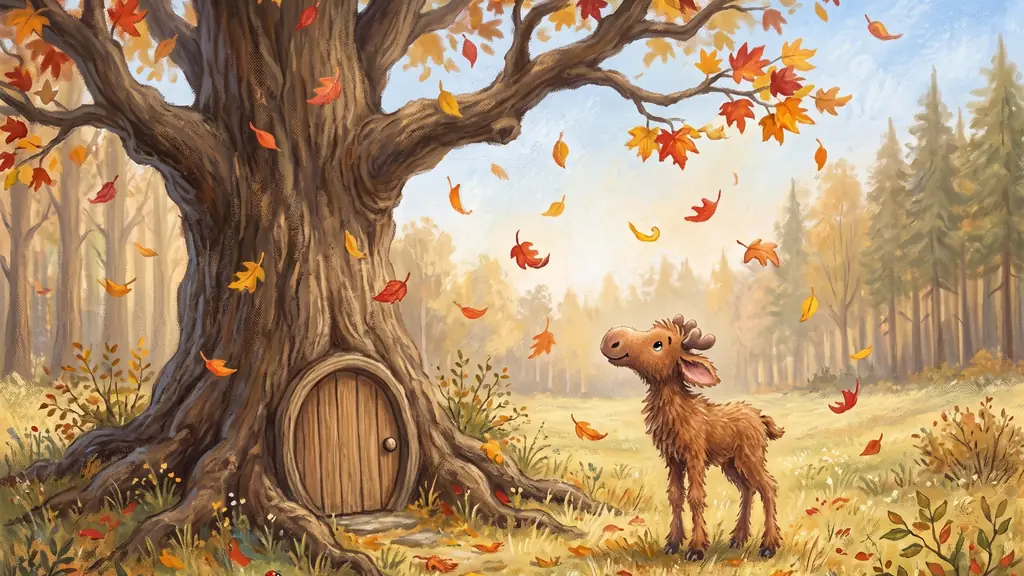
The leaves were falling all over Wanderful Woods. Red ones, orange ones, and yellow ones came twirling down from the big maple tree by Sunny Square, slow and crunchy, like snow that forgot how to be cold.
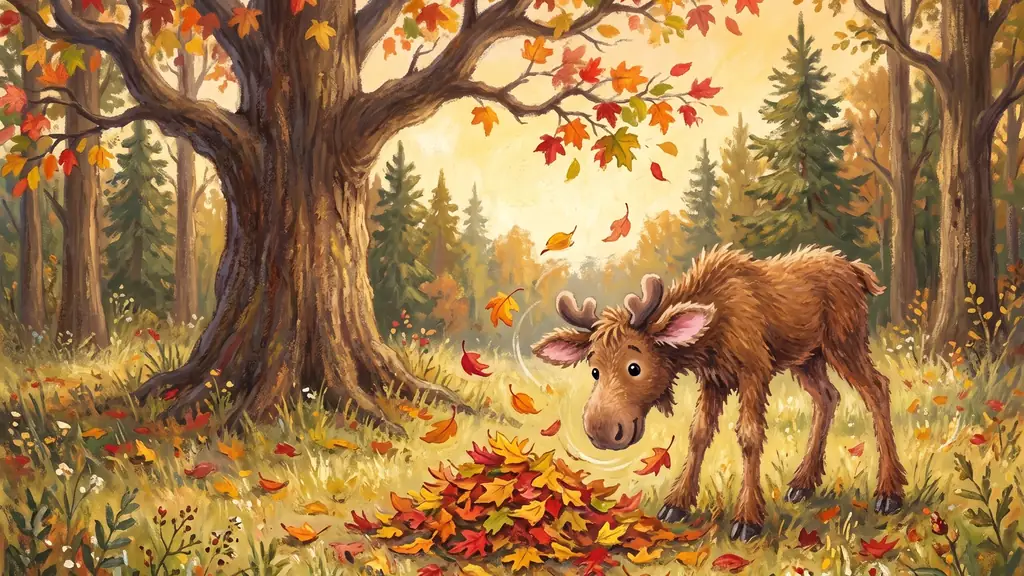
Under the maple, Mr. Moose was raking. He didn’t have a rake. He had antlers. He lowered his head, swished it left, swished it right, and the leaves piled up in front of him, higher and higher, until he had made the biggest leaf pile he had ever seen.
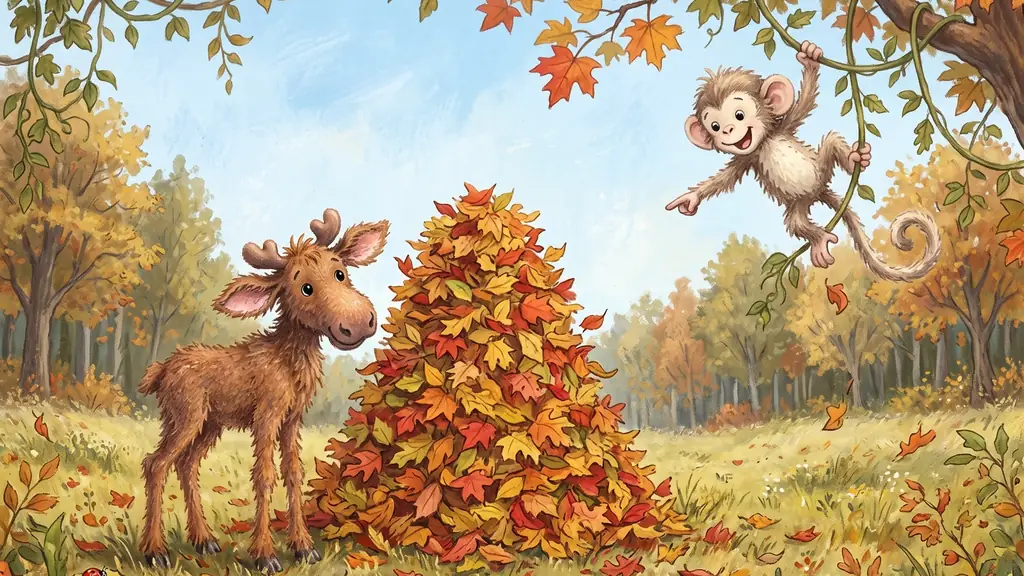
“Mr. Moose!” came a voice from the treetops. “Is that pile for jumping?”
“It might be,” said Mr. Moose.
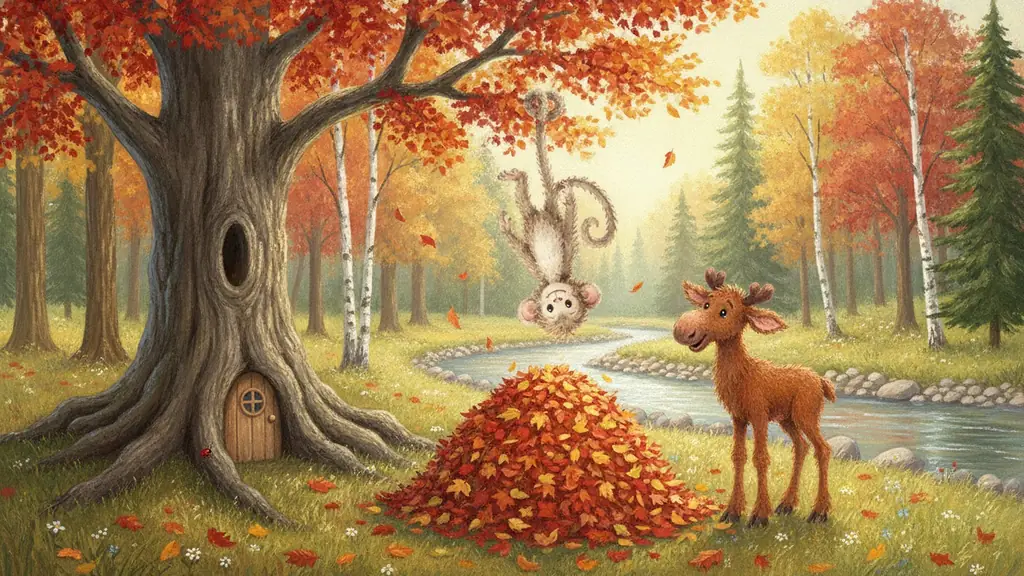
“CANNONBALL!”
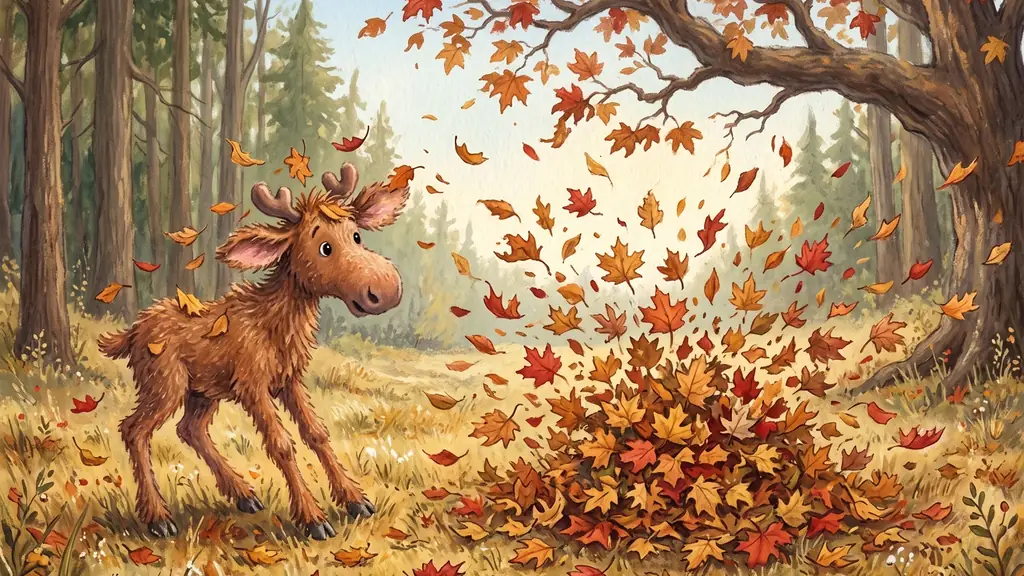
Mr. Monkey dropped from the treehouse vines, curled into a ball, and landed in the middle of the pile. Ka-FLUMPH. Leaves flew everywhere. Then the pile went still.
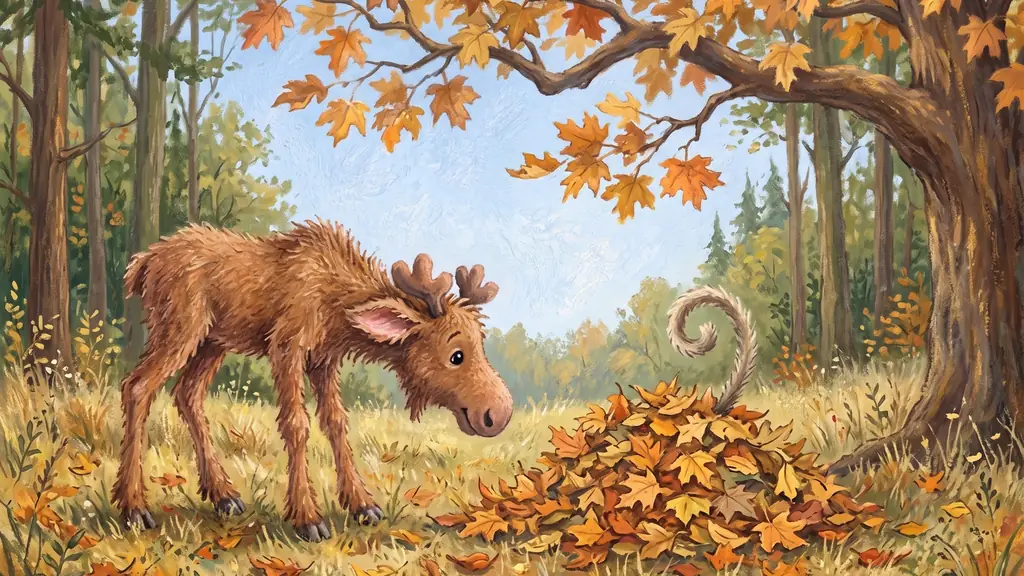
“Mr. Monkey?” said Mr. Moose.
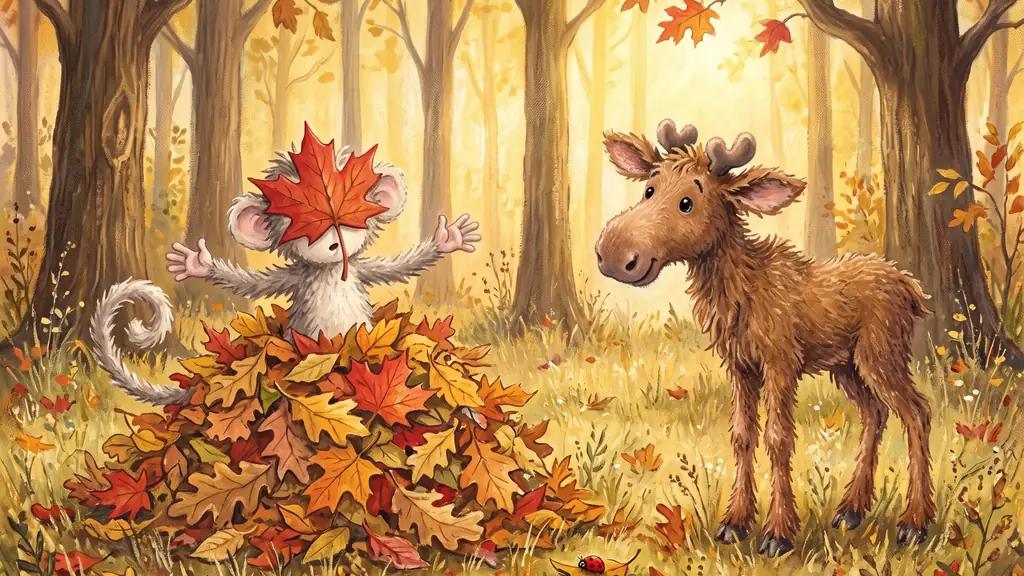
The pile wiggled. Out popped Mr. Monkey’s head, with one big red leaf stuck flat across his face.
“Mr. Moose?” he said. “Where did everybody go? It got dark.”
“Ha-ha-ha!” laughed Mr. Moose. “You have a leaf face.”
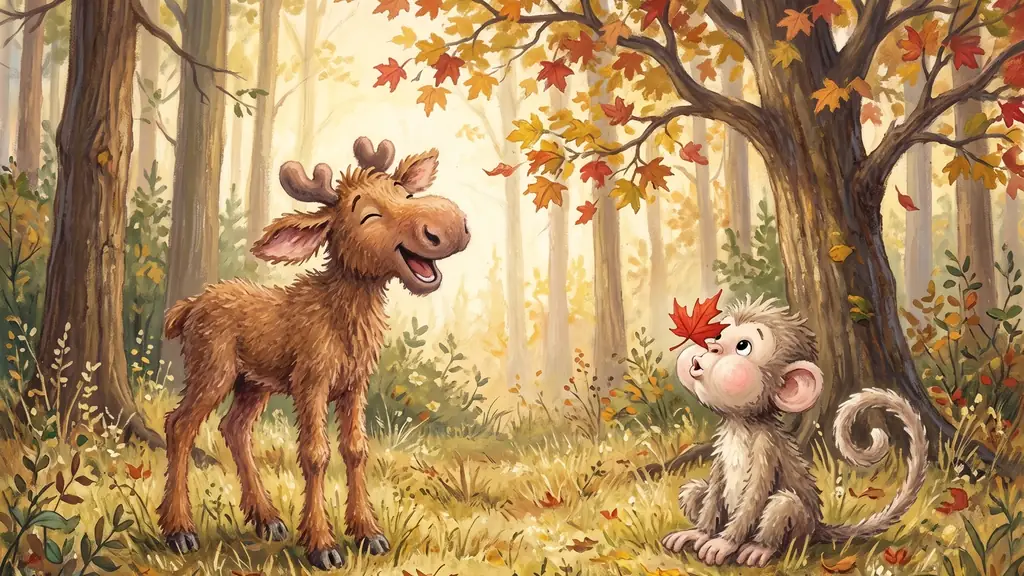
Mr. Monkey blew at the leaf. Fwap. It flapped up and stuck right back down. He blew harder. Fwap-fwap-fwap. The leaf flapped like a little flag, and stayed.
“I’ll just be a leaf monkey today,” said Mr. Monkey. “Hee hee hee!”
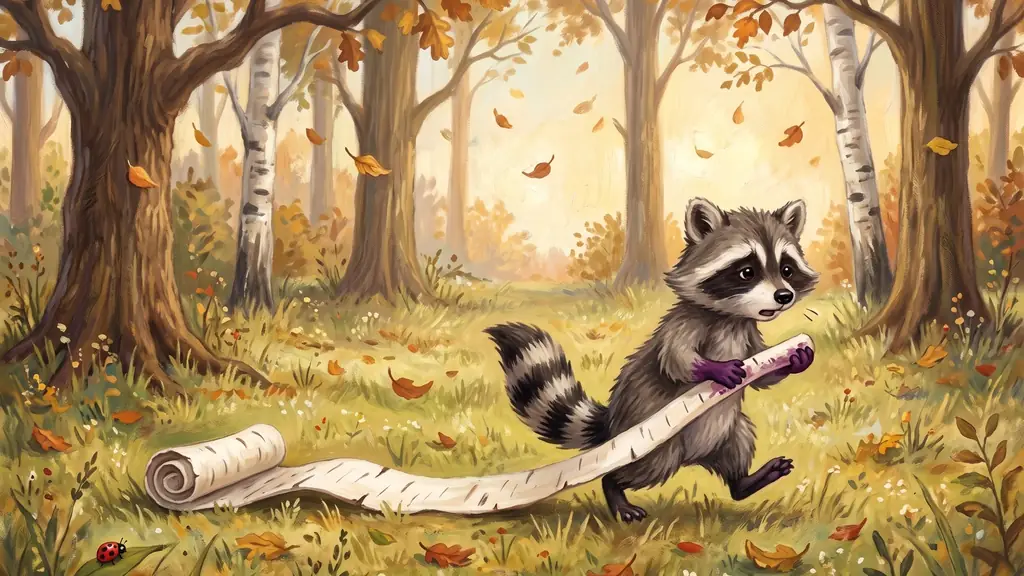
Just then, something came bumping across Sunny Square. It was Ricky Raccoon, dragging a long, curly roll of white birch bark behind him. He was huffing and puffing, and his clever little paws were covered in berry juice.
“Mr. Moose! Mr. Monkey!” he panted. “I have the best idea in the whole history of ideas.”
Mr. Monkey peeled the leaf off his face. “What is it?”
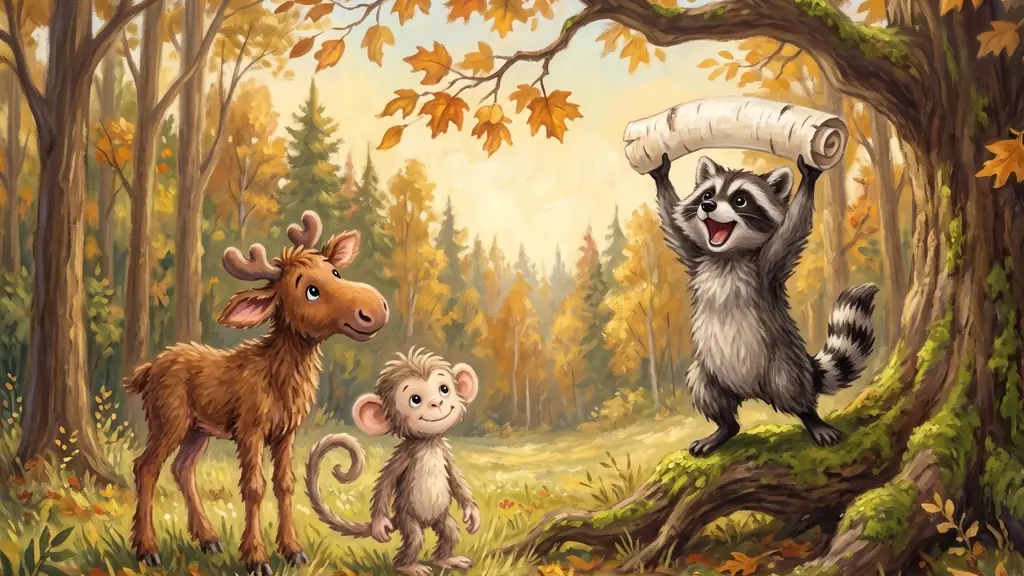
Ricky climbed up on a root and held the bark roll over his head. “You know the Thankful Feast? When the last leaves come down, and everybody in the whole woods eats together right here in Sunny Square?”
“I love the Thankful Feast,” said Mr. Moose.
“Well, THIS year,” said Ricky, “at the Thankful Feast, we are going to have… the GREAT BIG PRESENT SWAP!”
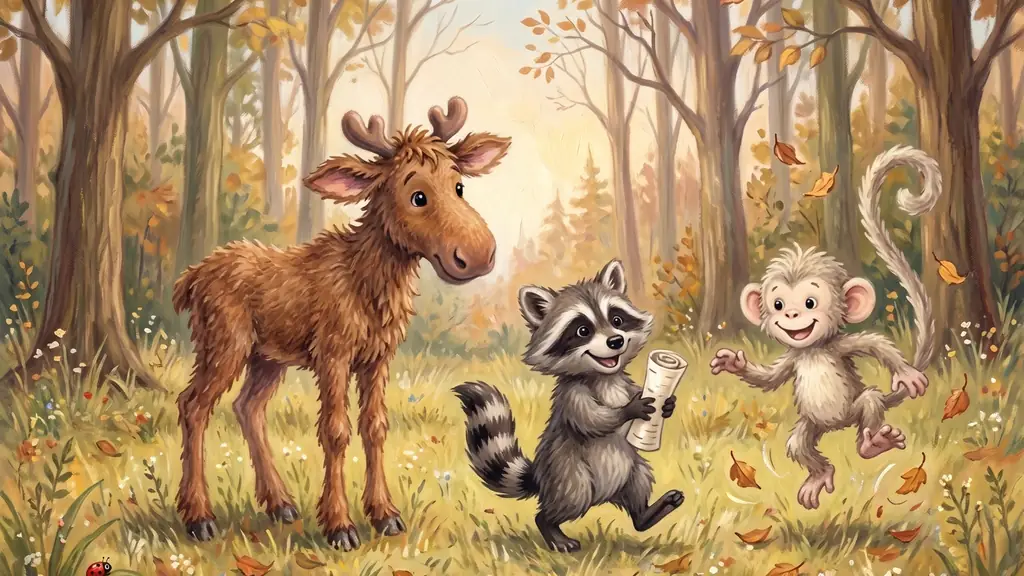
Mr. Monkey’s tail shot straight up. “What’s a Present Swap?”
“Everybody brings a present,” said Ricky, “and everybody gets a present.”
“Everybody GETS a present?” Mr. Monkey hopped up and down so fast that the leaves around him hopped too. “What am I going to get? What am I going to get? Mr. Moose, what are YOU going to get?”
“I don’t know,” said Mr. Moose. He looked at the bark roll. “How does it work?”
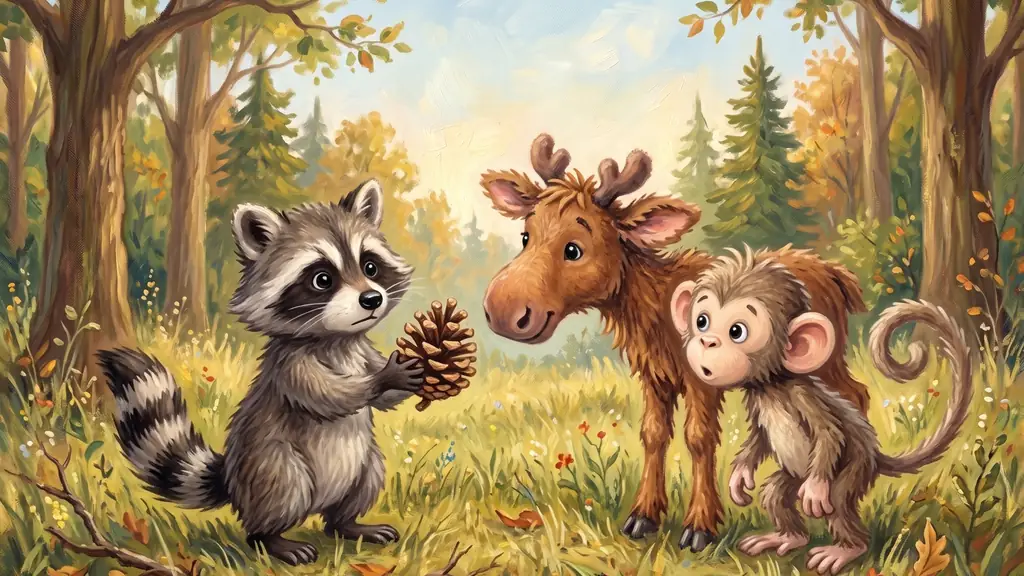
“Rules,” said Ricky proudly. “I made rules.” He unrolled the bark a little. “Rule one. Everybody brings one present. Rule two. All the presents have to be the same size, so it’s fair.”
“How big?” asked Mr. Moose.
Ricky picked up a pinecone from the grass. “This big.”
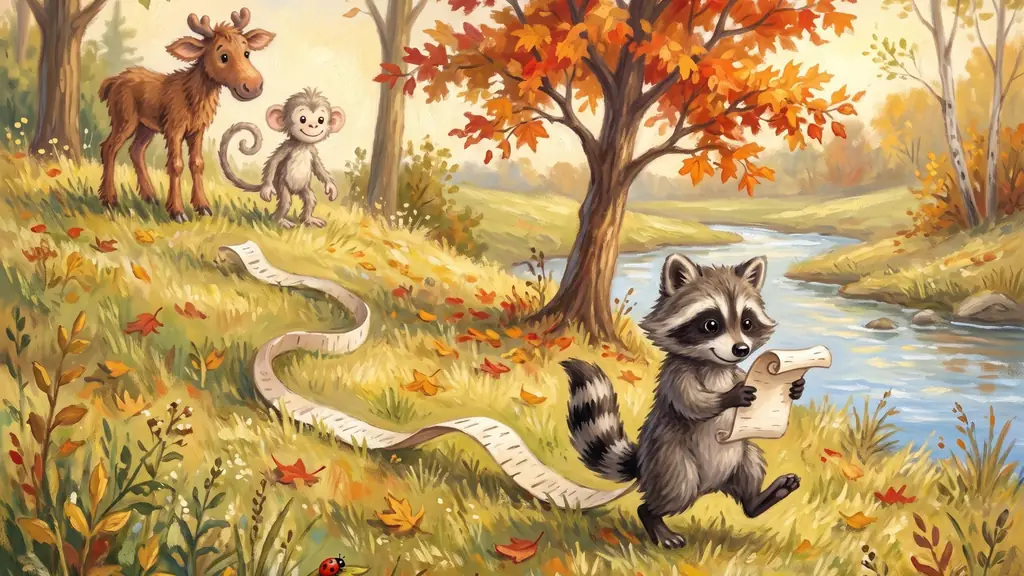
He unrolled the bark a little more. “Rule three. Everybody makes a wish list, so everybody knows what to bring. Rule four. Nobody gets left out.”
He kept unrolling and walking backward, reading as he went. “Rule nine. No presents that are alive. Rule twelve. No presents that are wet. Rule fifteen. No presents that are Bruno.”
“Why not Bruno?” asked Mr. Monkey.
“He won’t fit in the pile,” said Ricky. “Rule sixteen…”
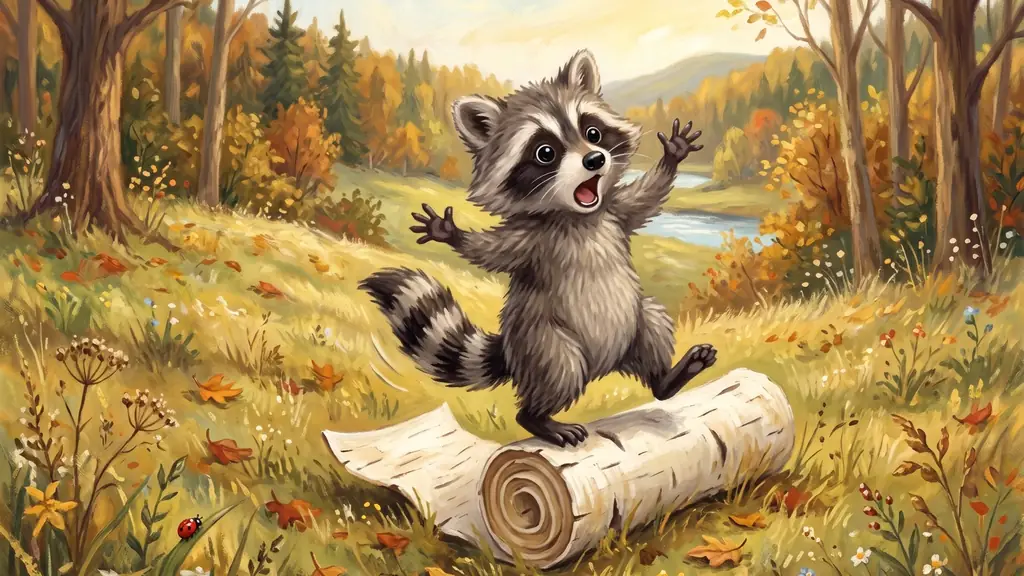
The bark unrolled across the grass, past the maple, and down the little hill toward Rainbow River. Ricky followed it, walking backward and reading. “Rule nineteen. Rule twenty…”
Then Ricky stepped backward right onto the rolled-up part.
It rolled.
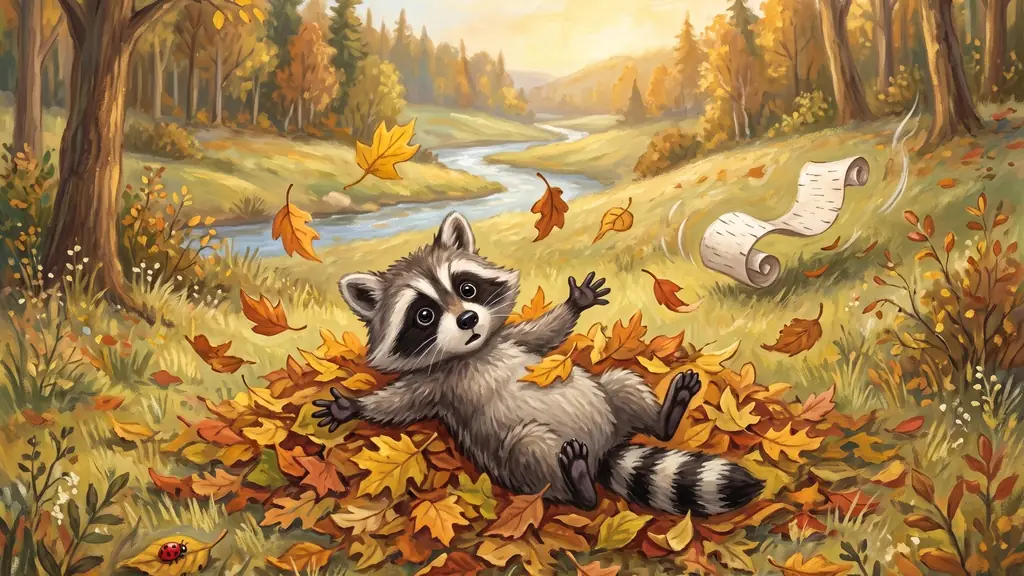
Ricky’s feet went round and round on top of it, like a squirrel on a log. “Whoa-whoa-whoa-WHOA!” He spun his arms. He wobbled. Then the roll shot out from under him, and Ricky landed, PLOOMF, flat on his back in Mr. Moose’s leaf pile.
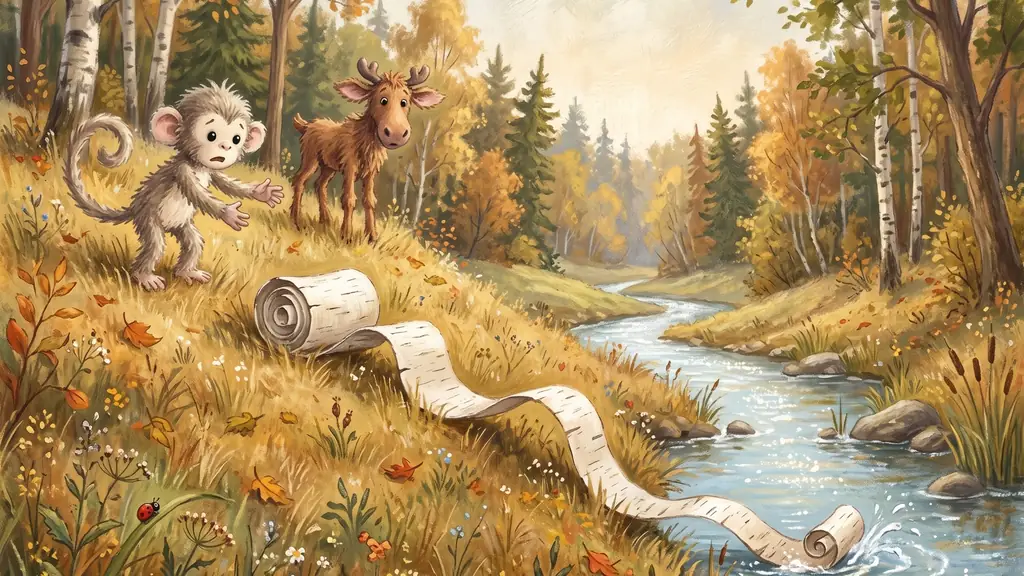
And the bark roll kept going. It rolled down the hill, faster and faster, unrolling as it went, and splish, slid right into Rainbow River.
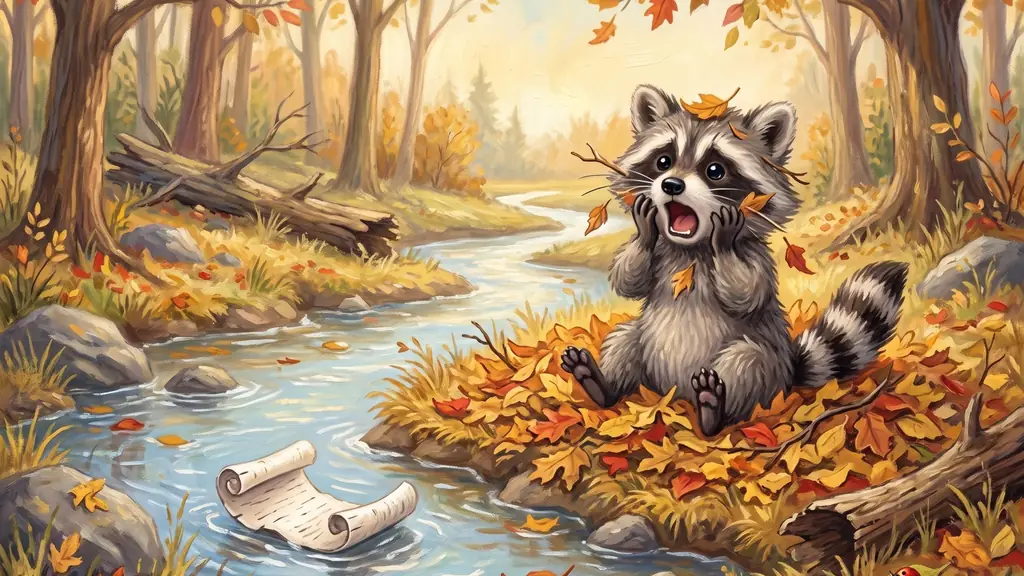
Ricky sat up with leaves in his whiskers. “My RULES!”
The roll was floating away down the river, bobbing along like a little white boat.
Mr. Monkey felt his chest go tight. Ricky had worked all morning on those rules. You could tell from the berry juice. He didn’t want Ricky to lose them. “We have to get it back!” he said, already running.
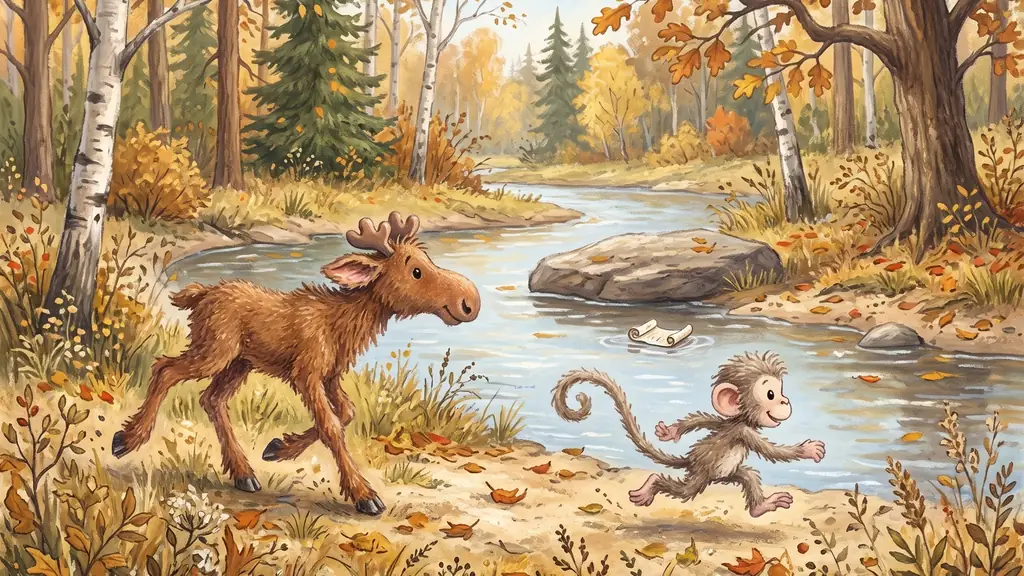
Mr. Moose ran too, slower, with his long legs. He watched the roll bob along. He knew this part of the river. “Mr. Monkey,” he said, “the river bends right up there, by the big flat rock. It gets slow and shallow. Everything that floats goes around that bend.”
“So we beat it there!”
“We beat it there,” said Mr. Moose.
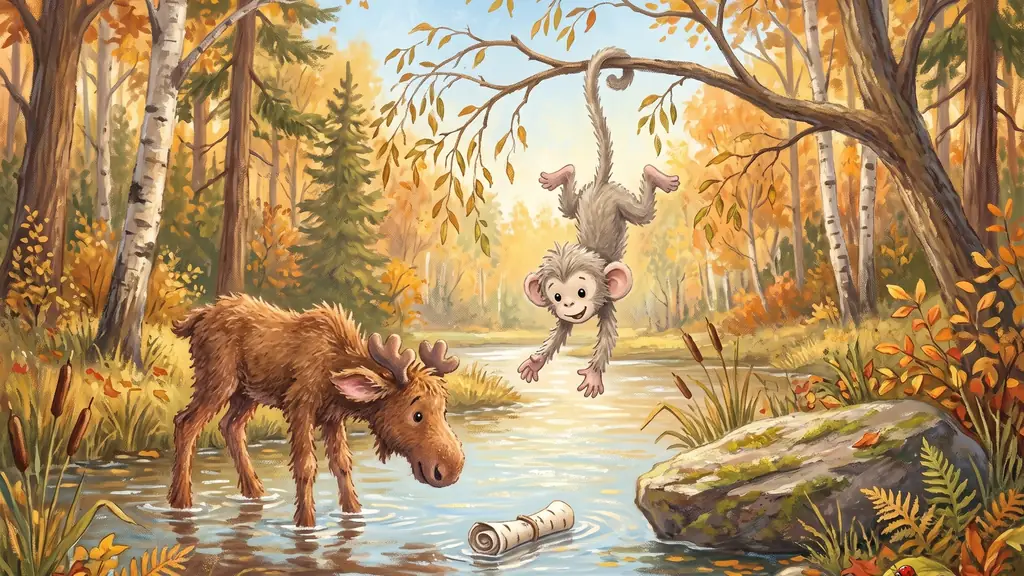
They ran along the bank, past the bend, to the big flat rock. Mr. Moose waded into the shallow water, where it was cool and only came up to his knees. He lowered his head and spread his antlers wide, like a net.
Mr. Monkey climbed out onto a low willow branch over the water, wrapped his tail around it, and hung upside down, just in case.
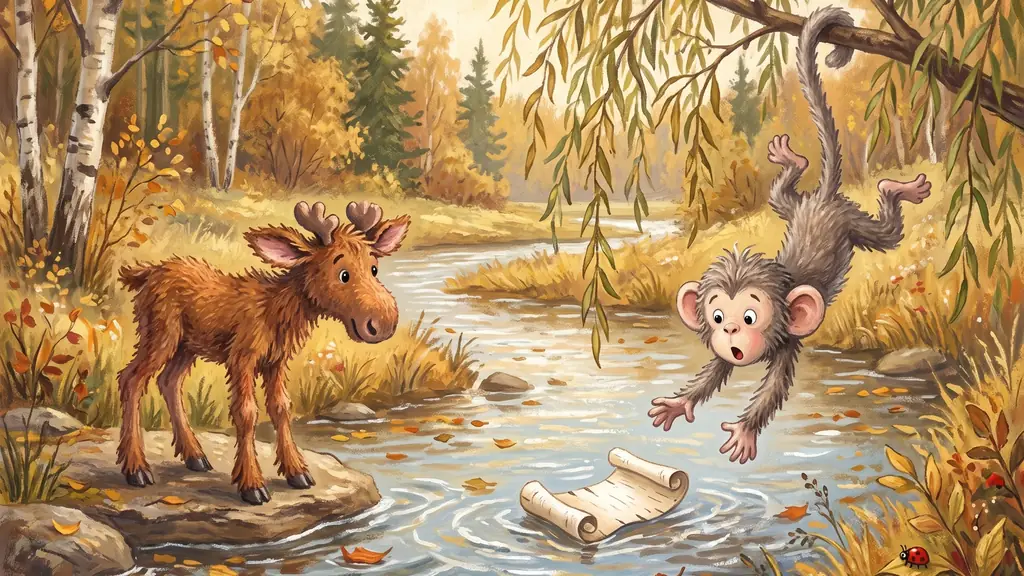
Here came the bark roll, bobbing and turning. It floated right past Mr. Monkey’s paws. He stretched. He reached. He missed. “Mr. Moose! It’s coming to you!”
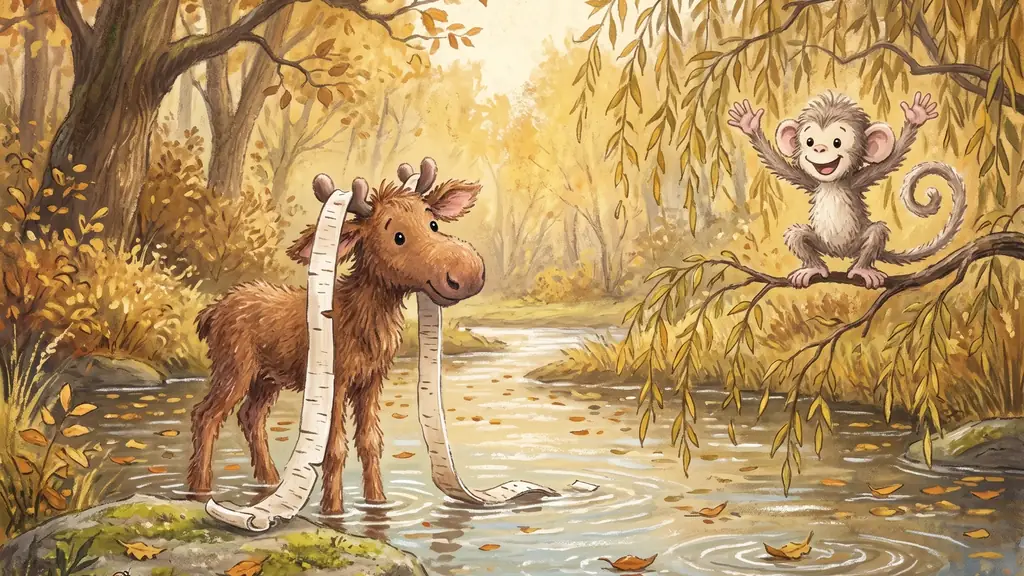
The roll bumped into Mr. Moose’s antlers and stopped. The bark hung down on both sides of his head, long and dripping, all the way into the water, like the world’s biggest, wettest scarf.
“I got it,” said Mr. Moose.
Ricky came running down the bank. “You saved my rules!” He looked up at Mr. Moose’s antlers, and his eyes went wide. “And I can still read them!”
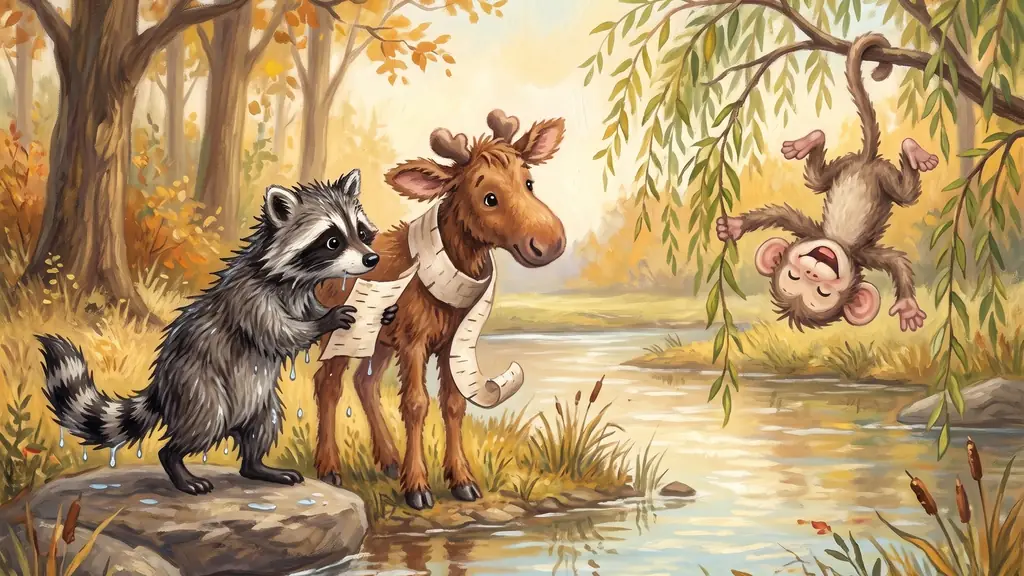
So Ricky walked around and around Mr. Moose, reading the rules off his antlers. “Rule twenty-two. No peeking. Rule twenty-three…” Mr. Moose turned slowly to help, and Ricky walked faster to keep up, and Mr. Monkey hung from the willow, watching them go around and around.
“Hee hee hee!” went Mr. Monkey. “Mr. Moose, you’re a rule tree!”
“Ha-ha-ha!” Mr. Moose laughed so his antlers jiggled, and the rules jiggled with them.
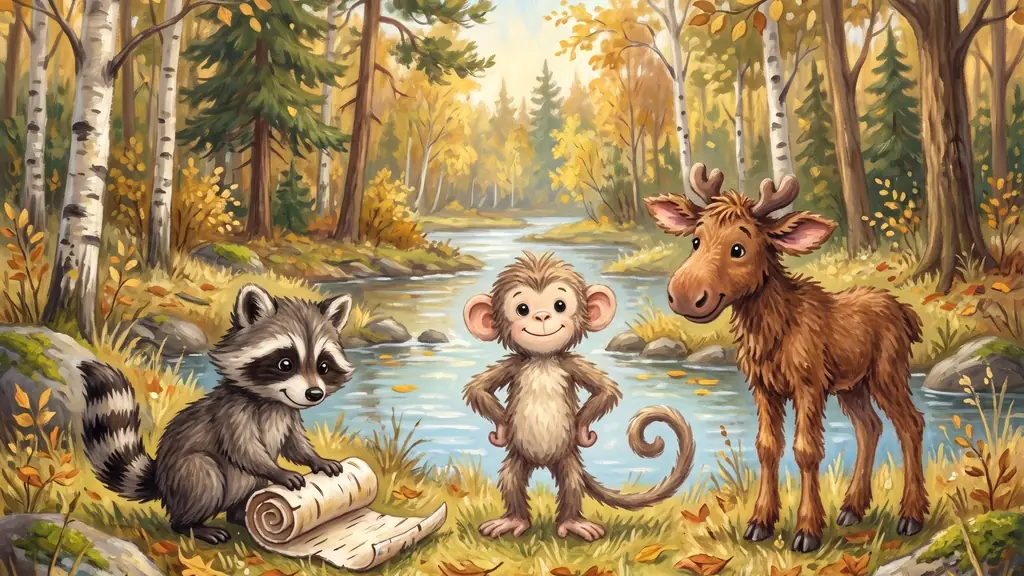
When the bark was dry enough, Ricky rolled it up again, very carefully. “Now I need helpers,” he said. “Everybody in the woods has to sign up by Sunday, so there’s time to make the presents. You two can be my Official Sign-Up Helpers.”
“Official,” whispered Mr. Monkey, very pleased.
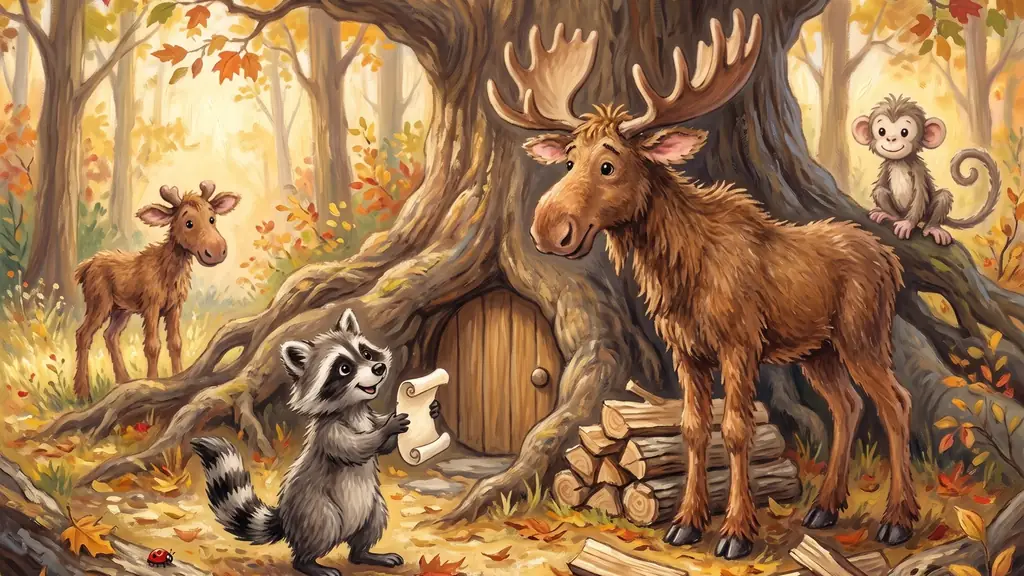
They started at the big maple. Daddy Moose was stacking firewood by the door.
“What do you wish for, Daddy Moose?” asked Ricky. “For your present.”
Daddy Moose thought for a long, slow time. “Hmm,” he said. “I have everything I need.”
“You have to want SOMETHING,” said Ricky.
Daddy Moose thought some more. “Then I’d like nothing.”
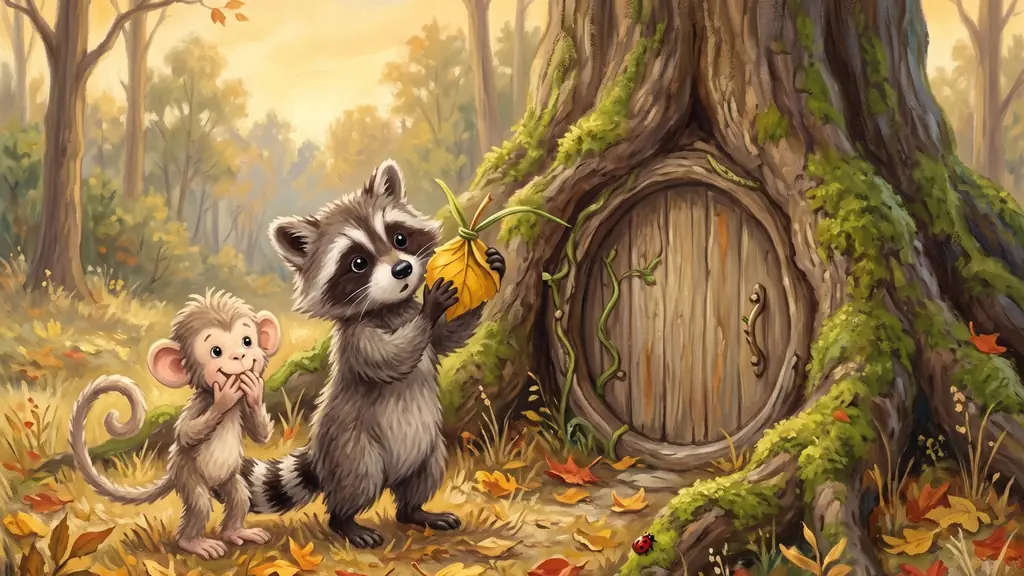
Ricky wrote NOTHING on the bark. Then he scratched his head. “How do you wrap nothing?”
He picked up a big yellow leaf, folded it around nothing at all, and tied it with a long piece of grass. He shook it next to his ear. Nothing. He handed it to Daddy Moose. “Here’s your nothing. That’s just a practice one.”
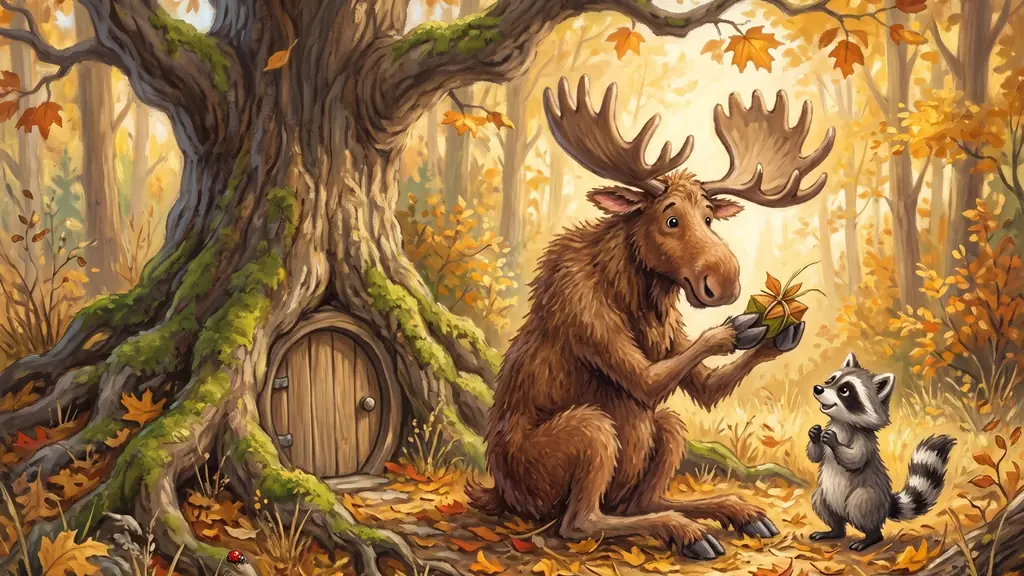
Daddy Moose held it up and looked at it very seriously. “It’s just what I wanted.”
“Hee hee hee!” went Mr. Monkey.
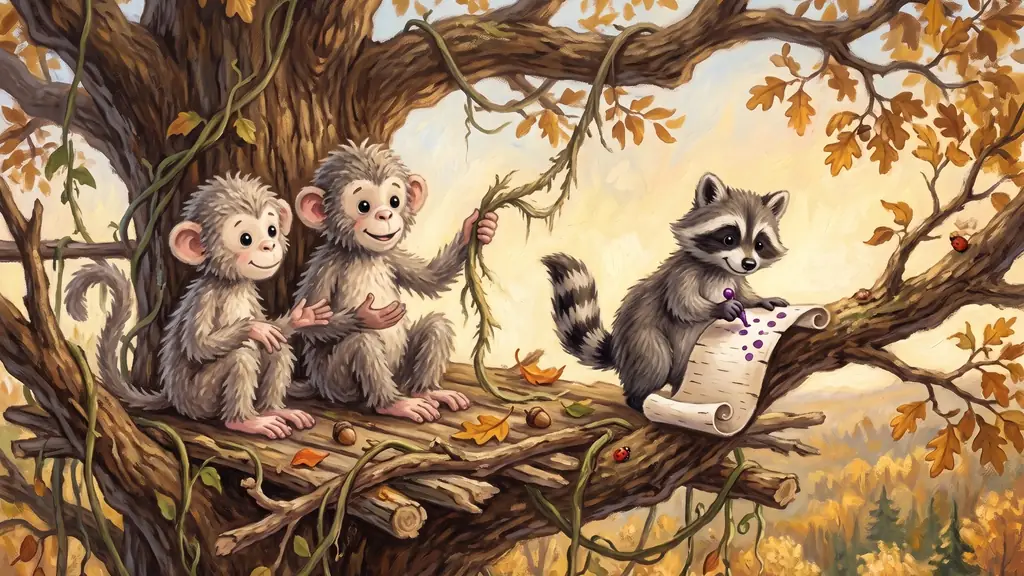
Up in the treehouse, Mama Monkey wished for “one whole day with everybody together.” Ricky wrote it down with a question mark. Daddy Monkey wished for a new swinging vine, because his old one was getting fuzzy. Ricky was so happy to get a real thing that he wrote it twice.
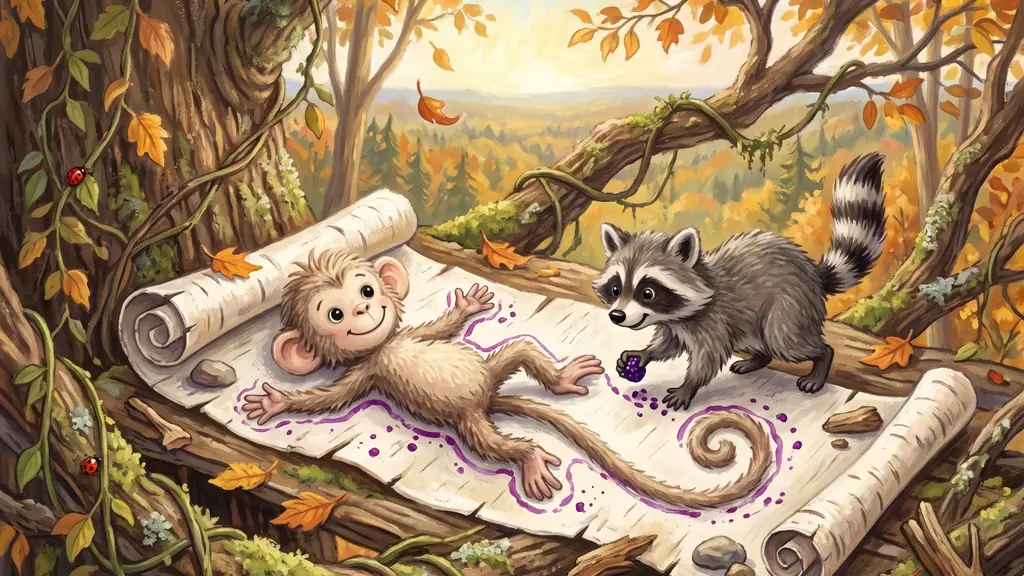
Then it was Mr. Monkey’s turn. “I want a banana,” he said. “A banana as big as ME.”
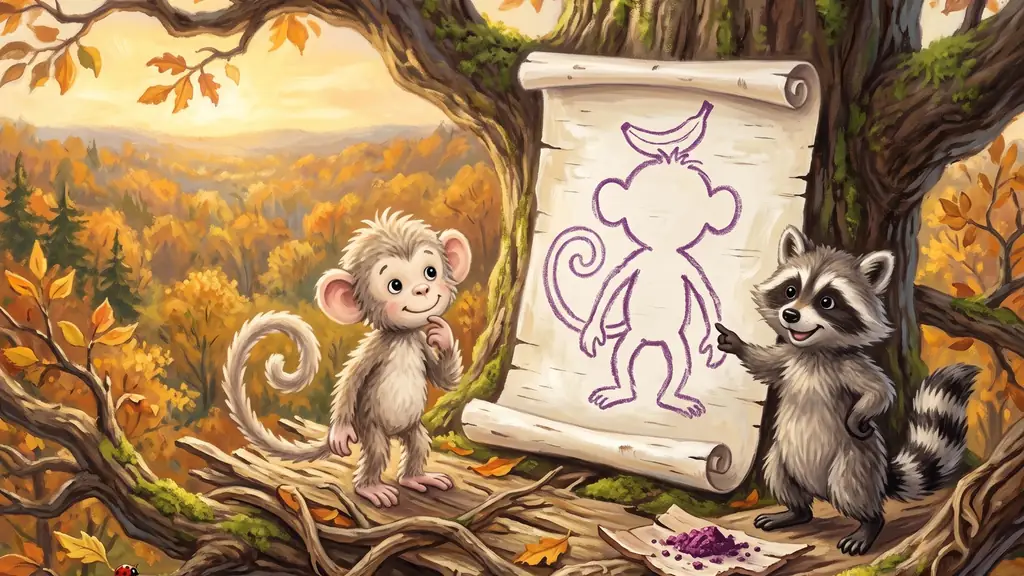
He lay down flat on the bark to show how big. Ricky traced all the way around him with a berry, ears and tail and all. When Mr. Monkey stood up, there was a Mr. Monkey-shaped banana on the list.
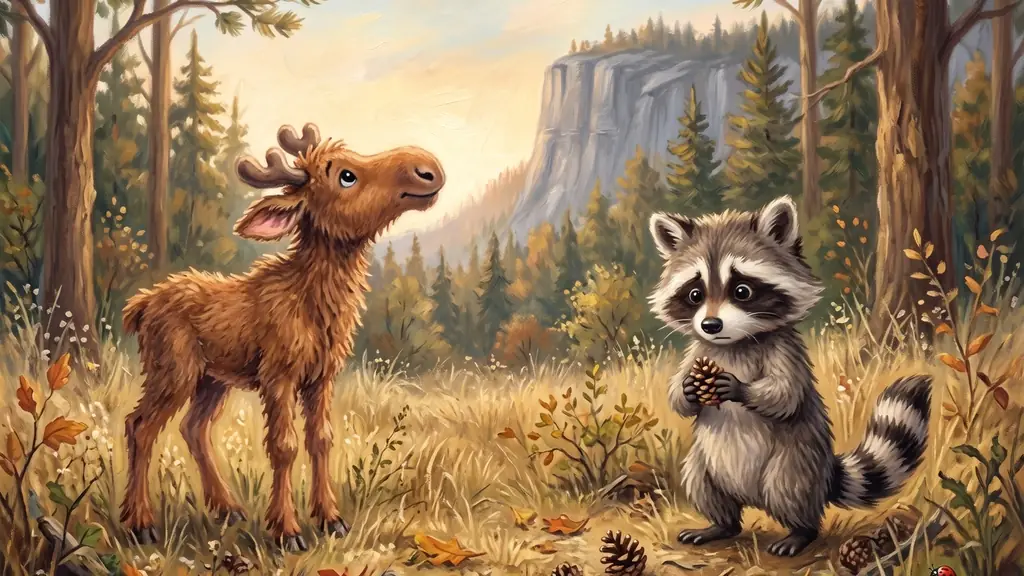
“And you, Mr. Moose?” asked Ricky.
Mr. Moose looked up past the treetops, past Lookout Ledge, to the high gray cliff where Everest Eagle lived. “I want to see the very top of Everest’s cliff,” he said. “The highest place in the whole woods.”
Ricky looked at the cliff. He looked at his pinecone. “You can’t wrap a cliff,” he said.
“I know,” said Mr. Moose. But it was still his wish.
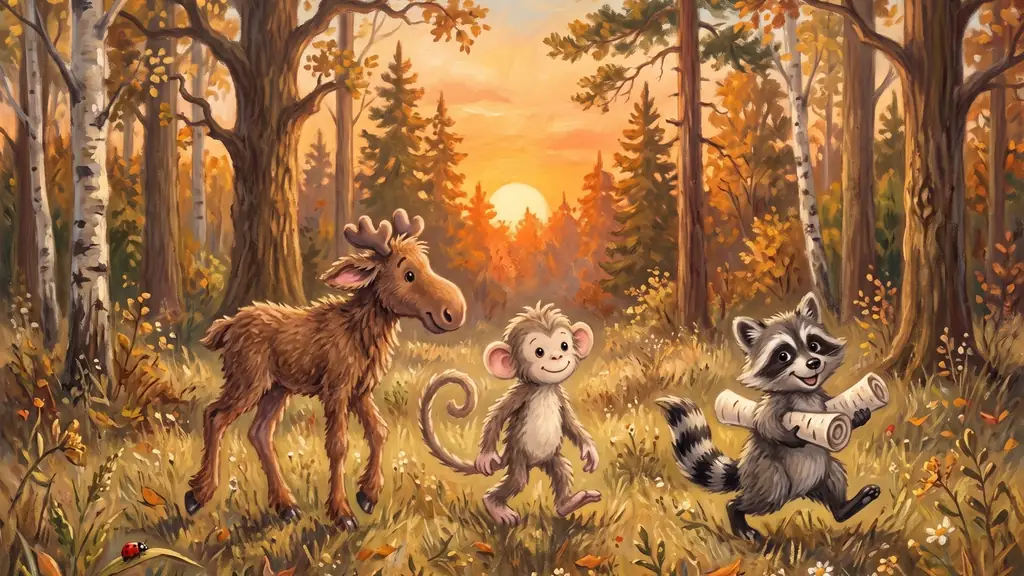
As the sun went down, they walked back across Sunny Square. Ricky counted the names on his bark. “Seven,” he said. “Only the whole rest of the woods to go.” He hurried home with his roll under his arm.
Mr. Monkey skipped beside Mr. Moose. “What do you think I’ll get? What do you think I’ll get?”
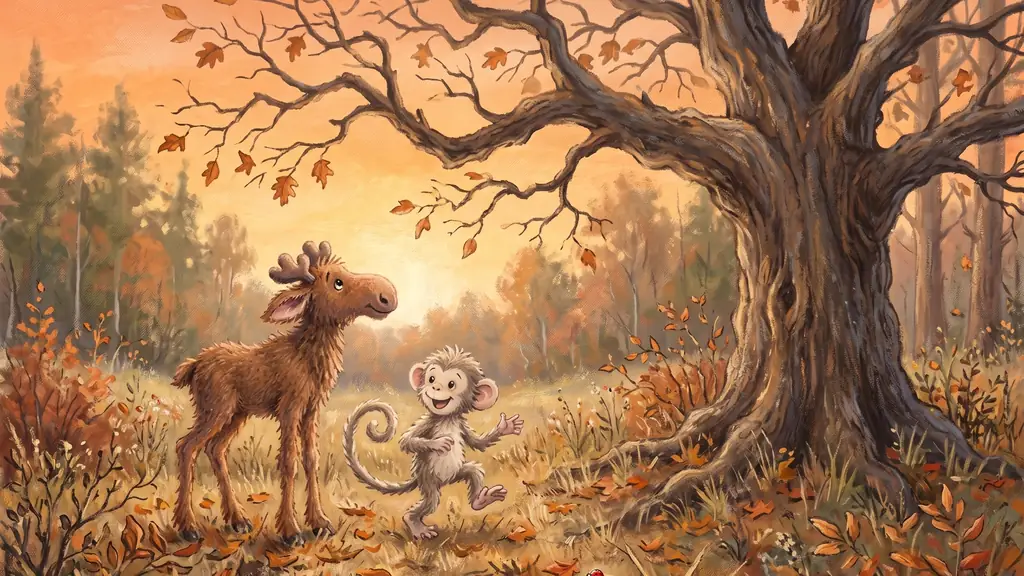
Mr. Moose didn’t answer right away. He was looking up at the maple, at all the branches that were almost bare.
“What a day!” said Mr. Monkey. “I had a leaf face. Ricky’s rules rolled into the river, and Mr. Moose caught them on his antlers. Daddy Moose wished for nothing, and he got it! And at the Thankful Feast, there’s going to be a Great Big Present Swap!”
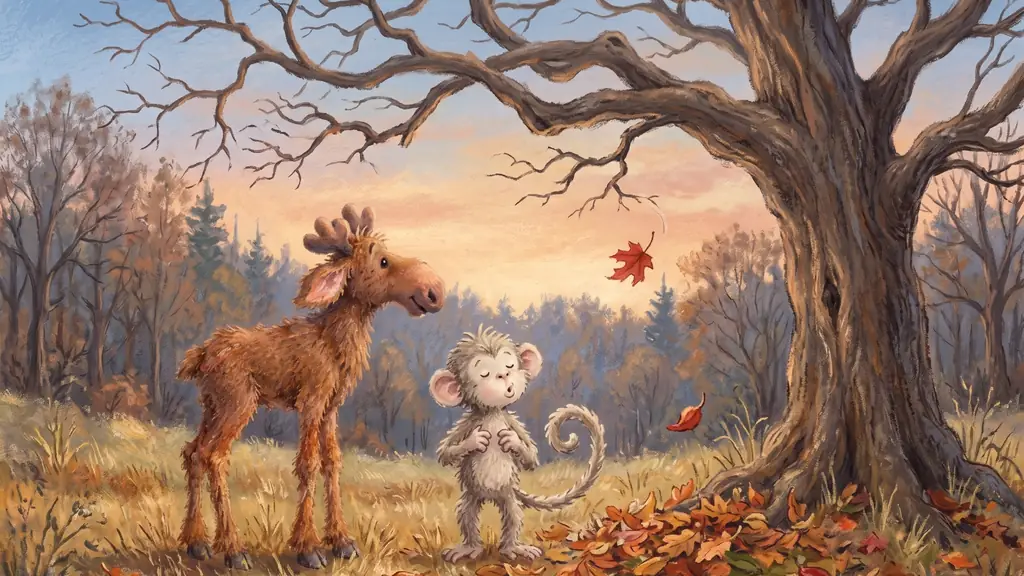
Mr. Monkey whistled, and Mr. Moose hummed, and together they sang:
We are better together,
Moose and Monkey forever.
And above Sunny Square, one more red leaf let go of the maple and twirled slowly down into the leaf pile.