Who in this house made my life better this year?
Suppose a nine-year-old named Ellie is writing a Core leaf for her dad. Her first try says, "Thank you for helping me with my bike. Love, Ellie."
Her mom reads it over her shoulder and asks her to try once more. "What did Dad actually do? And what can you do now that you couldn't before?"
Ellie thinks for a minute. Then she writes, "Thank you, Dad, for making my life better. You ran next to my bike up and down the street until your face turned red. A year ago I fell every time. Now I can ride all the way to Grace's house by myself. Love, Ellie."
Her mom reads it again and decides not to say anything about the spelling. She's thinking about how many thank-you notes she has written that sounded like the first one, and how few sounded like the second.
Why write a note at all? A thank-you that stays in your head hasn't done its job yet. Thinking "thanks" is closer to feeling grateful than to actually giving thanks, and writing it down is what turns a private feeling into a gift headed back the other direction. It also leaves a record. A year from now this note will still exist, and so will the memory of what it said.
Every note this week has the same two sides, on purpose.
The front carries the name. Just the person's name, big enough to read from across the room. If it's a photo leaf, the photo is the front.
The back carries the thanks. Start with this week's line, "Thank you, ___, for making my life better." Then, in plain words, say what got better and what they did. Monday's journal already has both, in the What line and the How line.
When the leaf goes up, the back faces the wall. The tree is public, and the words stay private until Thanksgiving morning, when each person takes down the leaves with their name on the front and the family reads them out loud together.
None of this has to be perfect, either. Ellie's second note was better because she put on her Gratitude Glasses: she added one true detail and what changed. That's the whole skill.
Today is the Core circle: each person writes leaves for the other people who live in their home.
Start with the name on the front, or use a photo of that person as the front.
Turn it over and write, "Thank you, ___, for making my life better." Then write what got better and what they did.
In a household of four, that's usually three leaves each, one for every other person. In a household of six or more, draw names or split them up so each person writes about three.
Write all the Core leaves before hanging any. Then everyone hangs theirs together.
Tape them to the trunk with the writing facing the wall and the name facing out.
Write from the journal entries and photos you gathered on Monday. There's no need to start from scratch.
Kids' story: read "Thanks for Being Nice" from The Thank-You Adventure in Wanderful Woods together.
Time: 20 to 30 minutes for the writing, 5 for the hanging.
With younger kids: they can tell an adult what to write, or draw a picture on the back and add a word. A drawing on the back counts.
If someone is stuck: start them with "Thank you, ___, for making my life better," then ask, "What's one thing they did?"
If someone in the house doesn't want to take part: invite them, then let it go. You can still write a leaf thanking them.
If a note comes out too general: ask, "What's one time you saw them do this?"
Tone: thanks only. Leave out anything that sounds like a review or a list of what someone could do better.
Hello, my wonderful story friends! Last time, the whole woods ate dessert first at the Backward Feast, and everybody said their thank-yous out loud. Now it’s time to put the thank-yous on the Wishing Tree.
When you say thank you to somebody, what do you say? Let’s go paint some leaves.
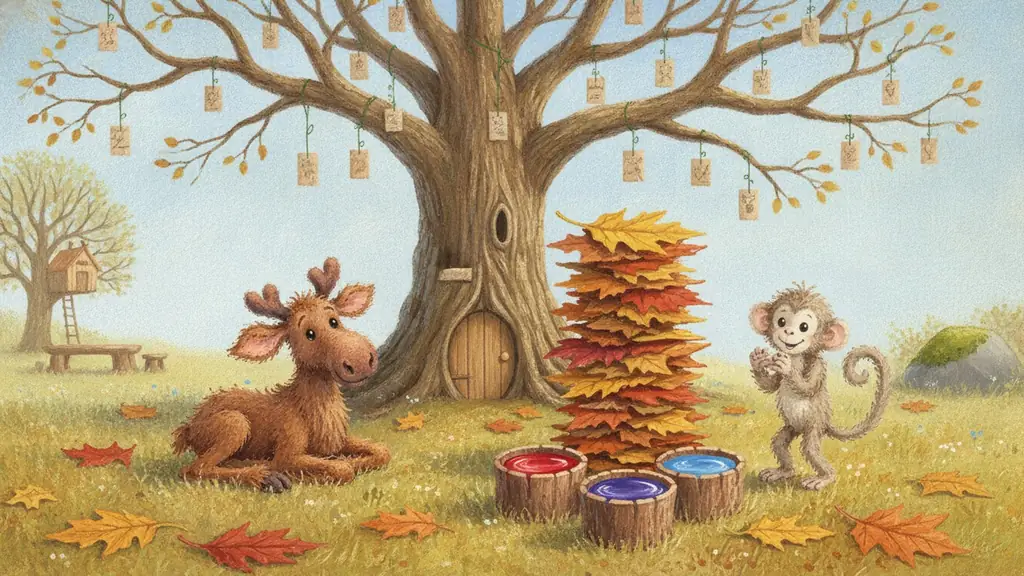
The morning was cold and clear, and the sky over Sunny Square was so blue it looked freshly washed. Under the Wishing Tree, the stack of flat leaves was waiting right where Bruno had sat on it all night. Beside it sat three bowls of berry paint: red, purple, and blue.
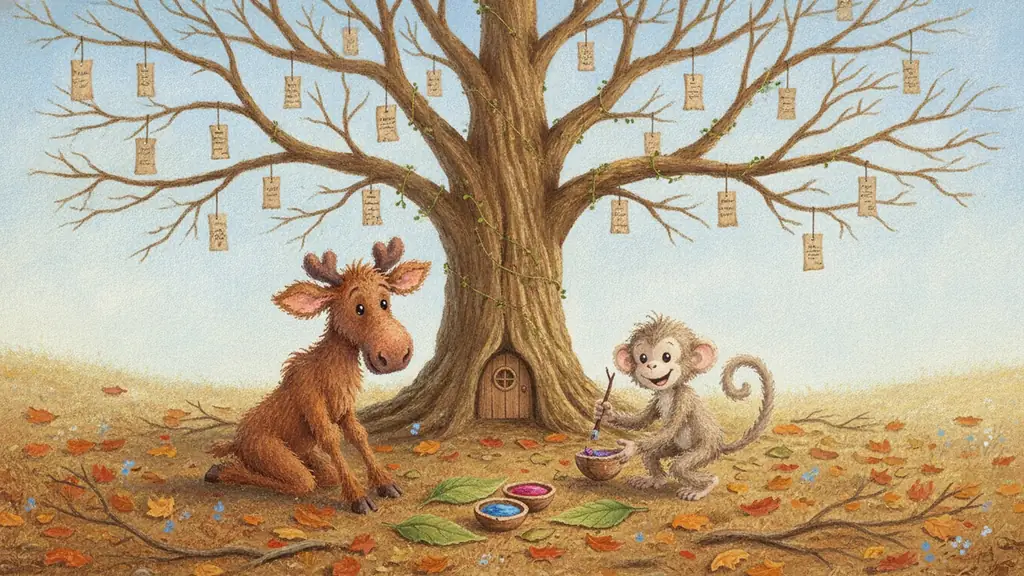
“Today,” said Mr. Moose, “is for our own homes. Our families.”
“Mama and Daddy Monkey,” said Mr. Monkey, rolling up his sleeves, even though he didn’t have sleeves. “And Mama and Daddy Moose. Let’s paint!”
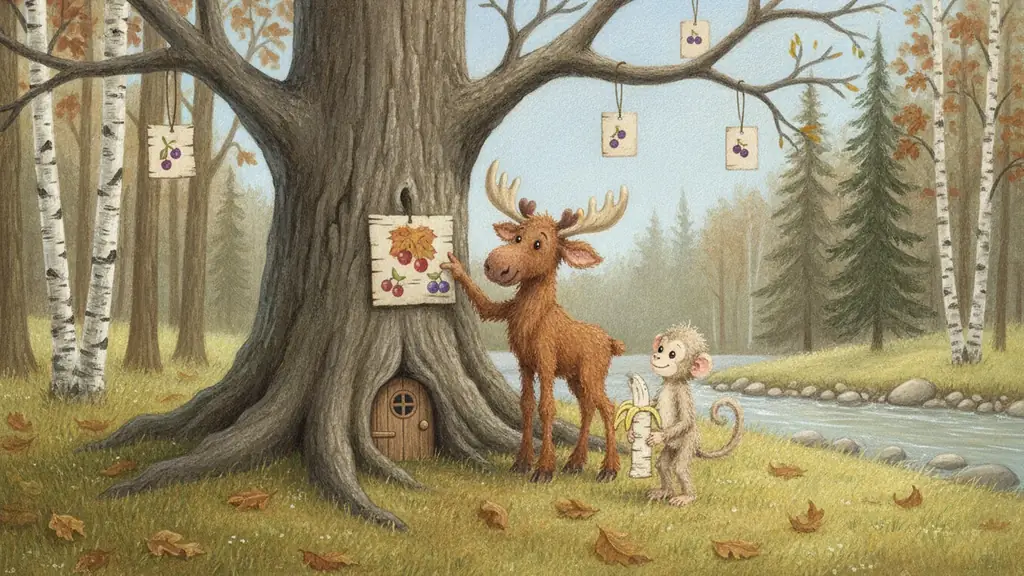
Mama Monkey had shown them how the leaves would work. On the front of the leaf, you paint who it’s for, so everybody can see. On the back, you paint the thank-you. Then you hang it on the tree with the thank-you side turned toward the trunk, so nobody can see it. “It stays a surprise,” she said, “until the Thankful Feast.”
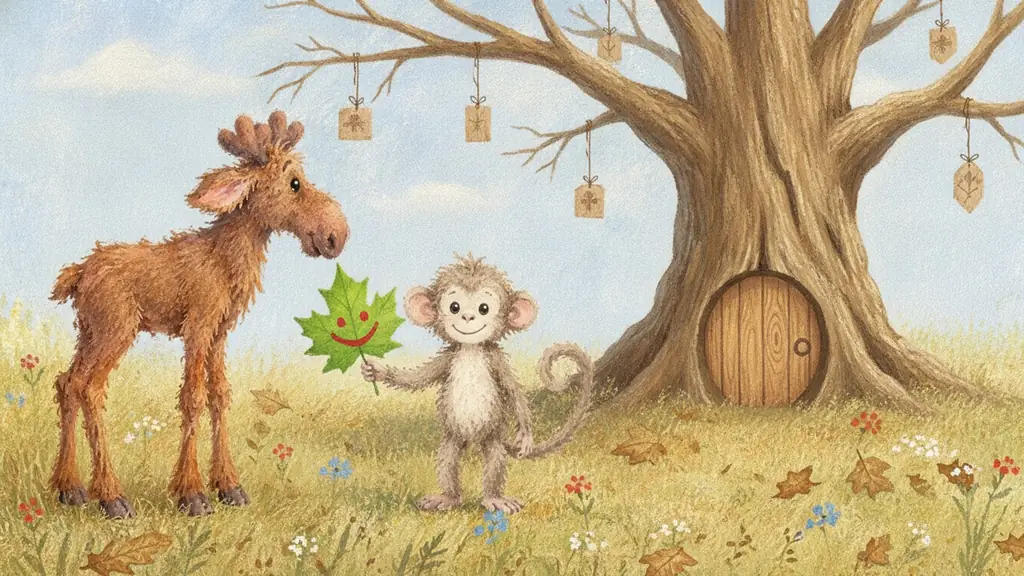
Mr. Monkey grabbed a leaf. He dipped his finger in the red paint. On the front, he painted a little monkey face with a big smile: Mama Monkey. Then he flipped it over and painted the thank-you. It took him about two seconds. A big round smiley face.
“Done!” he said. “Thanks for being nice!”
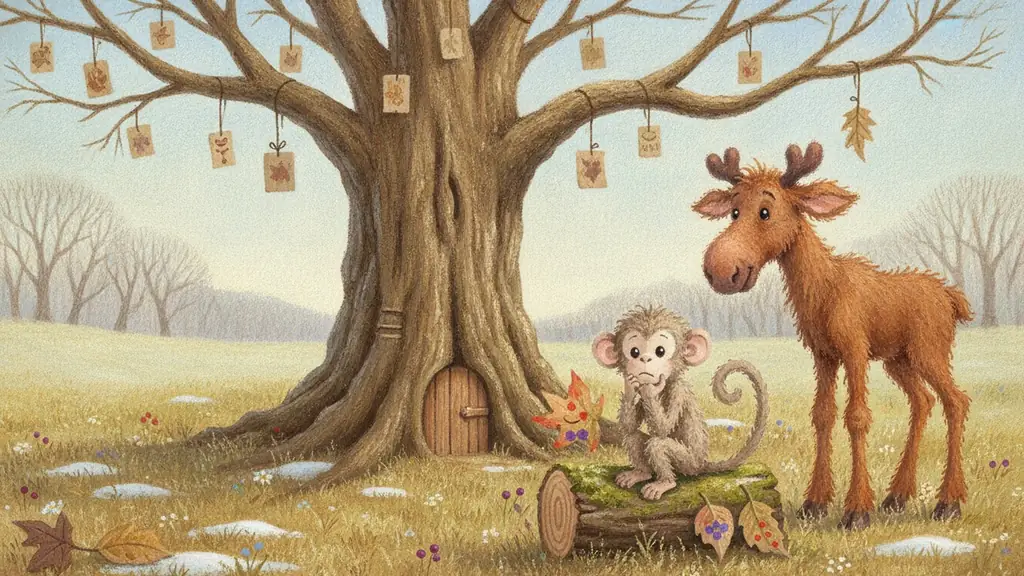
Mr. Moose looked at the smiley face. It was a very nice smiley face. “Mr. Monkey,” he said, “what did Mama Monkey actually do?”
Mr. Monkey thought. “She’s nice,” he said.
“But what did she DO?”
Mr. Monkey thought harder. Then he remembered. The high vines. The falling. Fwoop. Mama’s arms.
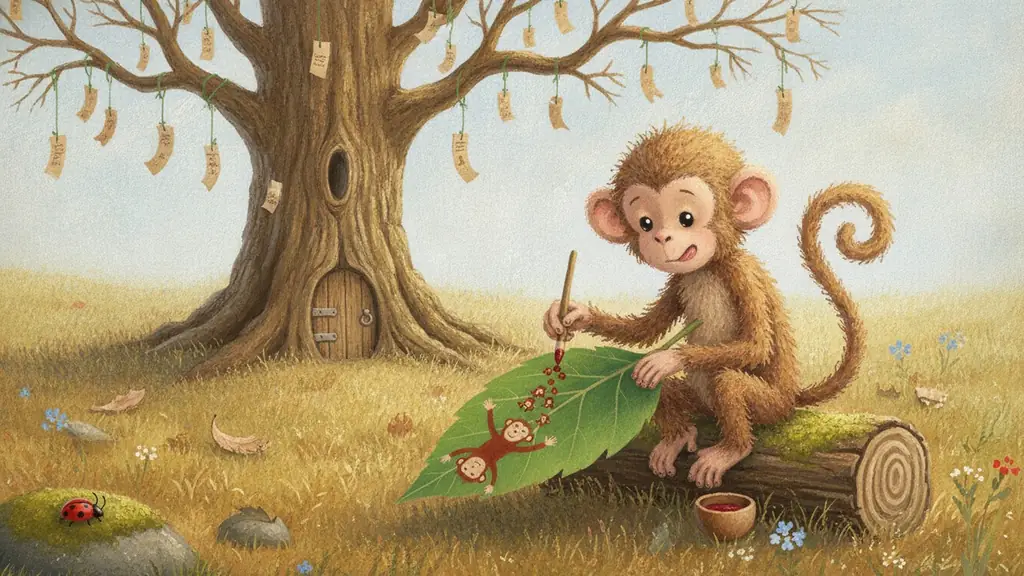
“She caught me,” he said. “A hundred and one times.”
“Then that’s what goes on the leaf,” said Mr. Moose.
Mr. Monkey grabbed a new leaf. This time, on the back, he painted the high vine, and Mama Monkey underneath it with her arms out wide. And then he started painting little Mr. Monkeys falling into her arms. One. Two. Three. Four. Five little monkeys falling…
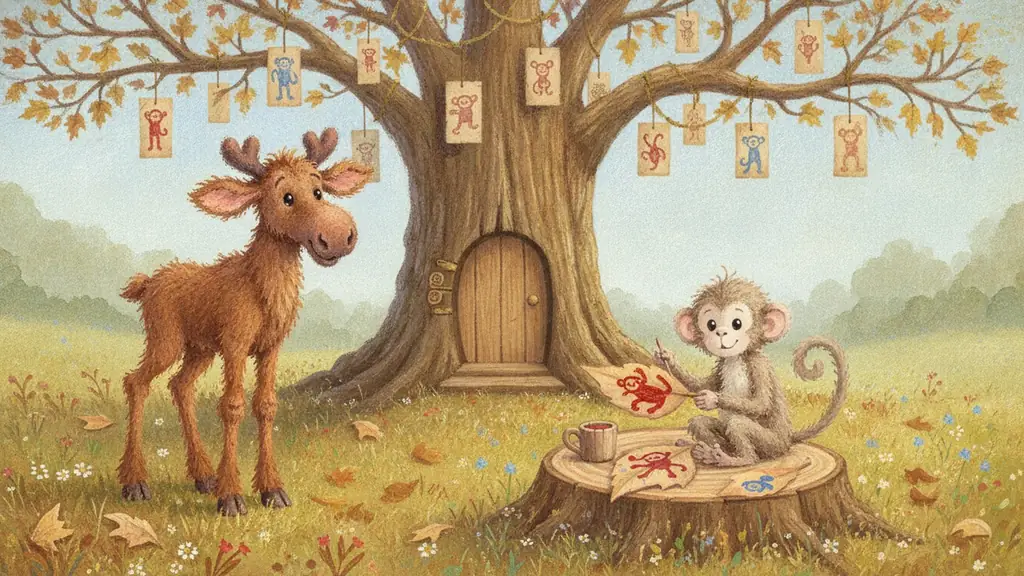
“Are you painting a hundred and one?” asked Mr. Moose.
“Yes,” said Mr. Monkey, painting very fast.
By monkey number twelve, he had run out of leaf. So he kept going on the next leaf. By monkey number twenty, he had run out of that leaf too. He looked around. He painted monkey number twenty-one on a rock. Monkey twenty-two on Mr. Moose’s hoof. Monkey twenty-three on his own tail.
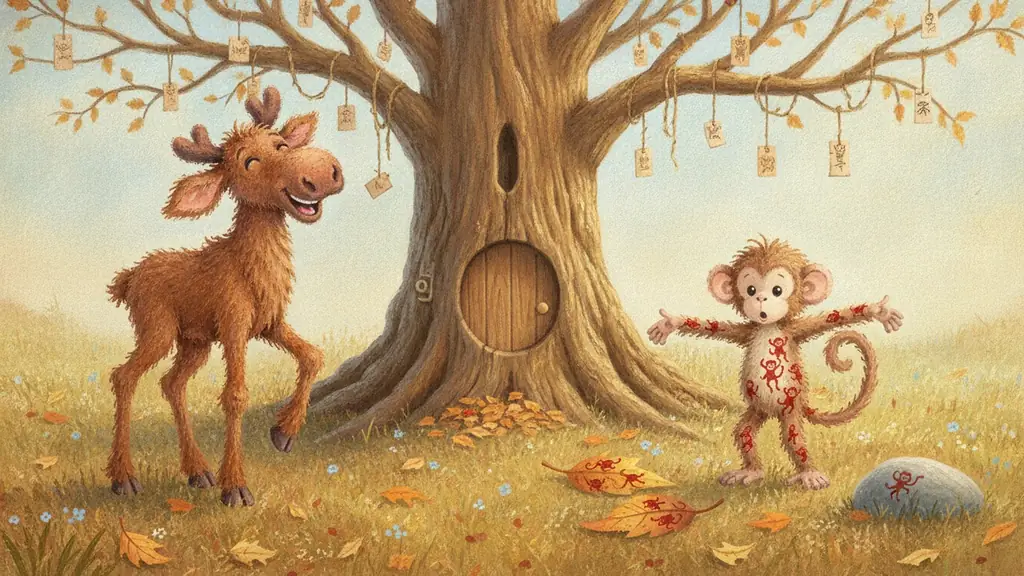
Then he looked down at himself. He was covered in tiny red monkeys.
“Mr. Moose,” he said. “I think I’m the leaf now.”
“Ha-ha-ha!” laughed Mr. Moose. “You’re a hundred and one monkeys.”
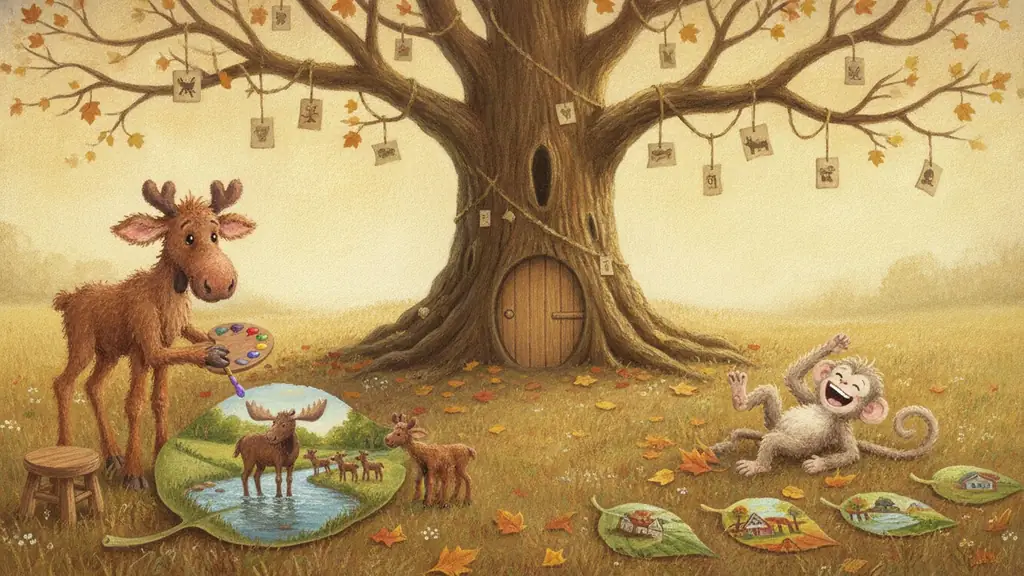
Mr. Monkey looked at his first leaf, the one with the vine and Mama and twelve falling monkeys. “Maybe twelve is enough,” he said. “She’ll know.”
Meanwhile, Mr. Moose was painting his leaf for Daddy Moose. Mr. Moose painted very slowly and very carefully. He painted the brook. He painted the skinny log. He painted Daddy Moose standing in the water. Then he started painting tiny moose calves falling off the log, one at a time, each one with very careful legs.
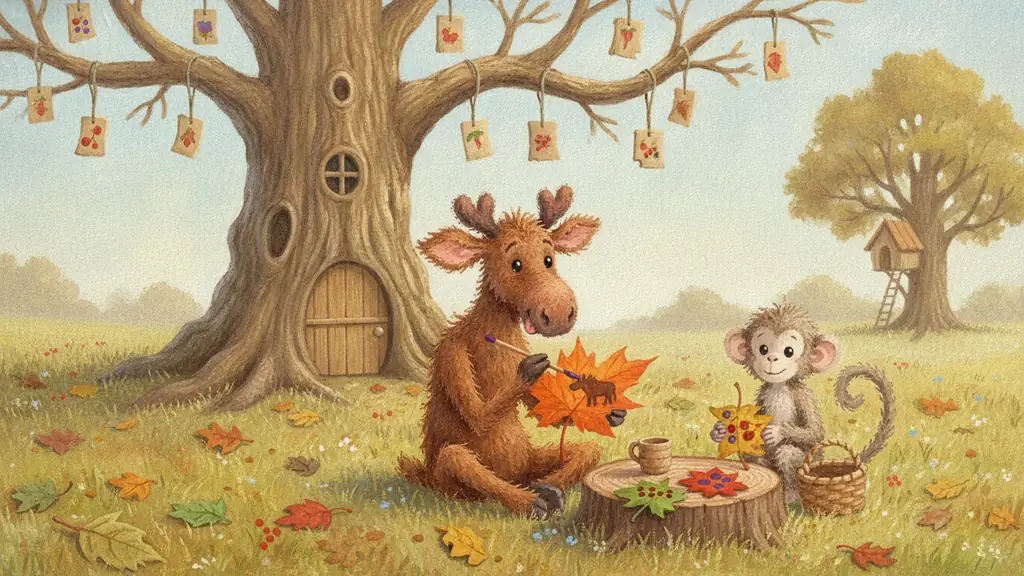
By the time Mr. Moose finished moose number three, Mr. Monkey had finished four whole leaves.
“How many are you painting?” asked Mr. Monkey.
“Twenty-two,” said Mr. Moose. “Daddy counted.”
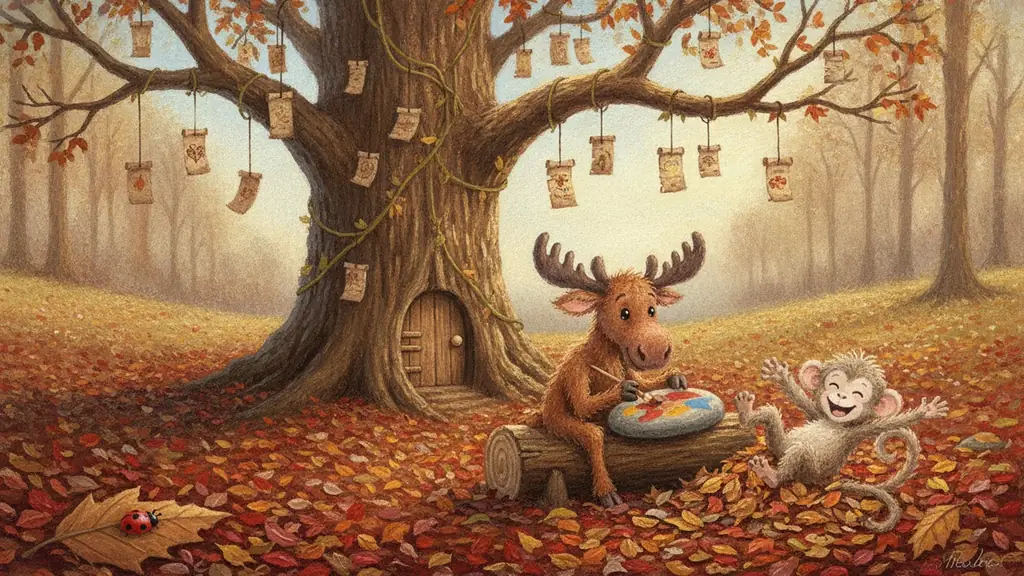
Mr. Monkey looked up at the sun, then back down at the very slow, very careful moose number four. “Mr. Moose,” he said, “we’re going to be here until the Thankful Feast.”
“Hee hee hee!” Mr. Monkey flopped onto his back in the leaves.
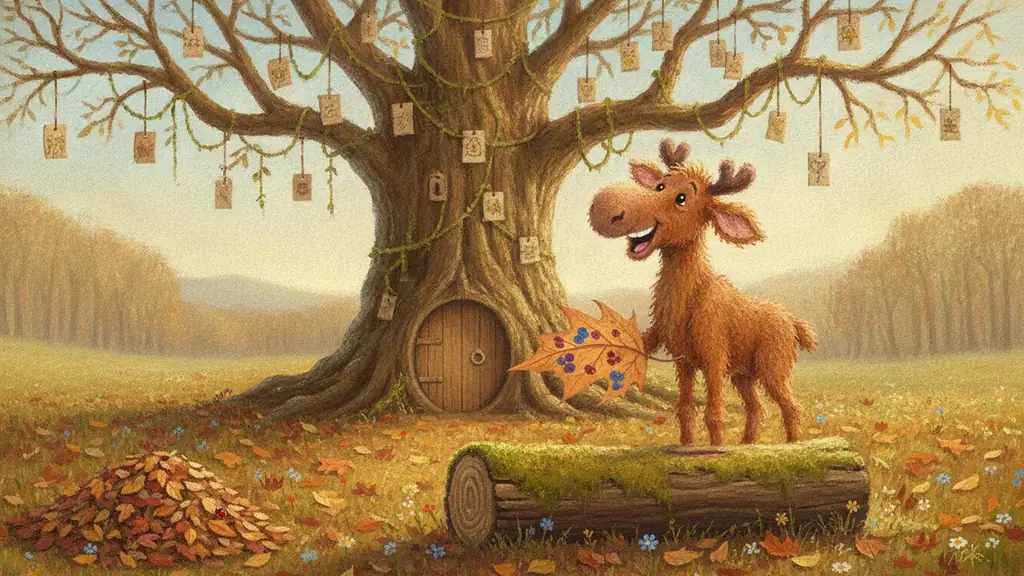
“Ha-ha-ha!” laughed Mr. Moose, and his paint hoof wobbled, and moose number four came out with an extra leg. He looked at it. “That’s okay,” he said. “That’s the day I fell in really funny.”
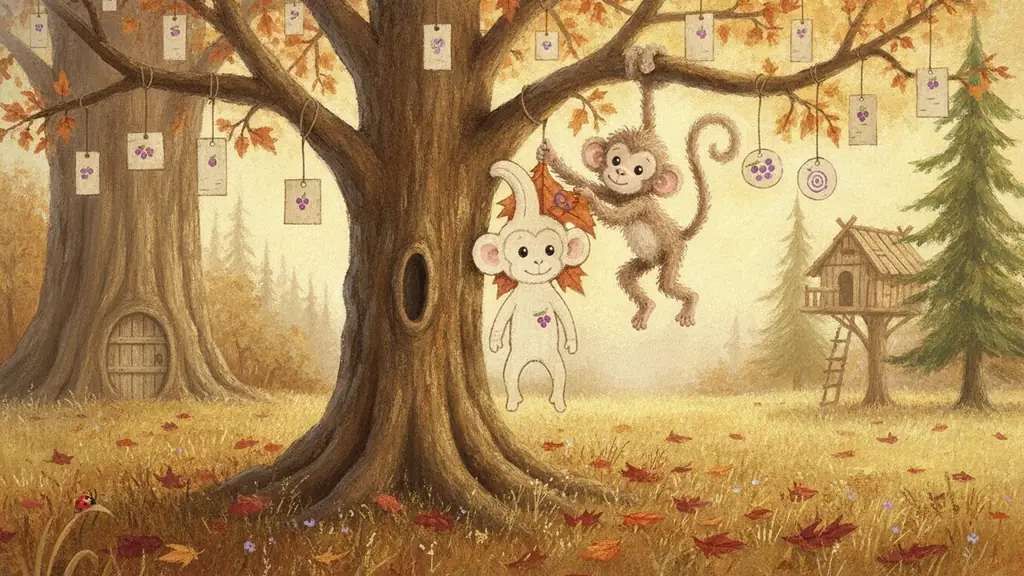
When the leaves were dry, it was time to hang them. Mr. Monkey climbed up into the Wishing Tree with a leaf in his teeth and a vine around his shoulder. He found the perfect branch, right next to his big banana wish. He hung Mama Monkey’s leaf there, with her little monkey face out and the thank-you turned toward the trunk.
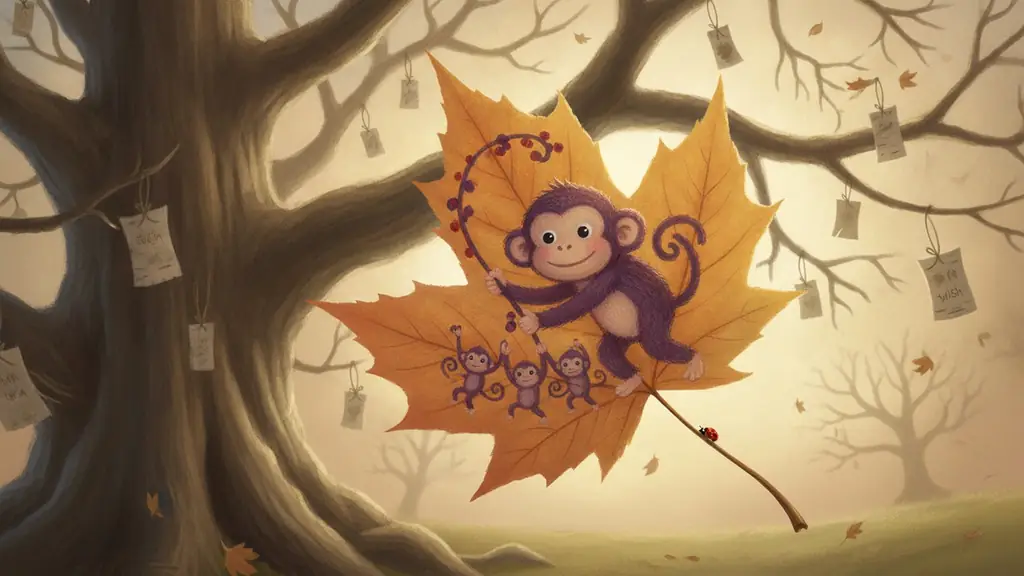
Then the wind blew.
Fwip-fwap-fwip. The leaf spun on its vine and flipped all the way around, thank-you side out, so everybody could see the twelve falling monkeys.
And right at that moment, Mama Monkey came walking across Sunny Square with her laundry basket.
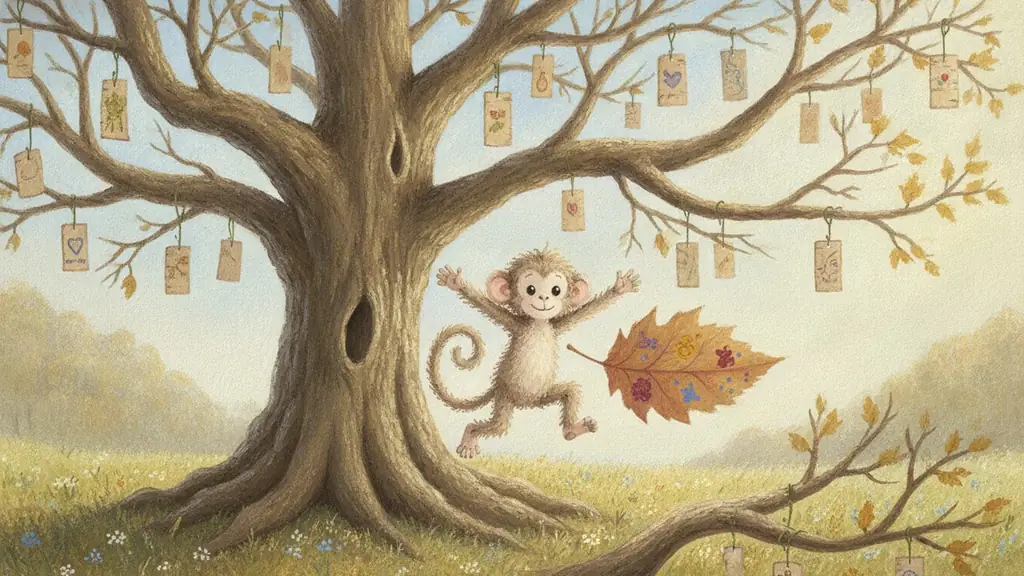
“Ack!” said Mr. Monkey. “Don’t look!” He jumped in front of the leaf and spread his arms out wide. The wind blew again, and the leaf flipped back. Then it flipped again. Mr. Monkey hopped left. He hopped right.
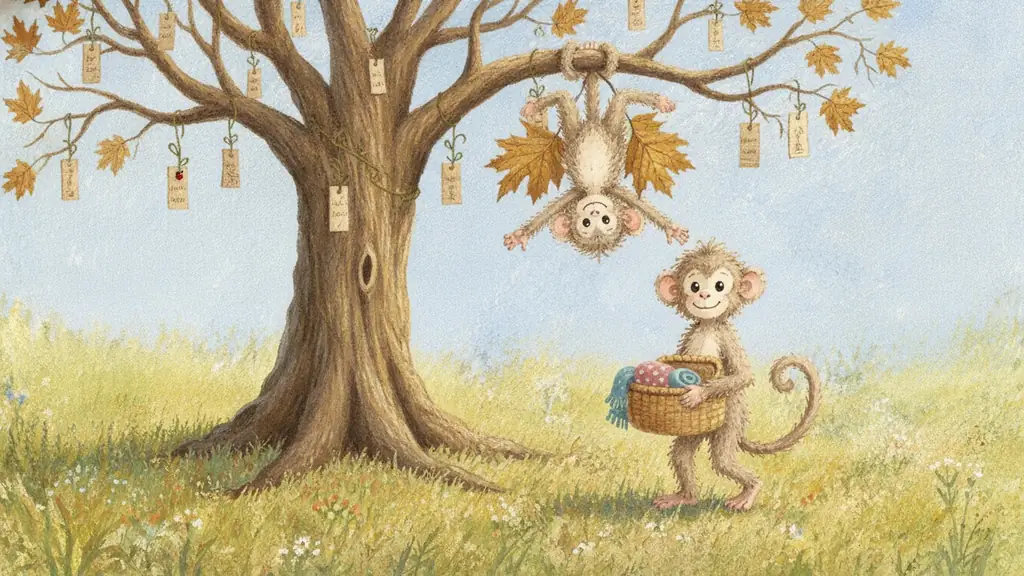
He hung upside down in front of it with his arms and legs and tail all stretched out, wiggling like a starfish, trying to cover every side at once.
Mama Monkey stopped and looked up at him. “Is there something on that branch, sweetheart?”
“Yes,” said Mr. Monkey, upside down. “It’s a secret.”
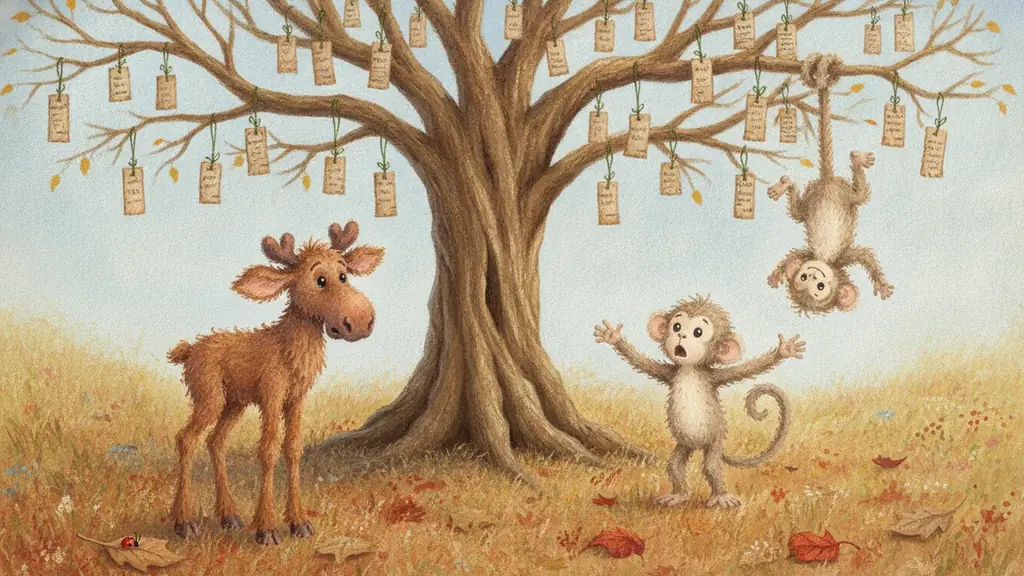
“Ha-ha!” laughed Mama Monkey, and she kept walking, very slowly, looking straight ahead the whole way, so she wouldn’t spoil it.
When she was gone, Mr. Monkey hung there with his arms still out. “Mr. Moose,” he said, “if the wind keeps flipping them, everybody’s going to see. It won’t be a surprise.”
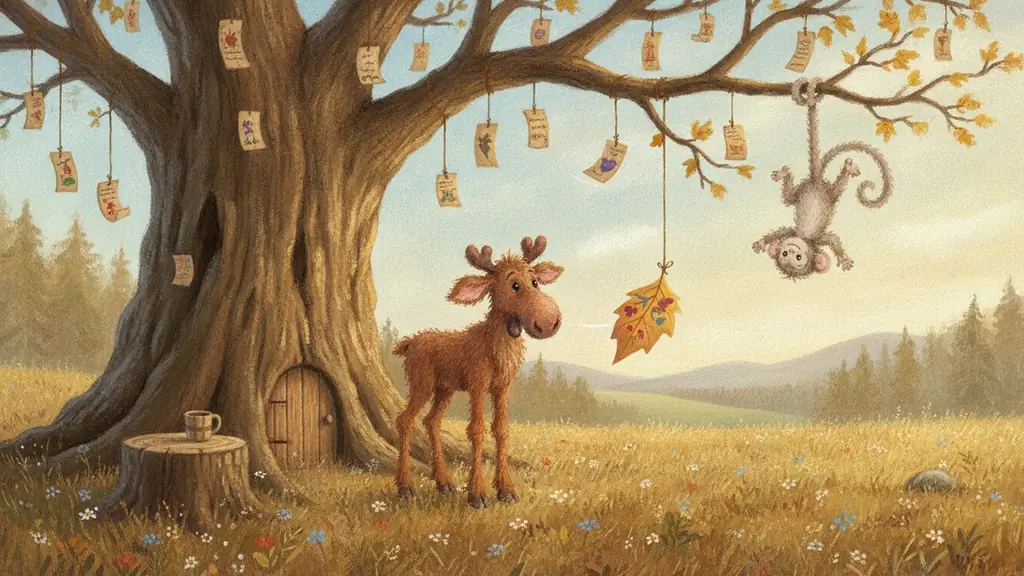
Mr. Moose looked at the leaf swinging on its single vine. One vine at the top meant it could spin all the way around, like a top. What if it couldn’t spin?
“It needs two knots,” said Mr. Moose slowly. “One at the top, and one at the bottom. Then it can’t flip.”
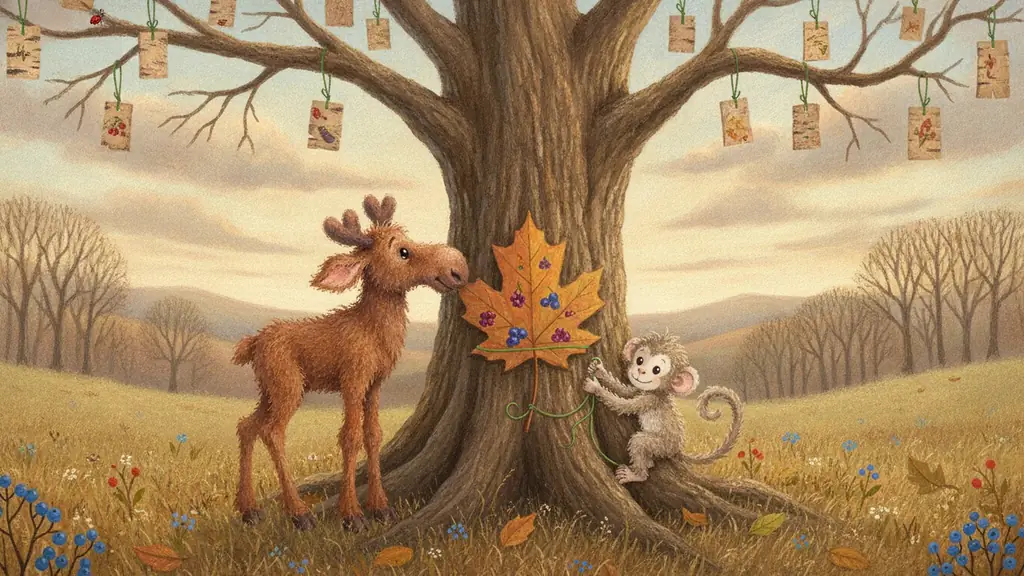
“Like Ricky’s knot!” said Mr. Monkey.
“Like Ricky’s knot,” said Mr. Moose.
Mr. Moose reached up and held each leaf flat against the trunk with his nose, very gently, thank-you side in. And Mr. Monkey tied one vine at the top and one vine at the bottom, with the knot that never slips. Mama Monkey’s leaf. Daddy Monkey’s leaf.
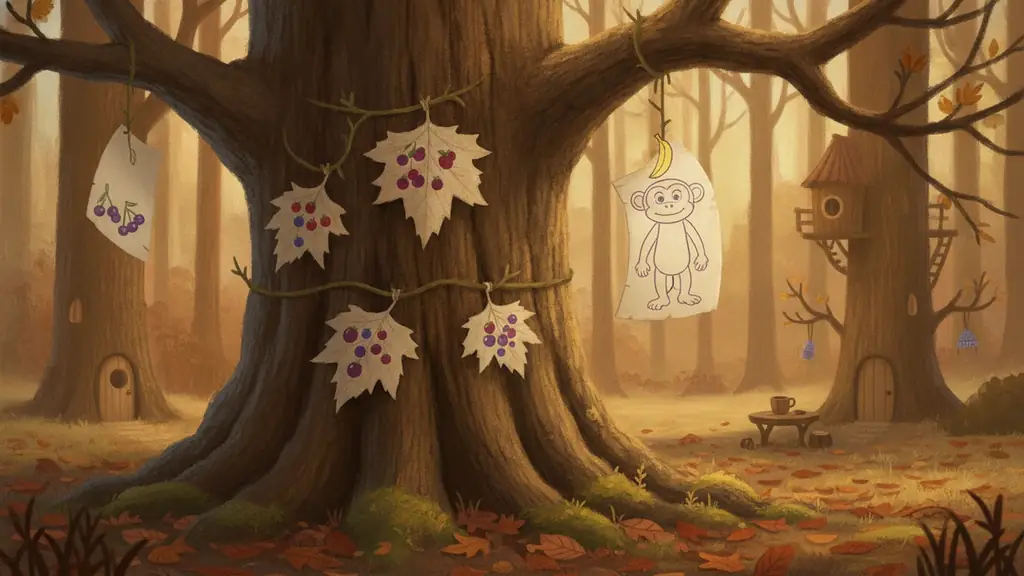
Daddy Moose’s leaf, with four careful moose calves on the back, one of them with five legs. And Mama Moose’s leaf, which Mr. Moose painted last, very fast for him, which was still pretty slow. Not one of them could flip.
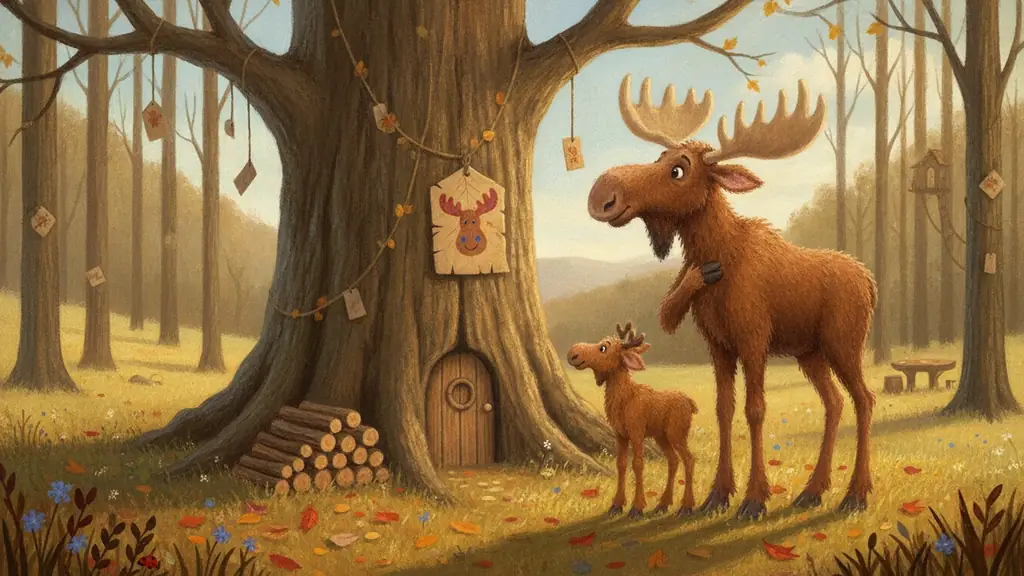
Then the wind blew. Whooosh. The wishes swung and clacked on their vines. But the thank-you leaves stayed right where they were, faces out, secrets in.
That afternoon, Daddy Moose came out of the big maple with an armful of firewood. He stopped. He looked up. There, tied to the trunk, was a leaf with his face painted on the front.
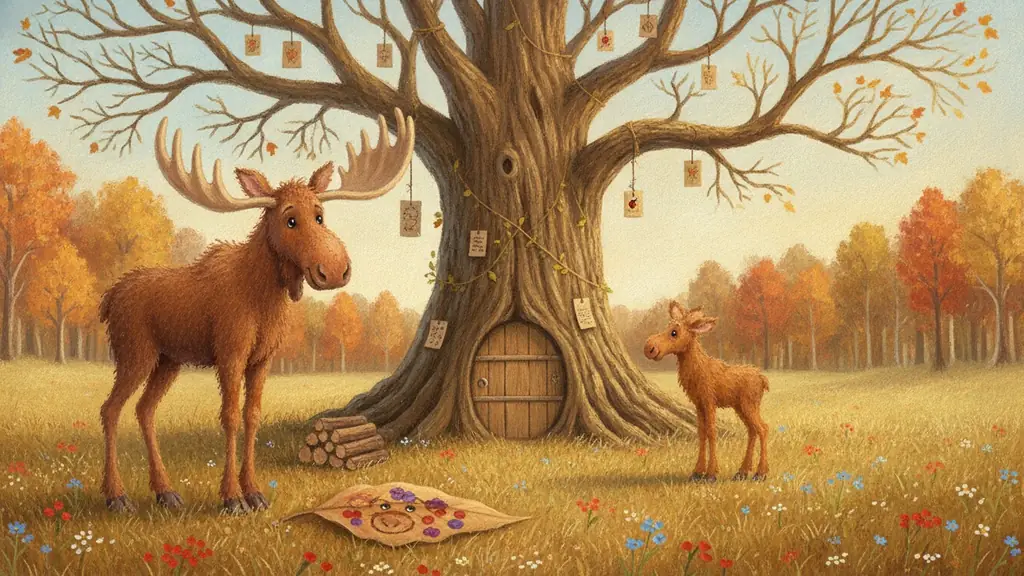
He looked at it for a long time.
“Is that my nothing?” he asked.
“It’s not nothing,” said Mr. Moose.
Daddy Moose put down his firewood. He didn’t try to peek. He just stood there, looking at the front of the leaf, with his hand on his chest, the way Mama Monkey had at the Backward Feast.
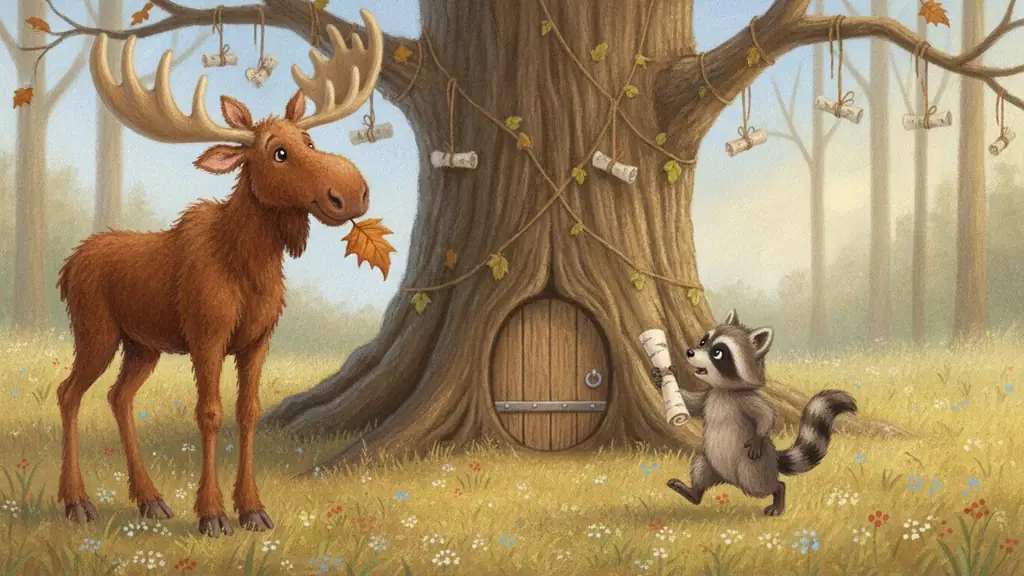
Then Ricky came by. He saw Daddy Moose looking at the leaf. “Rule twenty-two!” he called. “No peeking!”
“I’m not peeking,” said Daddy Moose. “I’m just looking.”
Mr. Monkey sat on a branch near the top of the Wishing Tree, between his big banana wish and Mama Monkey’s leaf. He looked at the banana. He looked at the leaf. Then he looked at the leaf some more.
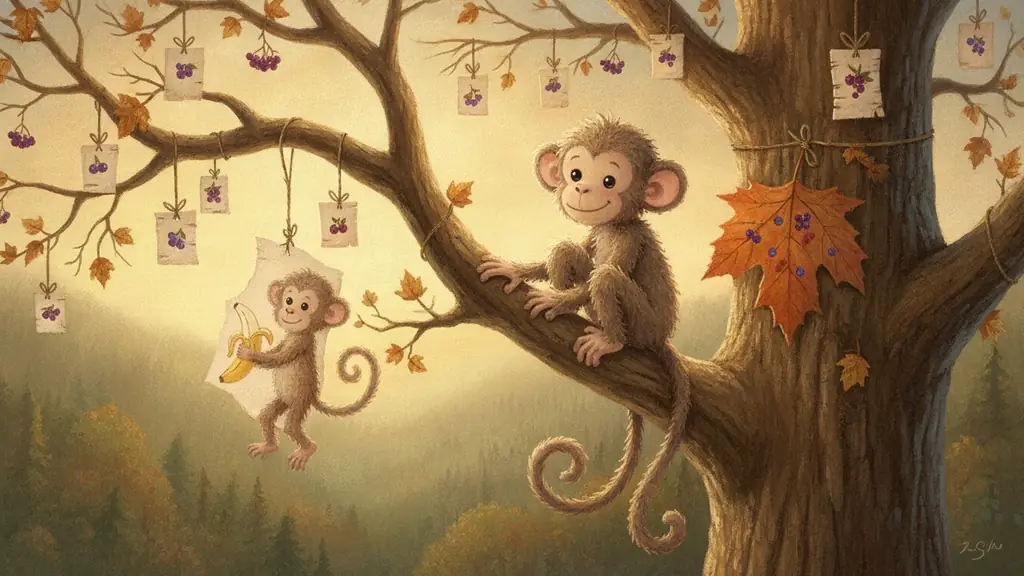
“Mr. Moose,” he called down. “I keep looking at the leaf.”
“Me too,” said Mr. Moose.
Mr. Moose looked at their basket. It still had five leaves in it from all week. And now four new leaves were on the tree, with lots more noticing still to go.
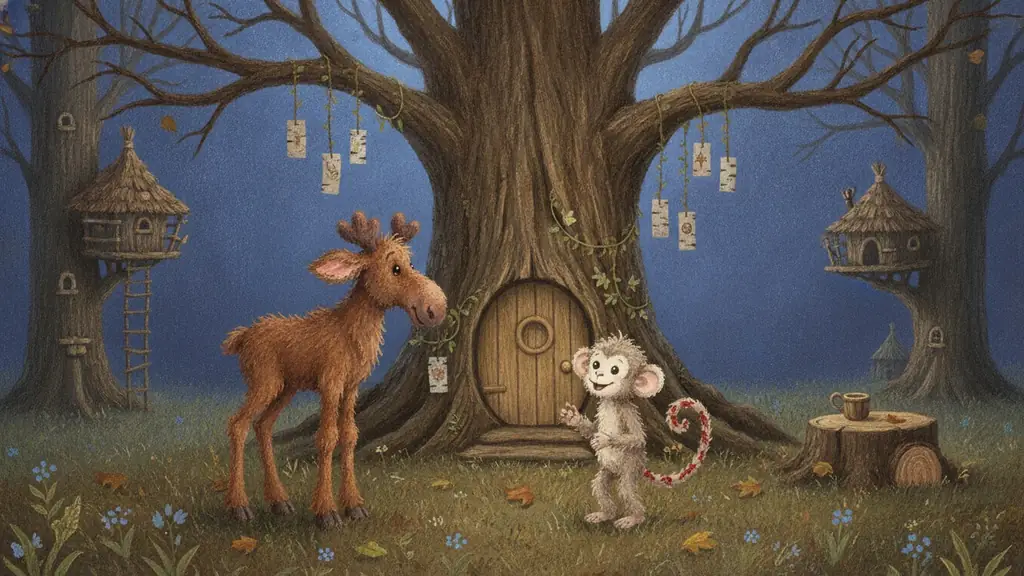
“What a day!” said Mr. Monkey as the sun went down. “My first leaf just said I was nice. Then I painted a hundred monkeys, but only twelve fit, and the rest went on my tail. Mr. Moose painted four moose calves all day, and one had five legs.
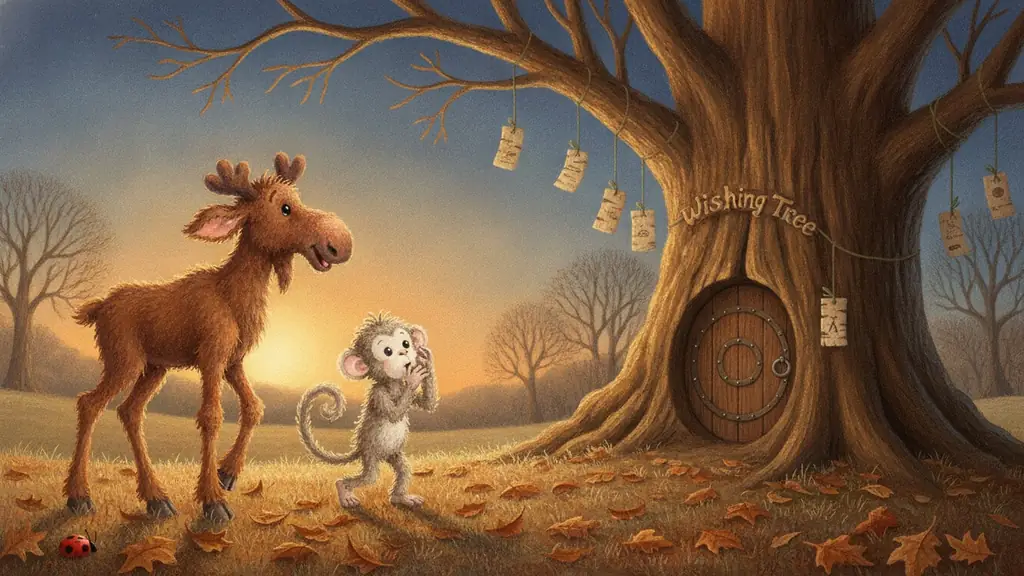
The wind kept flipping Mama’s leaf, so I was a starfish. And Daddy Moose found out he didn’t get nothing.”
Mr. Monkey whistled, and Mr. Moose hummed, and together they sang:
We are better together,
Moose and Monkey forever.
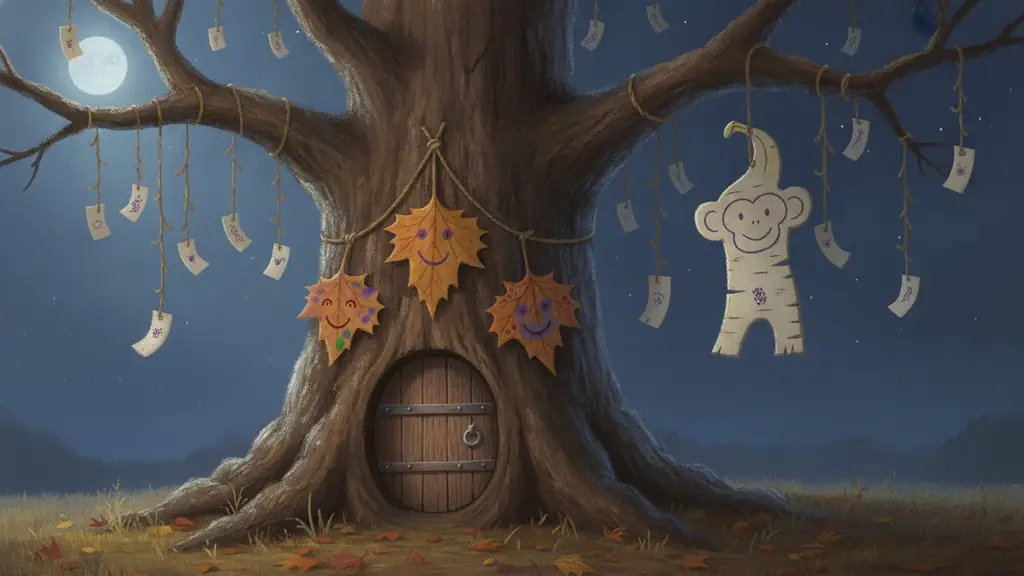
And on the Wishing Tree, four painted leaves sat snug against the trunk, faces out and secrets in, while the wishes swayed around them in the dark.