Improvement · Day 3
Wednesday, November 11, 2026
Receive ItCosmos
 Today in the WoodsNobody Planted It
What made my life better this year that no one arranged?
Imagine a woman who has walked the same trail behind her house almost every morning for years. Last spring she had surgery, and for eight weeks she couldn't walk it. She watched from the kitchen window while the maples along the trail went from bare branches to a haze of red buds and then to full green.
The Tuesday her doctor cleared her, she walked out to the first maple and put her hand on the bark. She couldn't have told you why. Nothing about the tree had changed. It had done what maples do every spring, without being asked, whether or not anyone was watching.
She stood there longer than made sense. Her body had knit itself back together while she slept, and the tree had leafed out on a schedule older than anyone in her family. Neither one had needed her permission, and neither one had needed her help.
She wasn't sure who to thank, or whether there was anyone to thank at all. She stood there a little longer, and then she kept walking.
Today the circle goes as wide as it goes. Some of the good things in a year have no person behind them: a healed body, a harvest that came in, a sunrise, a change of season, the next breath. Most of us treat these as background, the setting where the real events of our lives happen. Yesterday's question ("Who is behind the difference?") runs out of answers here, and a different kind of noticing takes its place. Some good things arrive that nobody arranged.
The Premise called this circle the Cosmos: the gifts none of us could have made for ourselves.
People name the source of those gifts in different ways. Some say God, some say nature, and some aren't sure anyone is behind them at all. The circle holds all three, and nobody has to settle the question to notice the gifts.
Jesus pointed people toward this circle. In the Sermon on the Mount, he tells the crowd to look at the birds, which don't plant or harvest or store food in barns, and yet God feeds them. Then he tells them to look at the wildflowers, which don't work or make their own clothes, and yet they're dressed better than Solomon, the richest king in Israel's story. His point was that they could stop worrying, because they were already being cared for in ways they hadn't earned.
Bodies heal, seasons turn, and the ground keeps growing food without waiting for anyone's permission. Today's practice asks only for a few minutes of attention to that.
There's some research here too. In a well-known 2003 study, psychologists Robert Emmons and Michael McCullough had people write down a few things they were grateful for each week, and those people felt better about their lives than people who wrote about hassles. Their lists covered all three of this week's circles, from "wonderful parents" and "the generosity of friends" to "waking up this morning" and thanks "to God for giving me determination." In 2023, Abdurrahman Kirca, John Malouff, and Jai Meynadier pooled 25 controlled studies of people expressing gratitude and found the effect on wellbeing is real but small. So a gratitude journal gives you a nudge. That's a modest result, but there's a good case for doing the noticing for its own sake anyway.
What good thing came into your life this past year that nobody arranged?
1. The journal. Answer the same three questions, with one change: today the middle line asks who or what, and "I don't know" is an honest answer.
What: What got better in the last year? What was it like then, and what is it like now?
Who or what: Who or what was behind it, as far as you can tell?
How: What exactly happened? Name one specific moment if you can.
People will fill in that middle line differently. Some will write "God." Others will write "Mother Nature," "Luck," "the way bodies heal," or "I don't know." Every one of those counts.
2. The photo hunt. Today's photos are the hardest to find, and you may not find any. That's fine, and it's one reason the tree has paper leaves as well as photo leaves. Still, take a look, since some may be hiding in your camera roll: a garden at its peak, a healed knee, a sunrise from a trip, the rain that saved the lawn. If nothing turns up, take a new photo today of something good that arrived on its own, like the light through a window, a tree changing color, or the food on your table. Add whatever you find to the Thankful Album.
Kids' story: read "Nobody Planted It" from The Thank-You Adventure in Wanderful Woods together.
Time: 10 to 15 minutes.
With kids: ask, "What's something good that happened this year that nobody planned?" If they draw a blank, point them toward something close by: the first snow, a rainbow, a new puppy next door, or how much taller they've grown.
If the room disagrees: a parent and a teenager may name different things behind the same difference. Let both answers stand. Nobody has to win.
If someone can't find anything that got better: a hard year may leave little to name. Something small counts.
Keep today's journal handy. Sunday's Cosmos leaves come straight from what you wrote today.
Tomorrow is Thankful Thursday, the week's celebration night. A few minutes today make it easy:
Choose the photos you want to print, a few per person. If you chose the fair tree back in Prepare (the gift goes out on a second print, so the first one stays up) or you're making a Gratitude Album, you'll need two copies of each. Decide when and where you'll print them tomorrow.
Find scissors and the colored paper. Tomorrow night you'll cut the leaves everyone writes on Friday through Sunday.
Ask everyone to think of one thing they can do now that they couldn't do a year ago. They'll show it off tomorrow night. Help a shy kid pick theirs.
Check that the trunk is up on the wall. The first leaves go on it Friday.
If something isn't ready by tomorrow, Thursday still works.
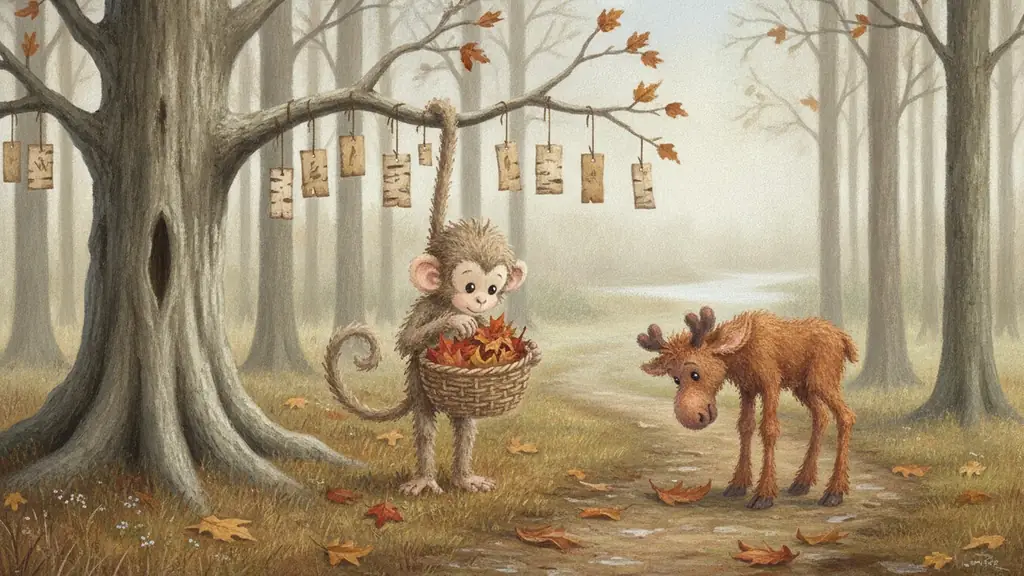
Hello, my wonderful story friends! Last time, Mr. Moose and Mr. Monkey found out Ricky had tied the swinging vine, and they put a leaf in their basket for him. Today they find something growing where it shouldn’t be.
Have you ever found something good that nobody put there? Let’s go see what’s growing in Sunny Square.
The morning was gray and soft, and a light mist hung over Sunny Square. Everything smelled like wet leaves and cold dirt.
Mr. Monkey was swinging from the low branches of the Wishing Tree, counting the leaves in the basket. “One, two, three, four,” he said. “Four leaves! Mama Monkey, Daddy Moose, Ricky, and Bruno.”
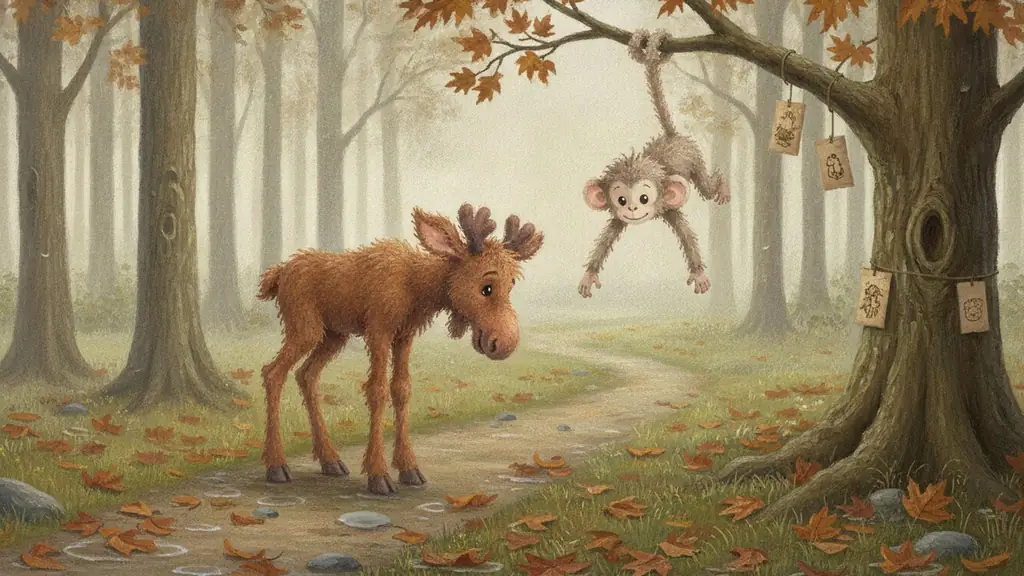
“Mr. Monkey,” said Mr. Moose. “Come look at this.”
Mr. Moose was standing very still in the middle of the path, the one that went from the Wishing Tree to the river bend, where everybody walked. He was looking down.
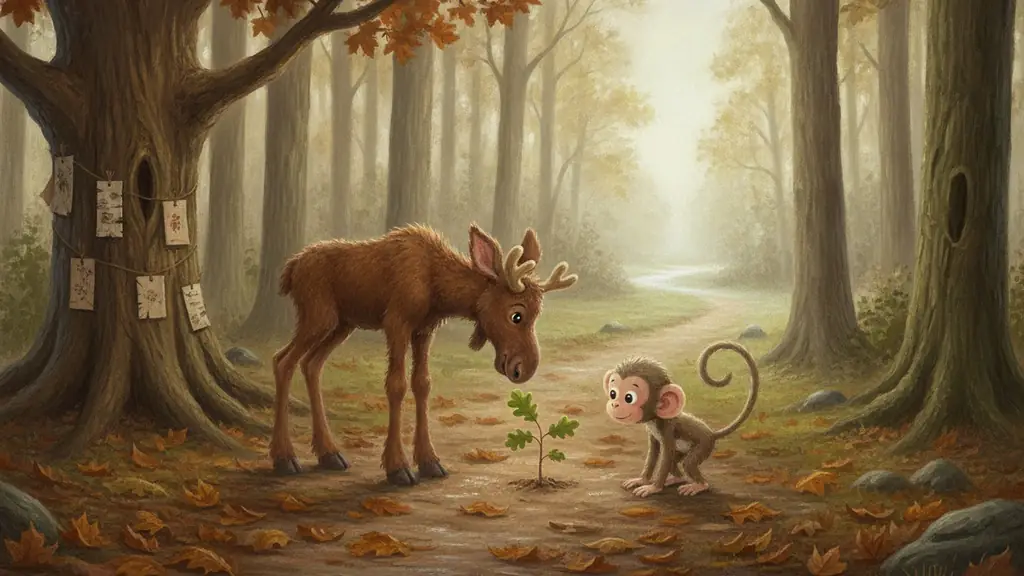
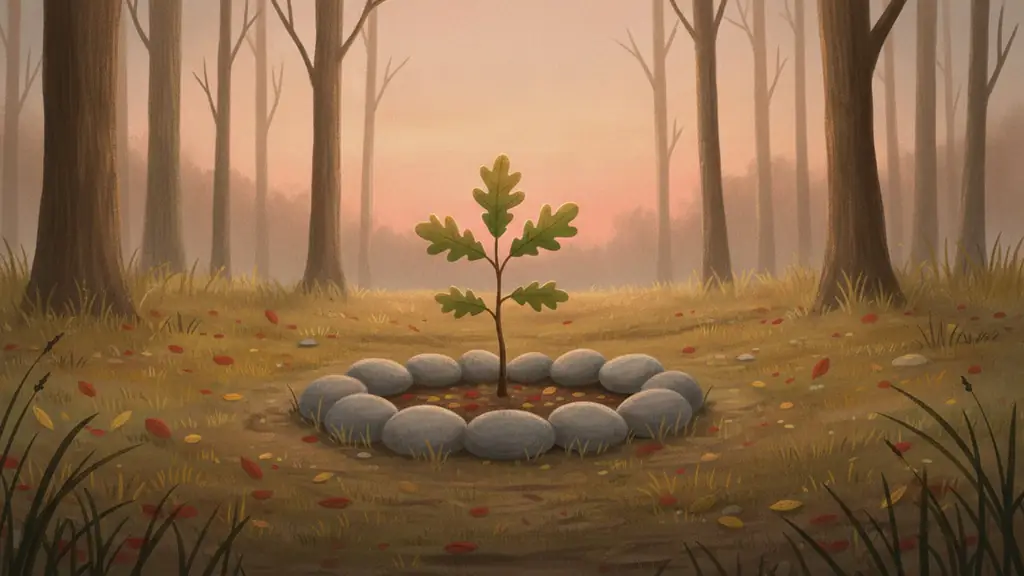
Mr. Monkey dropped down beside him. There, poking up out of the dirt right in the middle of the path, was a tiny tree. It had a skinny brown stem, three little branches, and five small leaves, still green, the only green leaves in all of Sunny Square.
“It’s a baby tree!” said Mr. Monkey.
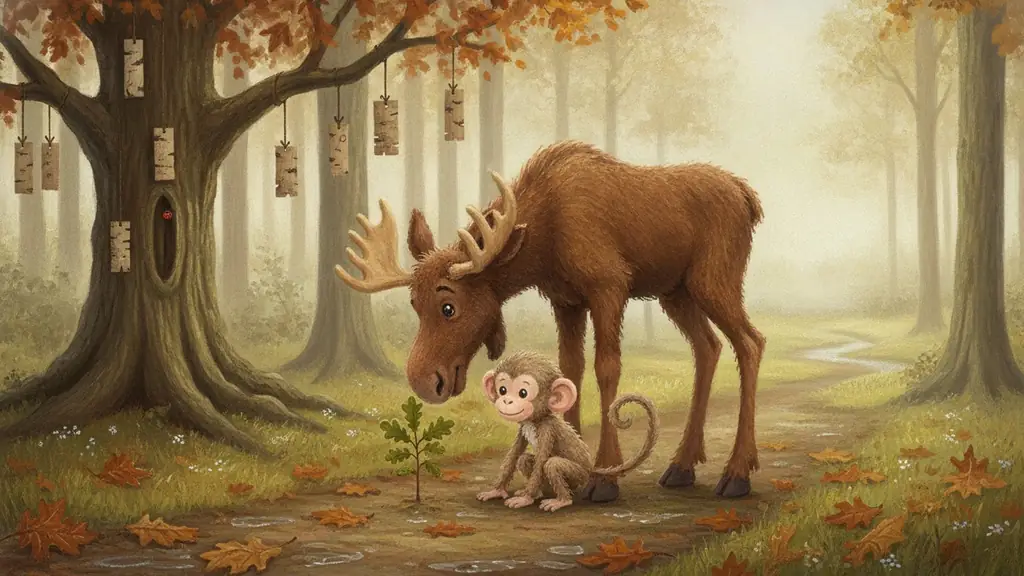
“It’s an oak,” said Mr. Moose. He bent down until his nose almost touched it. “See the leaves? They’re wiggly on the edges, like a big oak’s.”
“Who planted it?” asked Mr. Monkey.
Mr. Moose didn’t know. Nobody plants a tree in the middle of a path.
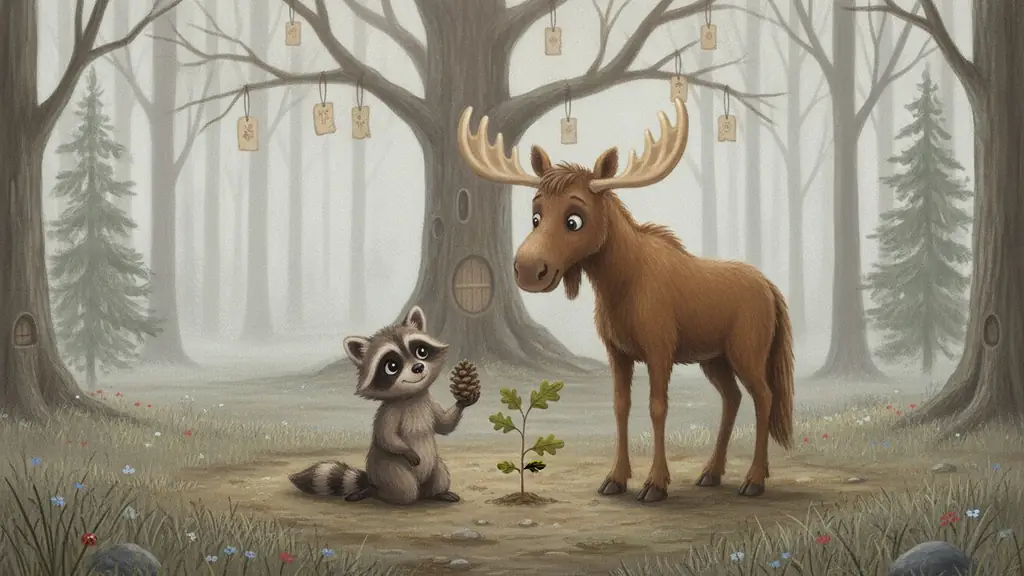
Just then, Ricky came bustling by with his rule list. He stopped. He stared at the tiny oak. Then he held his pinecone up beside it.
“It’s EXACTLY pinecone-size,” he gasped. “This is the perfect Swap present!”
“It’s alive,” said Mr. Moose gently. “Rule nine. No presents that are alive.”
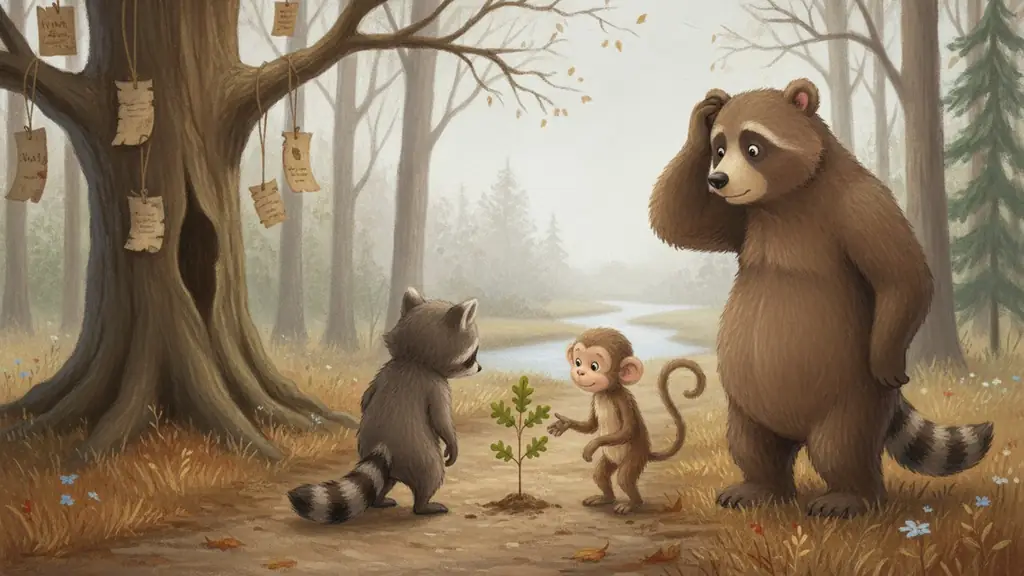
Ricky’s ears drooped. “Rule nine,” he said sadly. “I made that one up myself.”
“Let’s find out who planted it,” said Mr. Monkey. “So we can put a leaf in the basket for them!”
So off they went, asking everybody.
“Did you plant a tree in the path?” Mr. Monkey asked Bruno.
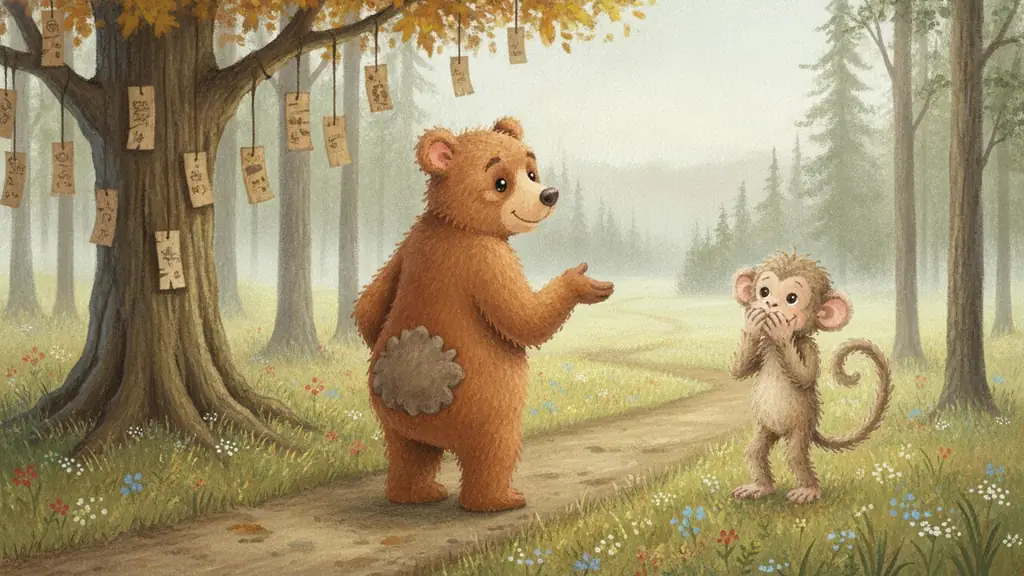
Bruno thought about it. “I planted my bottom in a mud puddle yesterday,” he said. “Is that the same?”
“Not really,” said Mr. Moose.
Hazel hadn’t planted it. Dottie hadn’t planted it, but she sniffed it so hard she sneezed, and the tiny oak waved back and forth. Benji hadn’t planted it, but he had been watching it grow all summer, very quietly, and he hadn’t told anybody because he thought everybody knew.
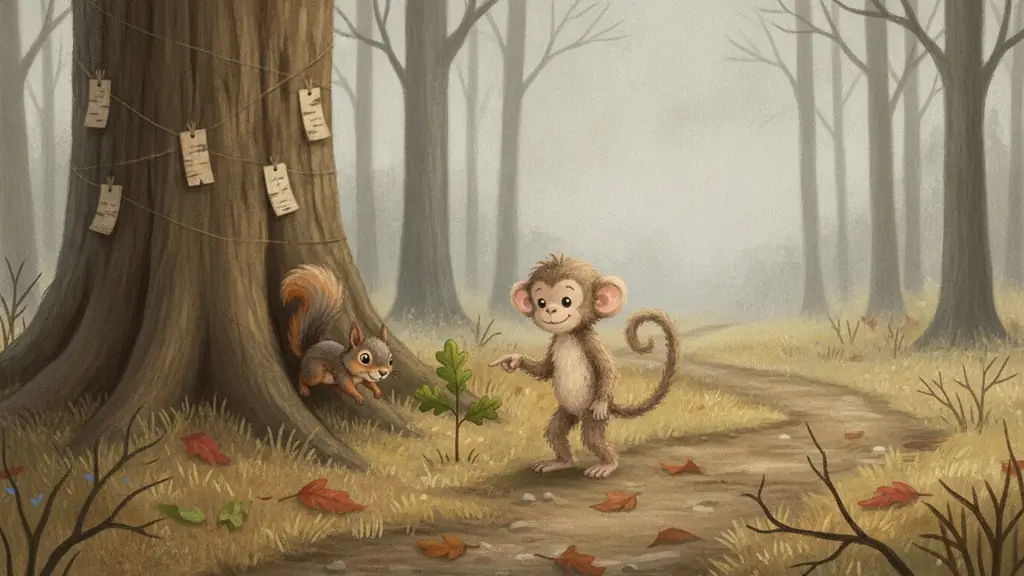
Then Sammy Squirrel came zipping down the maple. “What are you looking at? Is it a nut? Is it MY nut?”
“It’s a tree,” said Mr. Monkey. “A tiny one. Did you plant it?”
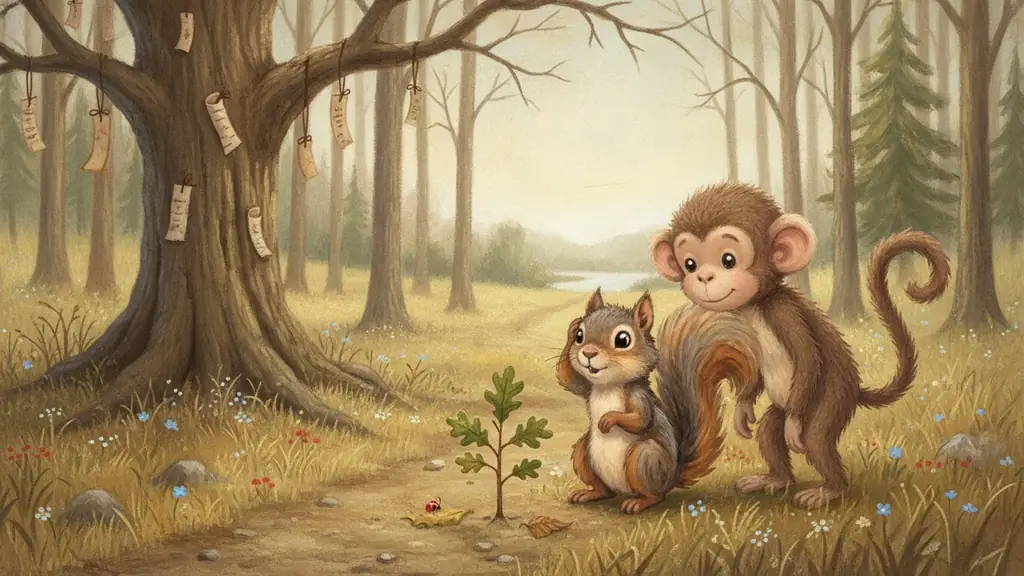
Sammy looked at the tiny oak. She looked at it for a long time, which was a very long time for Sammy. “Ohhhh,” she said. “Last fall I buried an acorn right here. I was going to eat it in the winter. And then I forgot where I put it.”
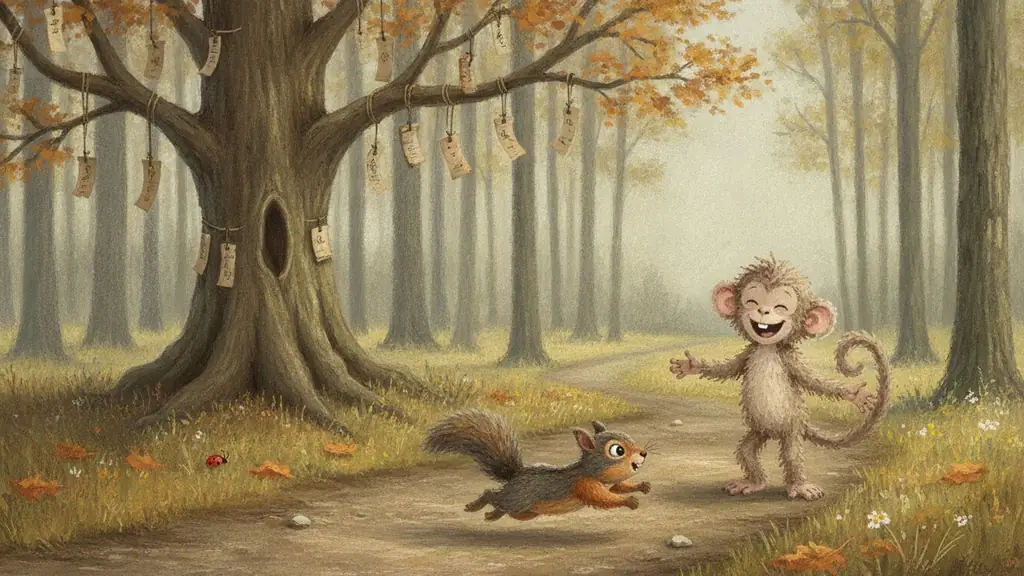
“So YOU planted it!” said Mr. Monkey.
“No,” said Sammy. “I just hid an acorn. I didn’t make a TREE. I don’t know how to make a tree.”
Then she zipped around the square in a circle, very fast. “Wait. Wait. If I forgot ONE acorn… I forgot LOTS of acorns! There could be trees EVERYWHERE!”
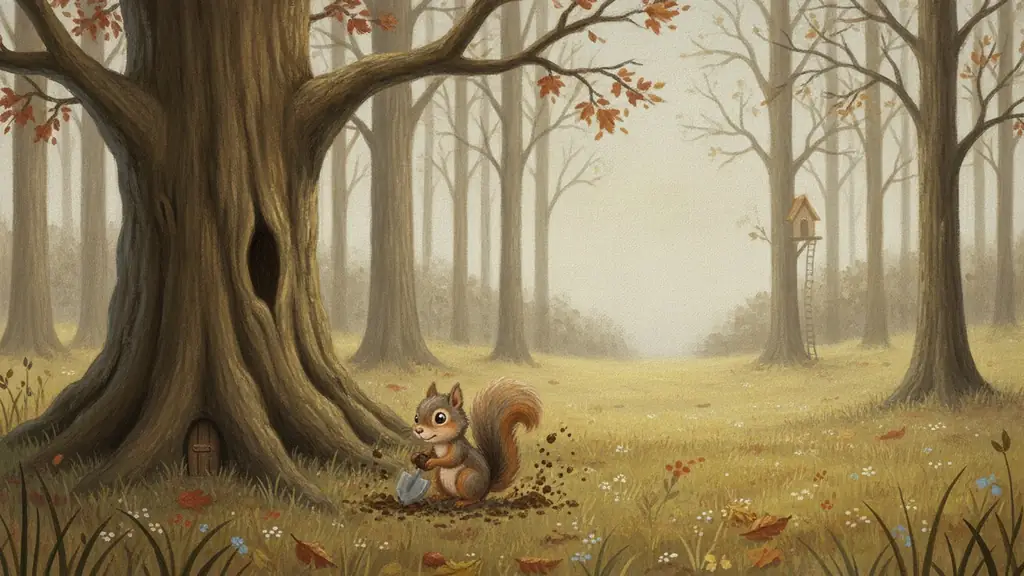
And she started digging.
She dug by the maple. Skritch-skritch-skritch. No acorn. She dug by the bench. Skritch-skritch. No acorn. She dug by the river. She dug by the Listening Log. Dirt flew up behind her in two little fountains. Dottie thought it looked like the best game ever and started digging too, right next to her.
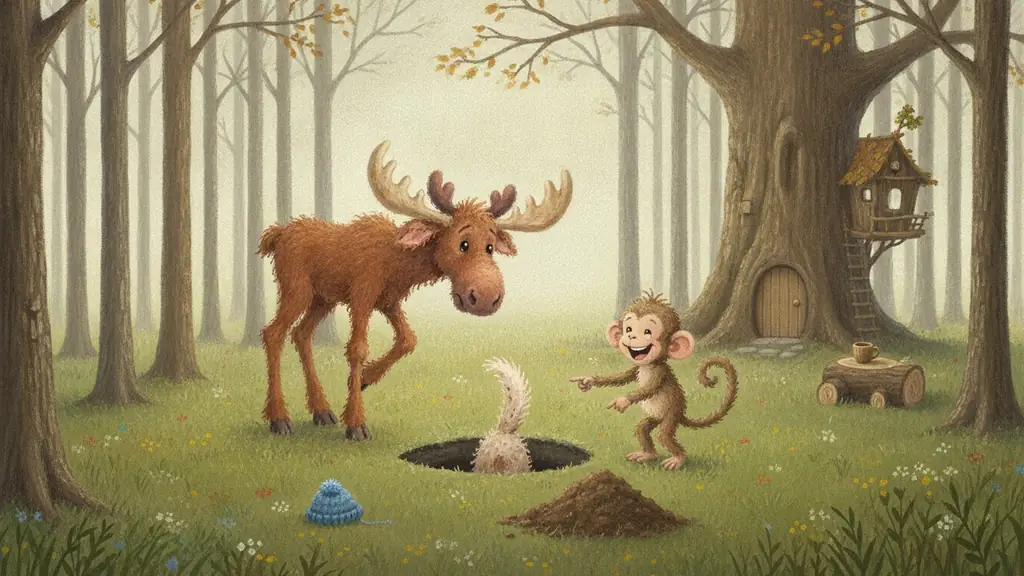
Dottie dug so deep, so fast, that soon all anybody could see of Dottie was her wagging tail sticking up out of the hole.
“Dottie?” said Mr. Moose. “Are you okay down there?”
“I FOUND A WORM!” said the hole.
“Ha! Ha!” Dottie’s laugh came up out of the ground, muffled and happy.
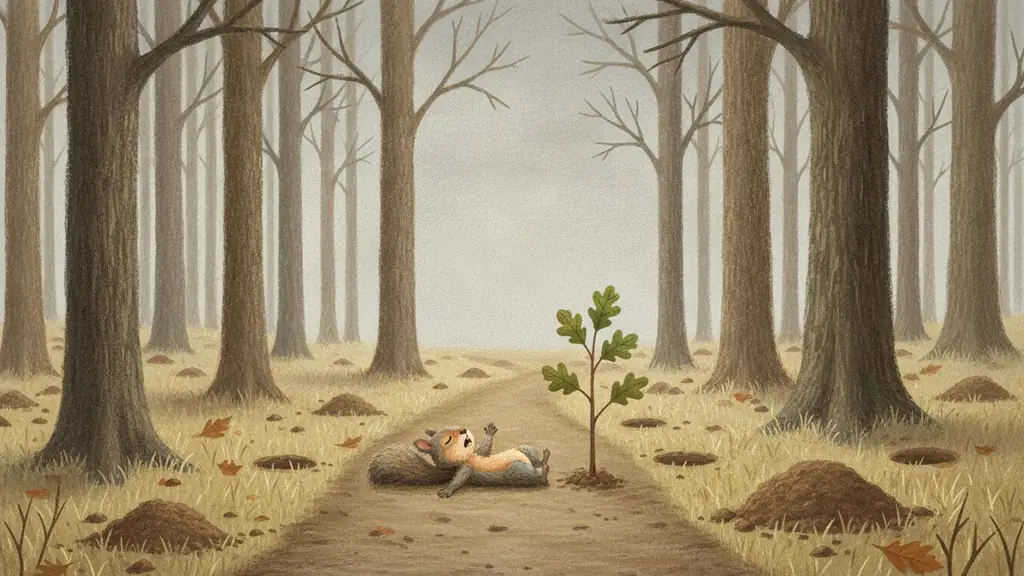
“Hee hee hee!” went Mr. Monkey. “It’s a talking hole!”
When Sammy finally stopped, there were holes all over Sunny Square, and no acorns at all. She flopped down beside the tiny oak, all out of breath.
“Hey,” she said. “What kind of tree fits in your hand?”
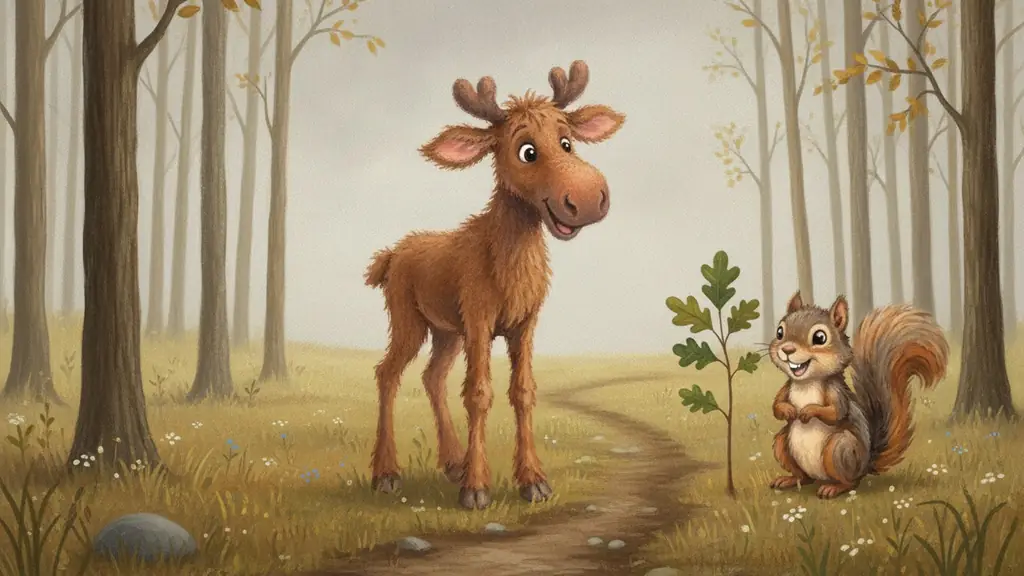
She zipped away before anyone could answer. Then she zipped right back. “A PALM tree!” She held out her paw, flat, right next to the tiny oak. “Or THIS one!” And she was gone again.
“Ha-ha-ha!” laughed Mr. Moose. “It does fit in your hand.”
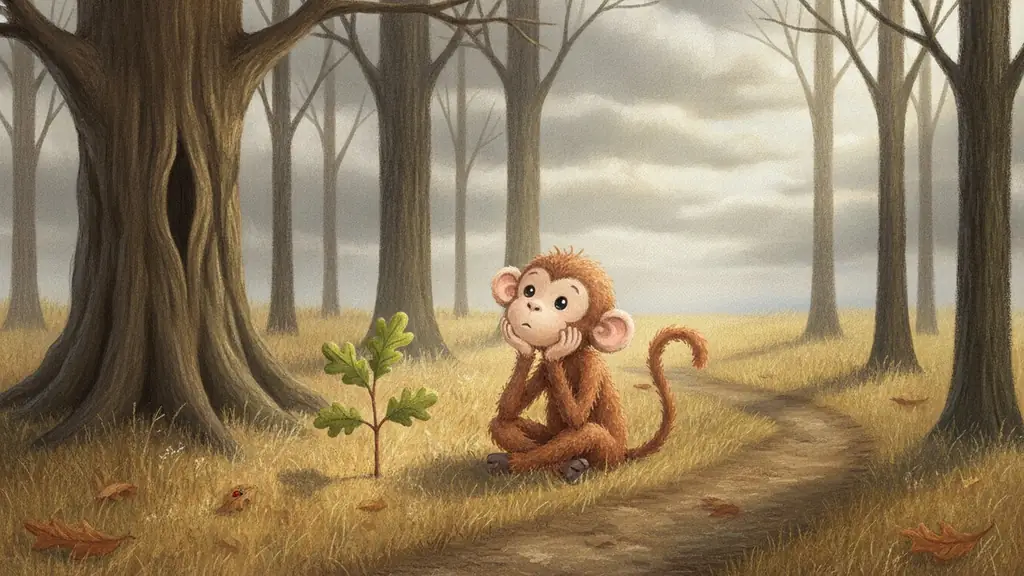
Mr. Monkey sat down beside the tiny oak. He looked at it. “So Sammy didn’t plant it,” he said. “She just forgot it. And nobody watered it. And nobody told it to grow.”
“The rain watered it,” said Mr. Moose. “And the sun warmed it. And it just… grew.”
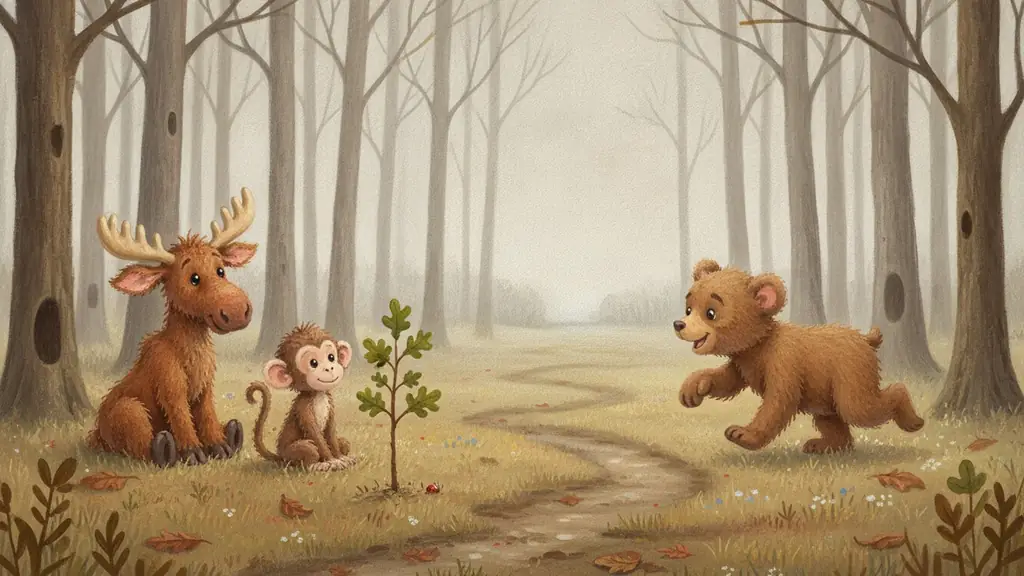
“So who do we put a leaf in the basket for?” asked Mr. Monkey.
Mr. Moose didn’t know. That was the strangest part.
Just then, THOOM, THOOM, THOOM. Bruno came running across Sunny Square, looking back over his shoulder. “Tag! I’m not it! Somebody else is it!”
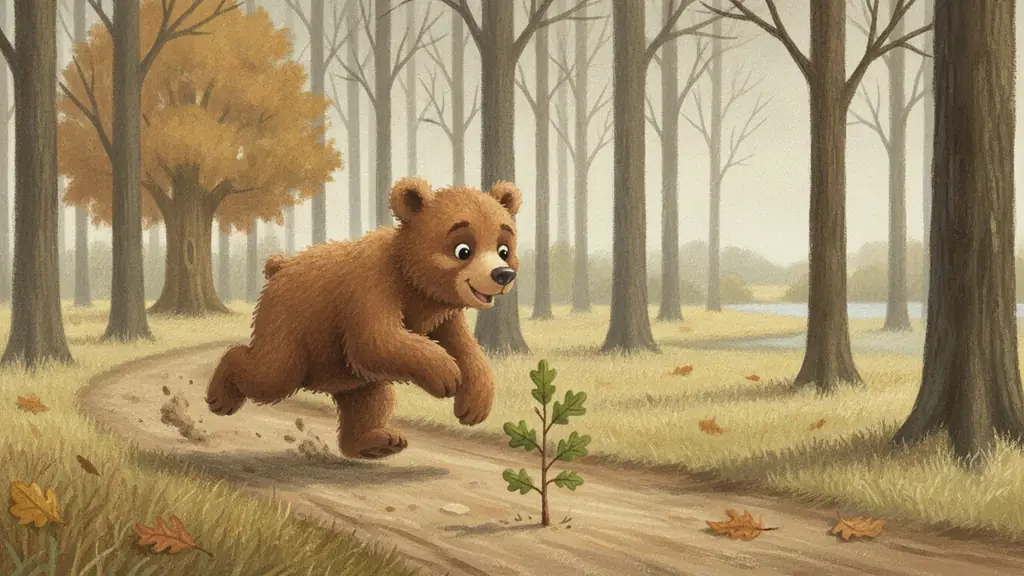
He was running right down the middle of the path. Right toward the tiny oak. His big feet went THOOM, THOOM, and he wasn’t looking down at all.
“BRUNO!” yelled Mr. Monkey.
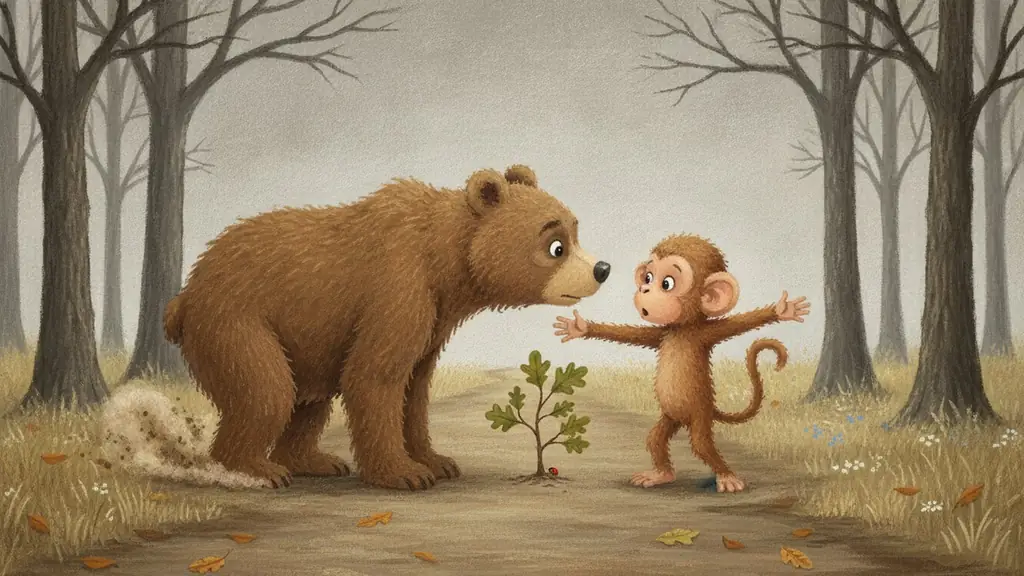
Mr. Monkey jumped up and stood right in front of the tiny oak with his arms out wide. Bruno skidded. He slid. He stopped with his big nose two inches from Mr. Monkey’s nose.
“Why are we stopping?” asked Bruno.
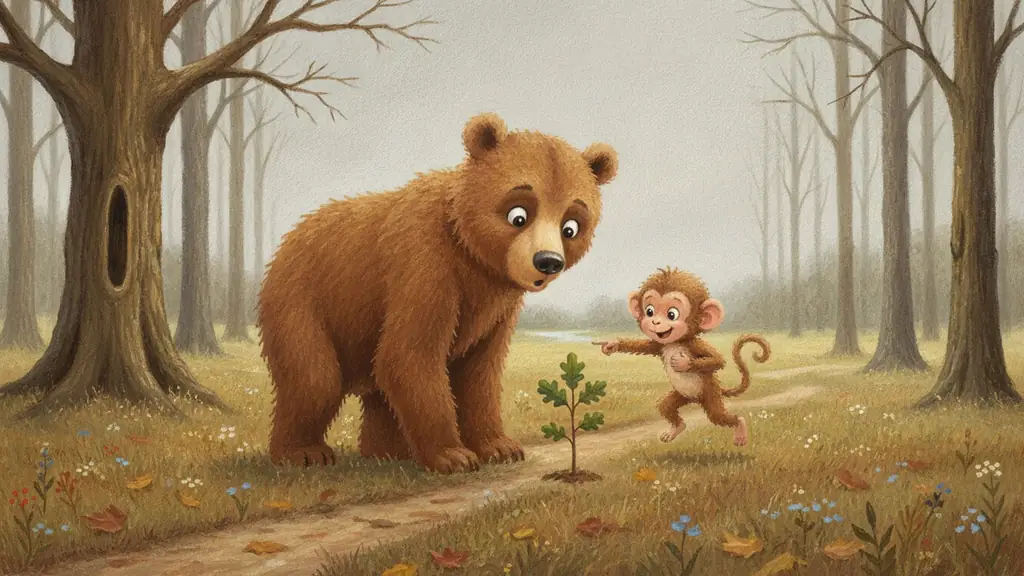
Mr. Monkey pointed down. Bruno looked. “Oh!” he said. “A tree! I almost squished a tree!”
Mr. Monkey’s heart was still thumping. The tiny oak had grown all by itself, all year long, right in the middle of the path, and nobody had even noticed. And now everybody was going to come running through Sunny Square on their way to the Thankful Feast.
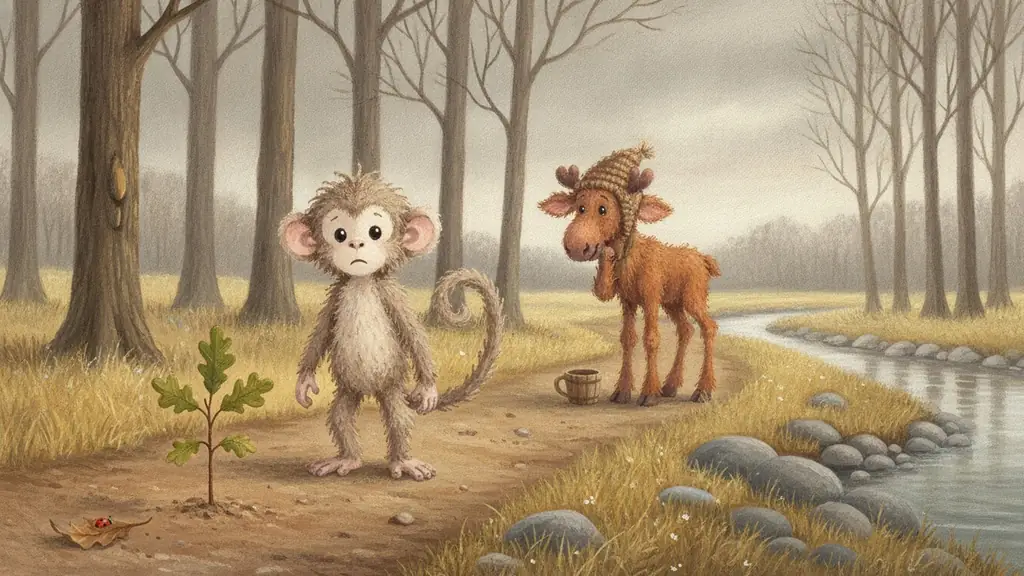
“Mr. Moose,” he said. “Everybody walks here. It’s going to get stepped on.”
Mr. Moose thought. They couldn’t move it. Its roots were already deep. And they couldn’t ask everybody in the woods to stop walking on the path. That wasn’t fair to the path.
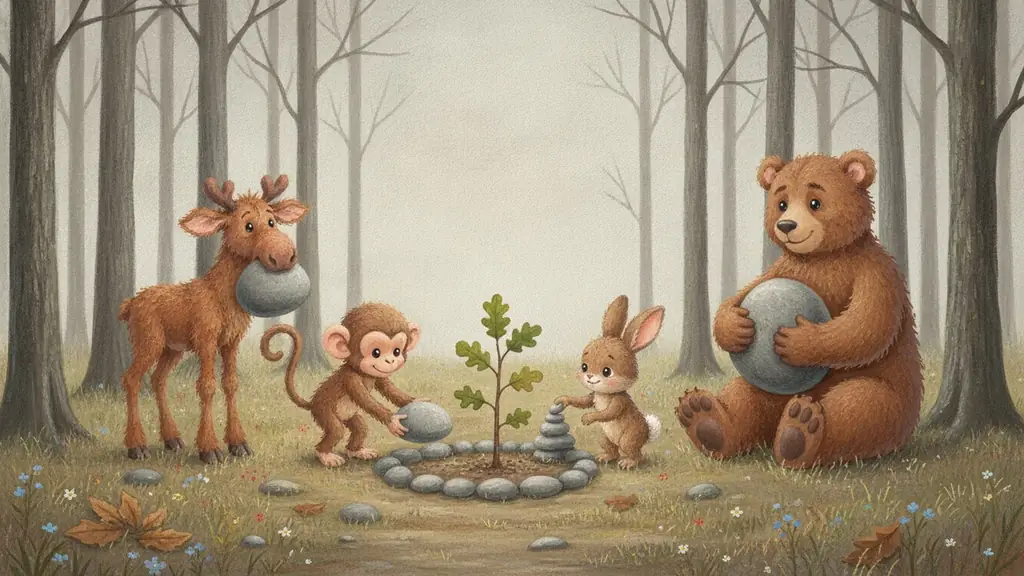
He looked around at the river stones, round and gray, lying all along the bank.
“We can’t move the tree,” said Mr. Moose slowly. “But we can show everybody where it is. If we put a ring of stones around it, nobody will step there.”
“A fence!” said Mr. Monkey. “A tree fence!”
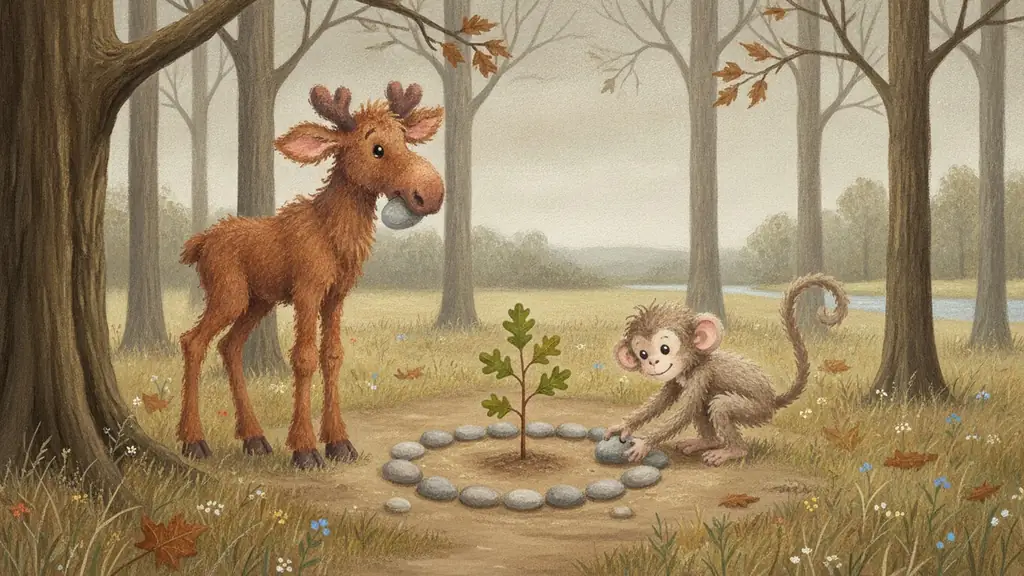
Mr. Moose carried the big stones from the riverbank in his mouth, one at a time. Mr. Monkey set them down in a circle around the tiny oak, nice and close, but not too close.
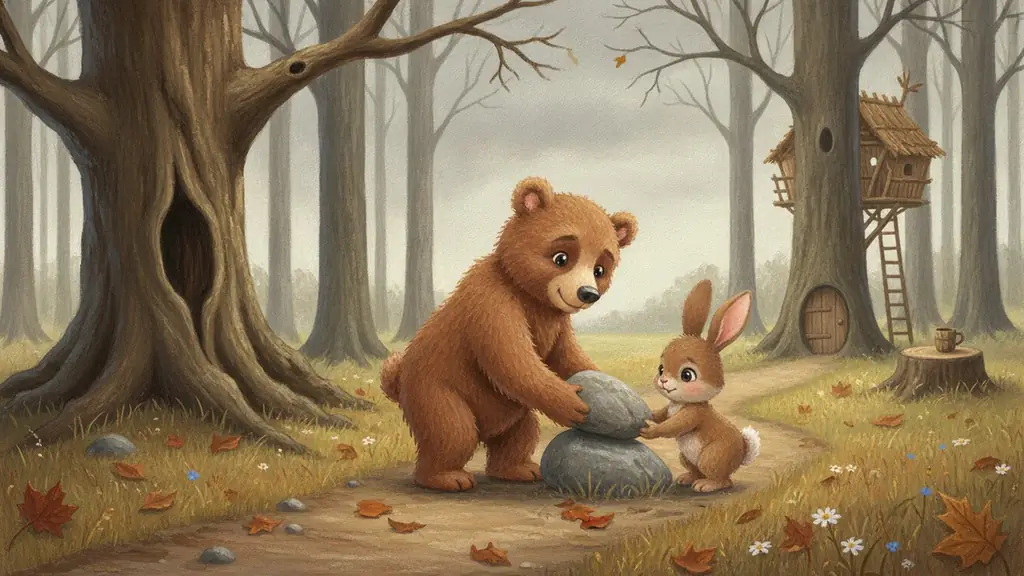
Bruno carried the very biggest stone of all, slowly and carefully, using both arms, and set it down where the path came in, like a front door. Benji found the smoothest stone and put it on top.
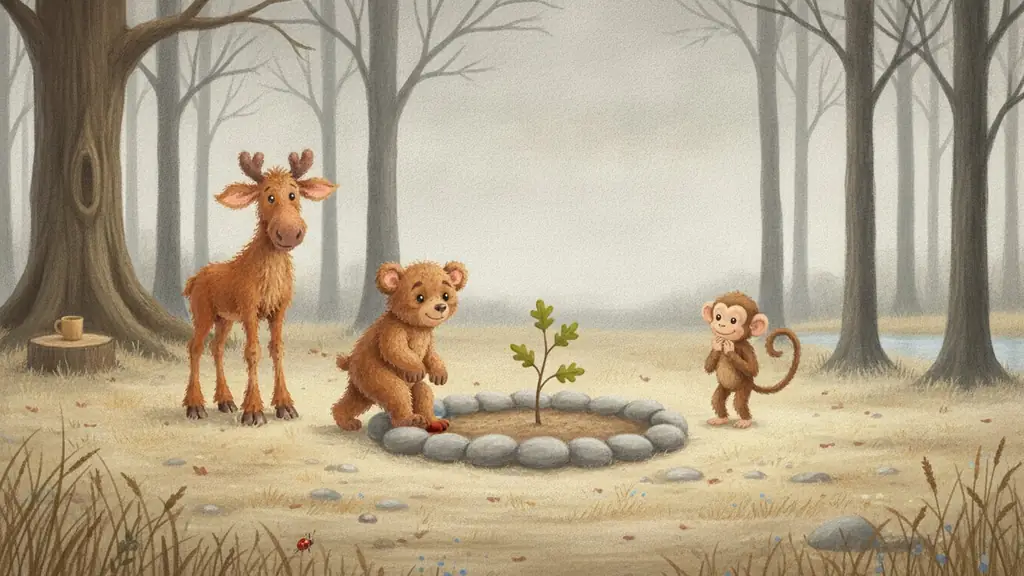
When they stepped back, the tiny oak stood in the middle of its ring of stones, safe and small and green.
“Now everybody will walk around,” said Mr. Moose.
Bruno walked around. Then he walked around again, just to practice.
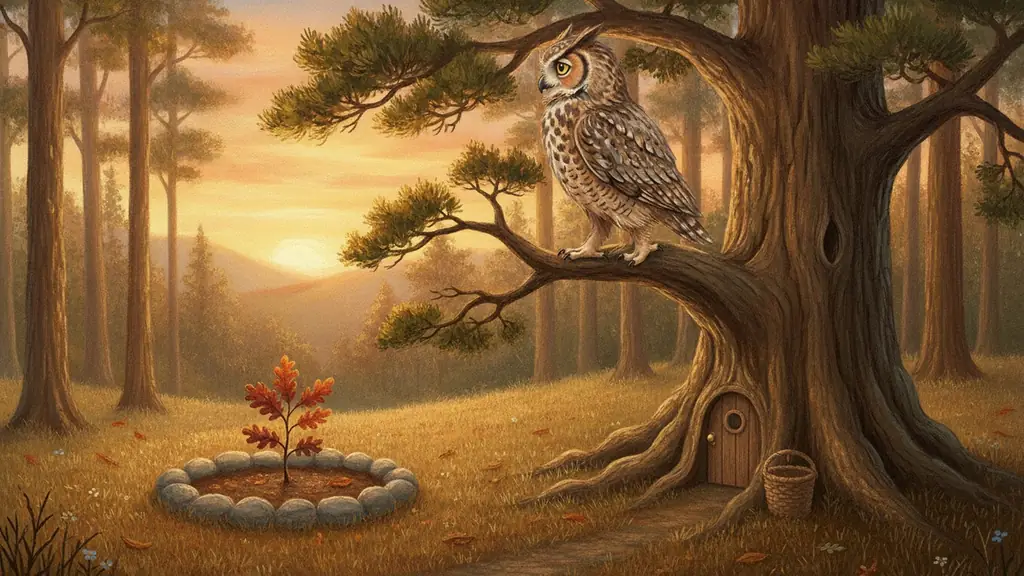
Late in the afternoon, Orion Owl woke up and fluffed his feathers. He looked down from Pilgrim Point at the little circle of stones. “Hoo,” he said. “What have you got there?”
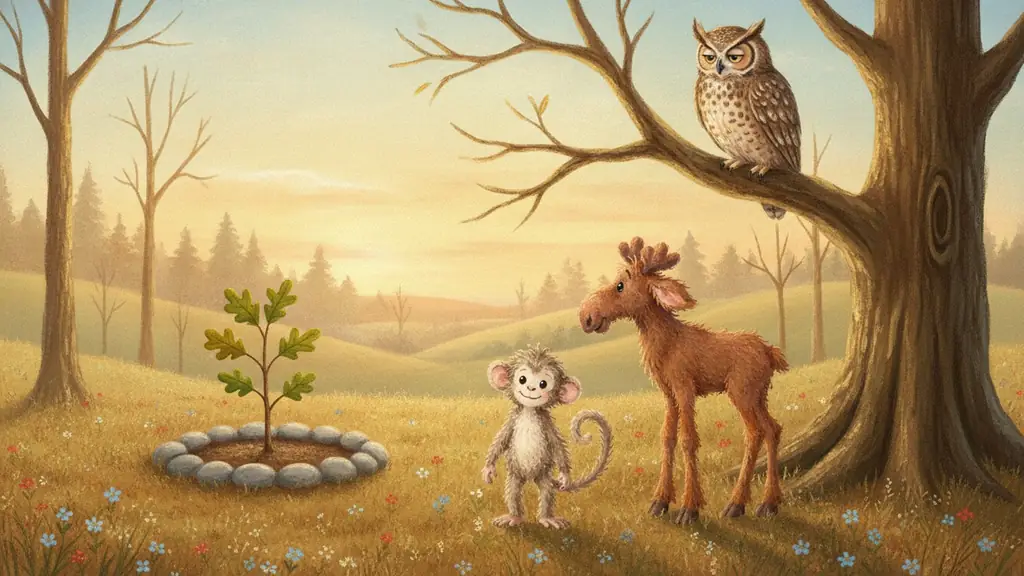
“A tree that grew by itself,” said Mr. Monkey. “We wanted to put a leaf in the basket for whoever planted it. But nobody planted it.”
Orion blinked slowly. “Then whose leaf will it be?”
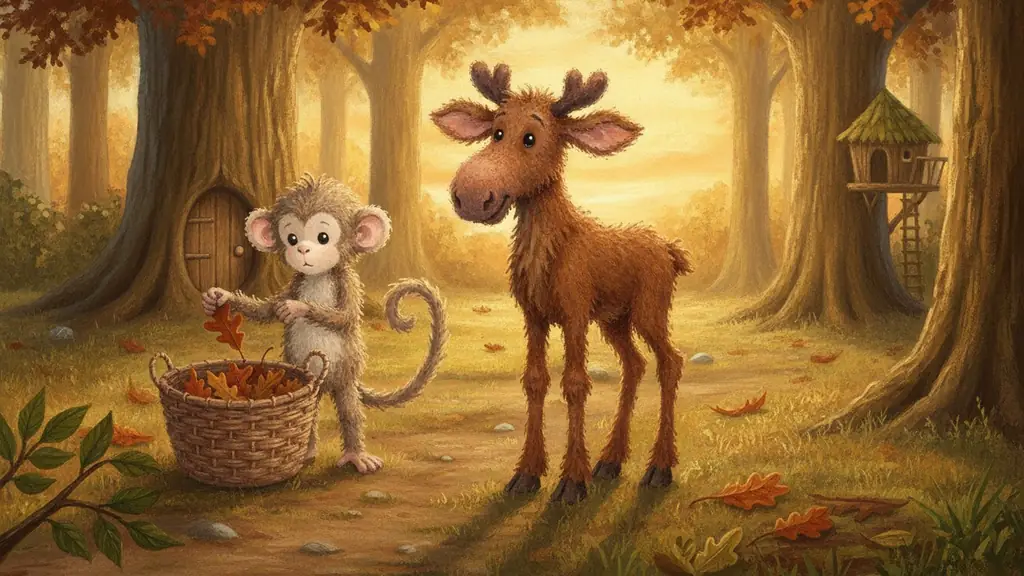
Mr. Monkey thought. He didn’t know. Mr. Moose didn’t know. Orion didn’t tell them. He just tucked his feet under his feathers and watched the sun go down.
Mr. Monkey picked up a small brown oak leaf and held it for a long time. Then he put it in the basket anyway. “This one is for whoever made the oak grow,” he said. “Even if I don’t know who.”
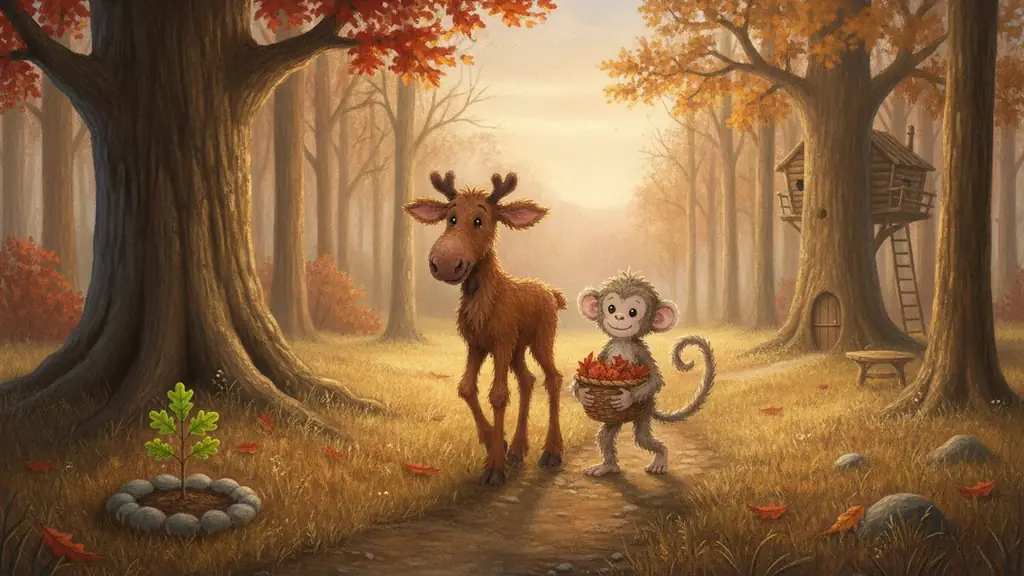
“Five leaves,” said Mr. Moose.
“What a day!” said Mr. Moose as they walked home. “We found a baby oak in the path. Sammy forgot an acorn and dug up all of Sunny Square. Dottie dug so deep she turned into a talking hole. Bruno almost squished the oak, so we built it a fence. And nobody planted it at all.”
Mr. Monkey whistled, and Mr. Moose hummed, and together they sang:
We are better together,
Moose and Monkey forever.
And in the middle of Sunny Square, inside its ring of river stones, the tiny oak held its five green leaves up to the last of the light.