Who in this house helped carry me to the end of a long wait this year?
Who helped me reach the end of a wait this year?
Generosity, Hope and Peace gave the tree its first three layers, and this week adds the fourth and last: joy. Hope was a want that walks, and peace was knowing the hard path was the right one. Joy is what happens when the walking finally gets somewhere. For the next seven days, we look at what it feels like when a long wait ends, why that feeling is meant to be shared, and how the first Christmas began with a few people who couldn't keep their joy to themselves.
December 22 to 24: Saturate. These three days are for receiving, one circle each: the people in your house (Core) on December 22, the people within your reach (Community) on December 23, and the good that comes from beyond anyone's grip (Cosmos) on December 24, Christmas Eve. Each day ends with an ornament.
December 25: Celebrate. It's Christmas. The fourth candle is lit from the third, and everyone reads the gold ornaments with their own name on them.
December 26 to 28: Participate. These three days are for giving joy, one currency at a time: time on December 26, resources on December 27, and words on December 28.
Every daily reading has the same three parts: a picture for the heart, a point for the head, and a practice for the hands. On the giving days, the picture is a story, then a song, then a scene from a film.
This story is true, and it's common enough that you may see yourself, or someone you know, somewhere in it.
A single man had a pretty good idea of the kind of woman he hoped to marry. The problem was that he wasn't sure she existed, and he was starting to lose hope. Then he met her. Two hundred days later, they were standing at the front of an auditorium on their wedding day, and the pastor opened the ceremony with a classic line: "Ladies and gentlemen, this is the moment we've all been waiting for." For the groom, those words were exactly true.
They said their vows, walked back down the aisle, and went out through the doors at the back of the auditorium. On the other side of those doors, something happened that he didn't see coming. He started crying, a lot. Nothing had gone wrong. The wedding had gone exactly the way they planned it. What he felt was relief: the weight of the wait was gone, and it came out as tears.
A few years later, they were expecting their first son in the spring of 2020. Then the pandemic arrived, the world shut down, and some hospitals started keeping dads out of the delivery room. The place that was supposed to feel safest was suddenly the place everyone was trying to avoid. What if he couldn't be in the room? A home birth had never been on their list, but after talking it through, they chose one with a team of midwives they trusted, and their son was born at home, quickly and without a single complication.
So when their second son was on the way the next year, everyone expected an even faster labor. It wasn't. The hours dragged, exhaustion set in, and nothing was wrong, but nothing felt right either. Then the midwife asked, "Do you want to go to the hospital?" She was thinking about how tired the mom was. What they heard was, Something is wrong. Was the baby okay? Was the mom okay?
The midwife wasn't worried, so on her advice they stayed home, but the worry stayed with them. A little while later, still in their own bedroom, one last push brought their son into the world. He was healthy. His mom was healthy. And the first thing both parents did was cry.
On December 25, your family lights the fourth of five candles from the third one, and joy gets added to the answer when the candle words ask, "What do we pass on?" This week is about the people who carried us to the end of ours.
An old line in Proverbs, a collection of ancient Israelite sayings traditionally linked to King Solomon, puts the whole story in one sentence: "Hope deferred makes the heart sick, but a longing fulfilled is a tree of life." Those slow hours in the bedroom were the first half of that sentence, and the baby's first cry was the second. Joy is hope fulfilled. It's what happens when the wait is finally over.
Joy usually arrives in two waves. The first is relief: the weight of the wait comes off. That's what those tears were, outside the auditorium doors and beside the bed. Both times, the good thing had already happened, and the body caught up a few seconds later. The second wave is rejoicing: the party, the phone calls, the reception. Relief comes first, and it's what makes room for rejoicing. You never feel quite as good as when you don't feel sick anymore.
Jesus told a short story with both waves in it. Luke records it: "Or suppose a woman has ten silver coins and loses one. Doesn't she light a lamp, sweep the house and search carefully until she finds it? And when she finds it, she calls her friends and neighbors together and says, 'Rejoice with me; I have found my lost coin.'" The story moves in the same order: first the lamp and the broom and the careful search, then the coin, then the neighbors at the door. A long wait ends the same way: the heavier the weight, the more there is to set down. Hope said the wait was worth the weight, and joy is the moment you find out it was.
Who in your house helped lift a weight this year, and how did you celebrate when it lifted?
Today the fourth and last green layer of the Giving Tree goes up, the smallest one, taped at the top. Then come the gold ornaments.
Cut a gold or yellow paper circle for each person in your house other than you.
On the front, write the person's name.
On the back, thank them for carrying part of a wait with you this year, or for celebrating with you when it ended. "Thank you for driving me to every physical therapy appointment, and for the pancakes the day the brace came off."
Tape it to the new layer with the writing toward the wall.
Nobody reads the backs yet. They wait for the fourth candle on Christmas Day.
Kids' story: read "The Big Phew" from The Overflow Adventure in Wanderful Woods together.
Time: 15 to 20 minutes, plus about five to put up the layer.
With kids: ask, "What's something you waited a long time for this year? How did you feel when it finally happened?" A child can draw that moment on the back of the ornament and tell you who waited with them.
If you live alone: use the choice you made for line 6 of your plan in Prepare.
Hello, my wonderful story friends! Last time, it was the longest night of the whole year, and the friends kept every single light in the woods burning until morning. Even the old crow’s son called back across the river. Now the long night is over.
Have you ever waited and waited for something, and then, when it finally happened, you felt something you didn’t expect? Let’s go see what Mr. Monkey feels.

The sun came up over the hills a tiny bit earlier than the day before, and it poured gold light across the snow. Icicles along the Moose home’s roof began to drip, tink… tink… tink, and every drop caught the sun on its way down.
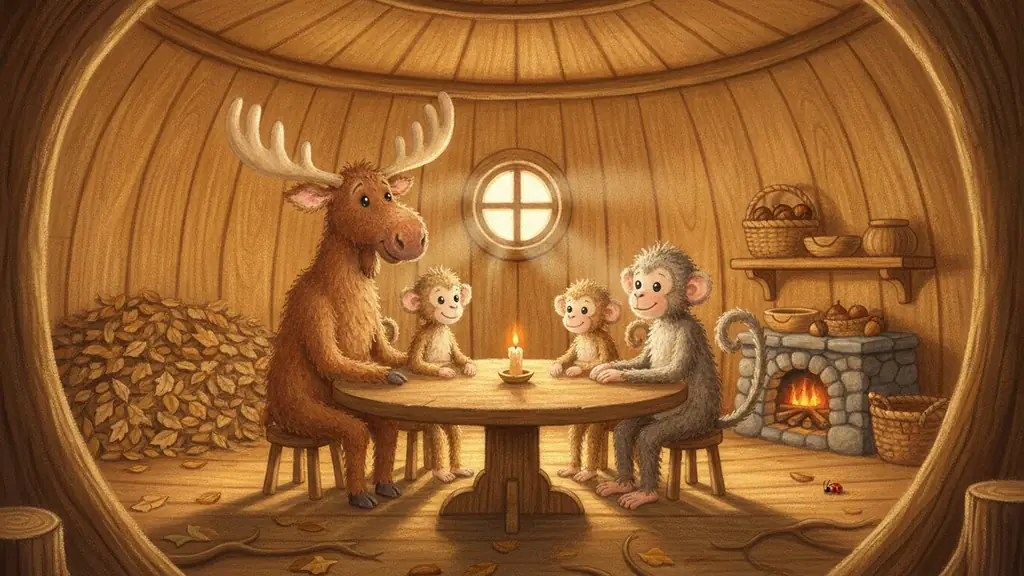
Breakfast was over. Both families were still at the Moose home: Mama and Daddy Moose, Mama and Daddy Monkey, Mr. Moose, and Mr. Monkey. The gold candle on the table had burned all night long and was only a little stub now, but it was still lit.

Mr. Monkey ran outside into the sunshine. This was it. The longest night was over. Every light had stayed lit. The light at the top of Everest’s cliff was still glowing, way up high. He had been waiting for this morning for days and days.

He was going to be SO happy. He was going to do a cartwheel, and then a backflip, and then a cartwheel AND a backflip at the same time.
He put his hands up to start the cartwheel.
And then he sat down in the snow instead, flump, with his legs sticking straight out in front of him.
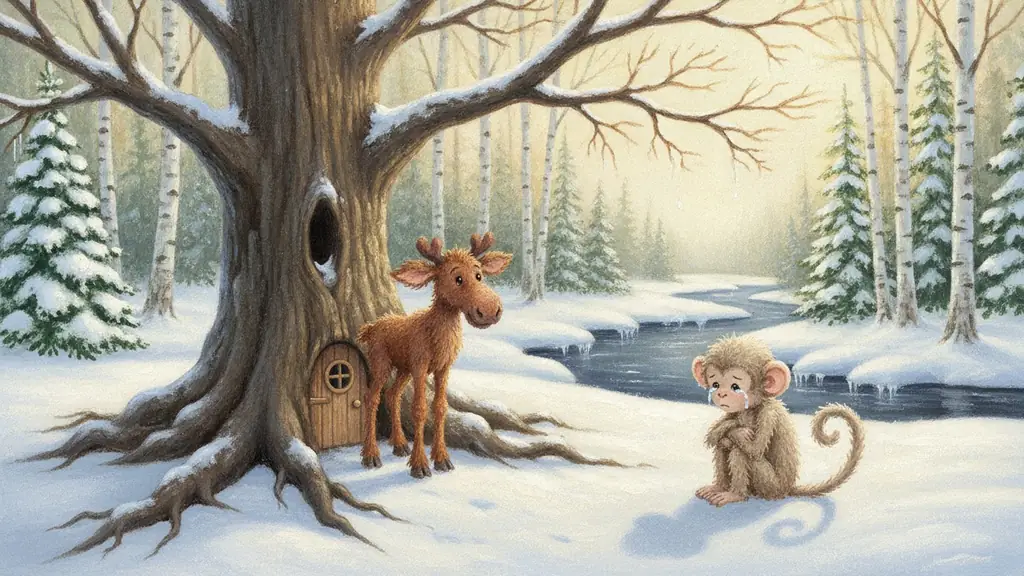
He didn’t know why. His arms felt floppy. His legs felt floppy. His tail lay in the snow like a wet noodle. And then, all by themselves, his eyes started to leak. Big round tears rolled down his cheeks and dripped off his chin, plip, plip, into the snow.
Mr. Moose came out the door and stopped.
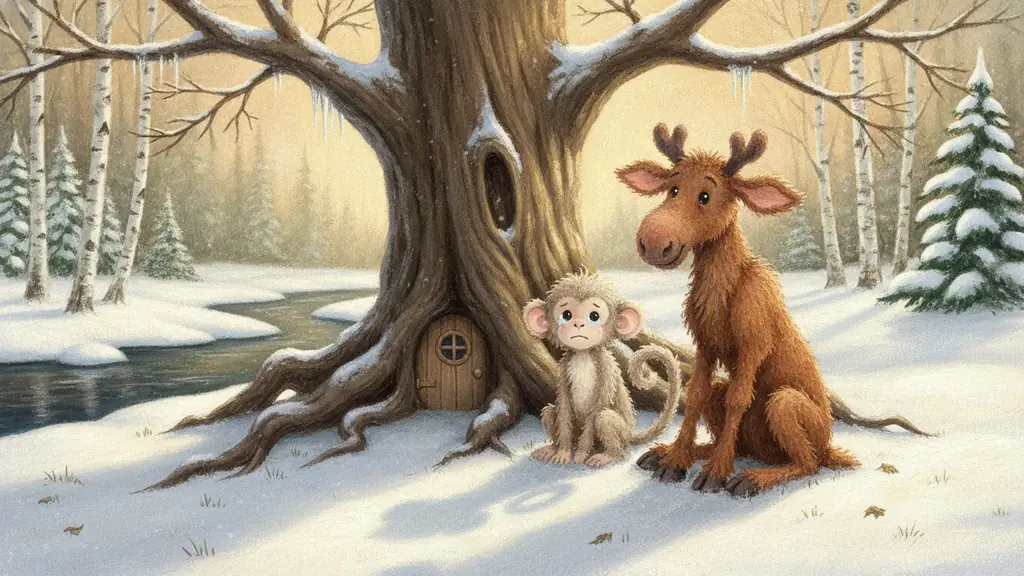
“Mr. Monkey,” he said softly. “What’s wrong?”
“Nothing!” said Mr. Monkey, and another tear fell off his chin. “Nothing’s wrong! Everything’s right! That’s the problem! Why am I crying when everything’s right?”
Mr. Moose sat down in the snow beside him. He didn’t know either. He thought about it. He thought about it very hard.
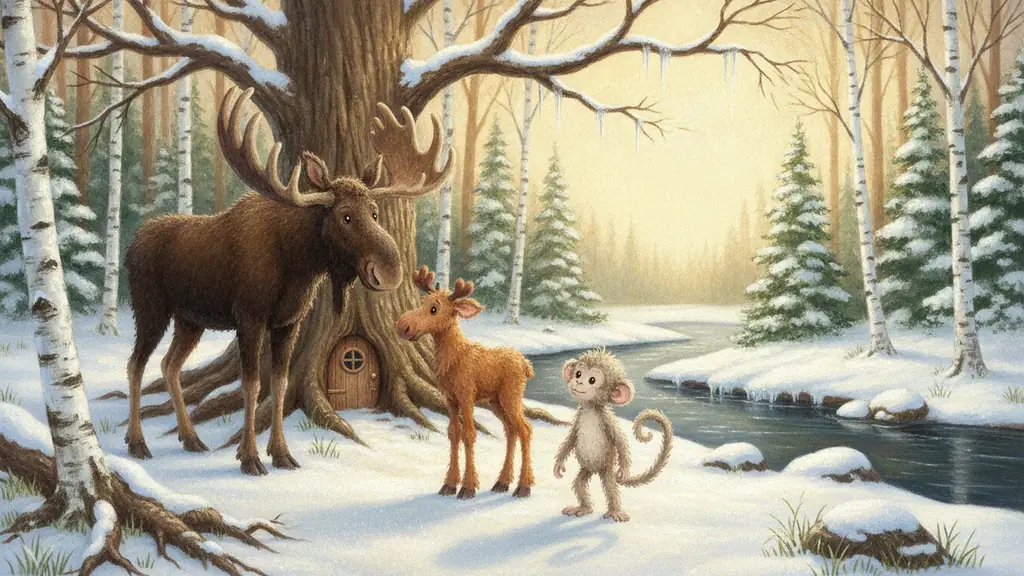
Mr. Monkey wasn’t sad. He was sure of that. Sad was when something was broken. Nothing was broken. So what was this?
“Daddy,” called Mr. Moose. “Why would somebody cry when everything is right?”
Daddy Moose came out and looked at Mr. Monkey sitting in the snow, all floppy, and he didn’t look worried at all. He looked like he knew exactly what this was.
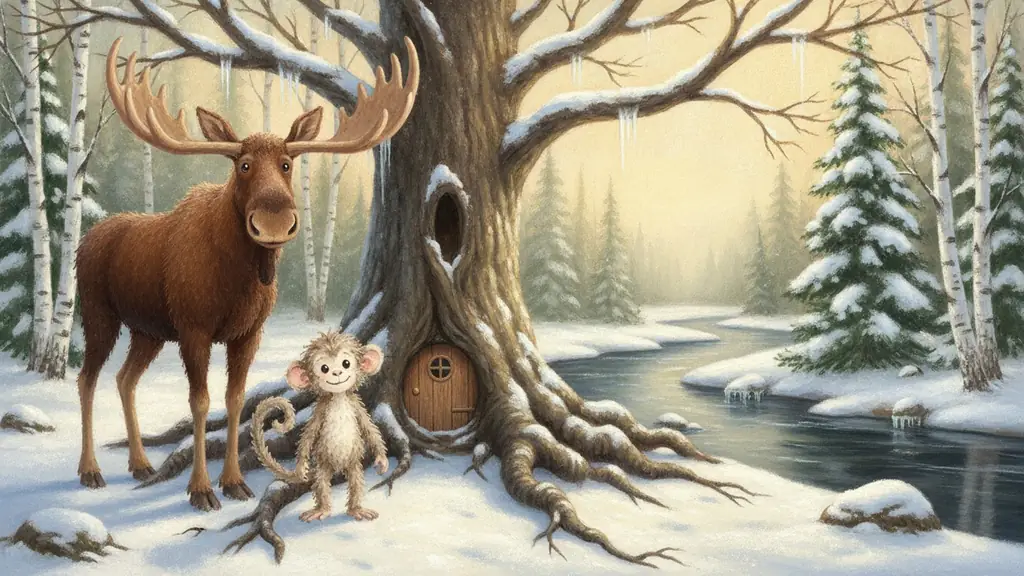
“Come here,” he said. “I’ll show you something.”
He led them back to the door of the Moose home, and Mr. Monkey stood in the doorway. “Push your arms out against the sides,” said Daddy Moose. “Hard. As hard as you can. And keep pushing while I count.”
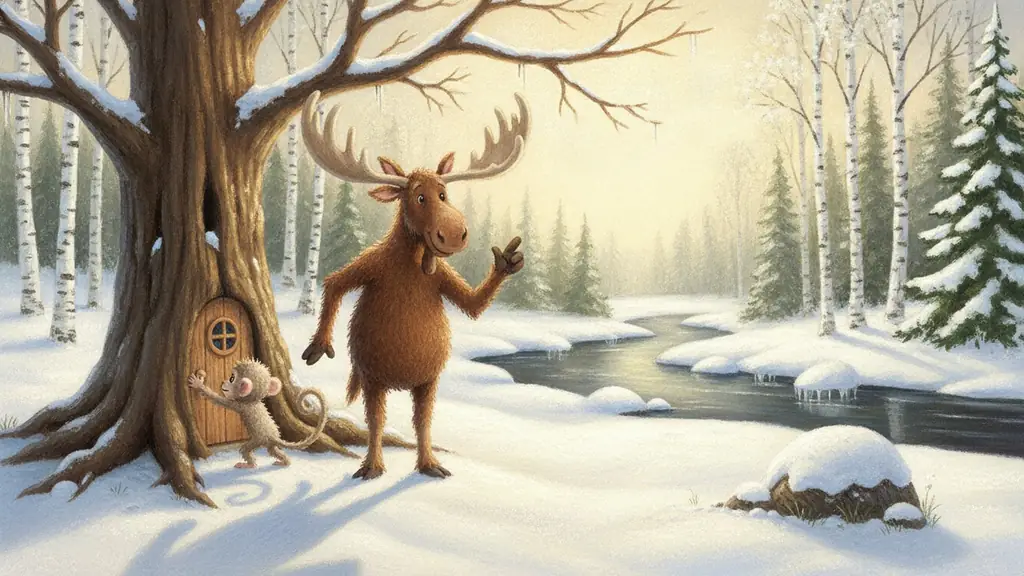
Mr. Monkey pushed against the sides of the doorway with both hands. He pushed so hard his face scrunched up. Daddy Moose counted, slowly, all the way to thirty.
“Now step out,” said Daddy Moose. “And let your arms go.”
Mr. Monkey stepped out of the doorway and let go.

And his arms floated up. All by themselves. Up, up, up, until they were sticking out on both sides like the wings of a bird, and he wasn’t doing it at ALL.
“MY ARMS ARE FLOATING!” shouted Mr. Monkey.
“Ha-ha-ha!” laughed Mr. Moose.
“Hee hee hee!” went Mr. Monkey, with tears still on his cheeks. “Mr. Moose, I’m not doing it! They’re doing it by themselves!”
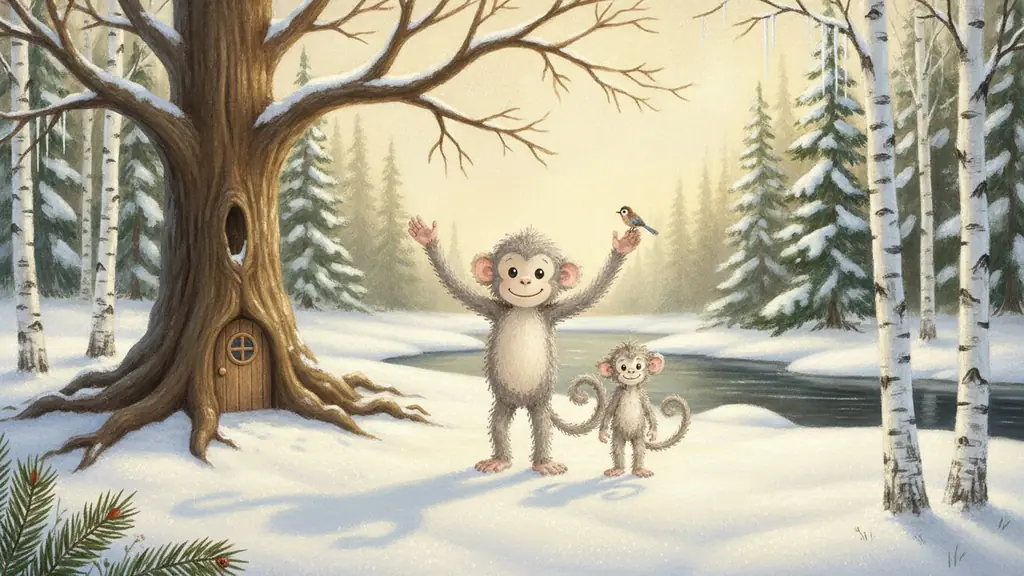
Of course, then everybody had to try.
Daddy Monkey went next. He pushed and pushed, counted to thirty, and stepped out, and his arms floated straight up over his head. “Look!” he said. “I’m a tree!” And he stood there in the snow with his arms up like branches, and a little bird came down and landed right on his hand.

“Hee hee hee!” went Mr. Monkey. “Daddy, you ARE a tree!”
Mama Monkey went after him. She stepped out of the doorway, and her arms floated up and out, and before she could stop them, they floated right around Mama Moose and gave her a big surprise hug.
“Oh!” said Mama Moose.

“I didn’t do it!” said Mama Monkey. “My arms did!” And she didn’t let go.
Then it was Mr. Moose’s turn. Mr. Moose didn’t have arms like a monkey. But he had antlers. So he stood in the doorway and pushed his antlers up against the top of it, hard, as hard as he could, while Daddy Moose counted to thirty.

He stepped out.
And his head floated up. Up, up, up, slowly, until his nose was pointing straight at the sky.
“I can see the clouds,” said Mr. Moose, very seriously, looking straight up. “I didn’t mean to look at the clouds.”
“Ha-ha-ha!” laughed Daddy Moose, which almost never happened.

“Hee hee hee!” went Mr. Monkey. “Mr. Moose is looking at the clouds with his whole head!”
“Daddy Moose, now you!” said Mr. Monkey.

So Daddy Moose stood in the doorway and pushed his big antlers up against the top of it. He pushed so hard that the whole Moose home creaked, crrrreeeak, and all the snow on the roof slid off at once, SHHHHHUMP, right on top of him.
Daddy Moose stood there, all white, with only his eyes and his nose showing.

“Phew,” said Daddy Moose, from somewhere inside the snow.
“Ha-ha-ha!” laughed Mr. Moose. “Daddy’s a snow-moose!”
When everybody’s arms and Mr. Moose’s head had come back down, and Daddy Moose had shaken off the snow, Mr. Moose looked at the doorway. Then at Mr. Monkey. And he figured it out.

“You pushed and pushed,” he said slowly. “All week. You pushed to keep the lights lit. You pushed up the windy ridge. You pushed to stay awake on Lookout Ledge. You pushed all through the longest night. And this morning, you finally stopped pushing.”
Mr. Monkey stared at him.
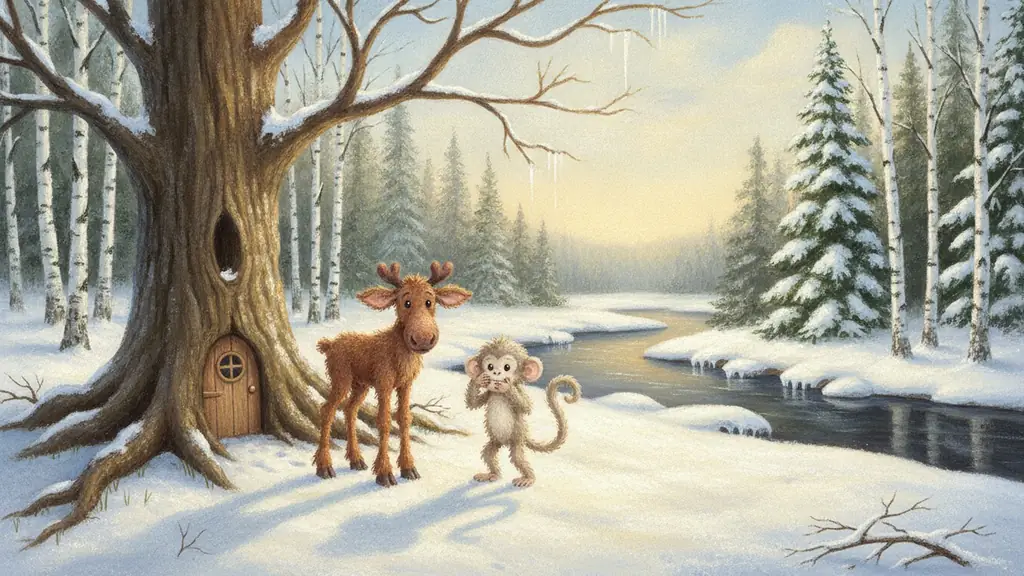
“So now it’s floating up,” said Mr. Moose. “Only it’s not coming out your arms. It’s coming out your eyes.”
Mr. Monkey wiped his face with his tail. “My eyes are floating?”
“Kind of,” said Mr. Moose.
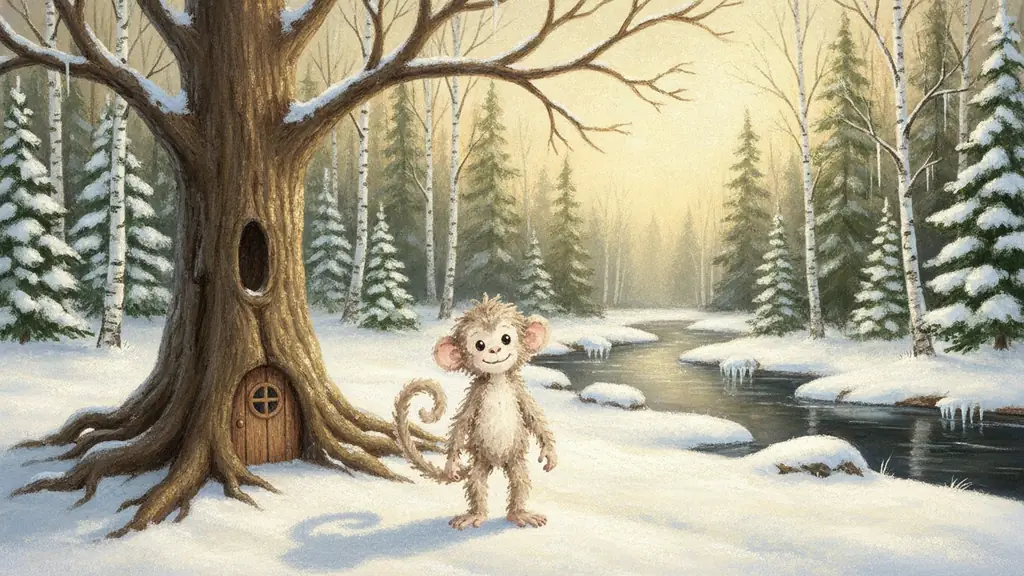
Mr. Monkey thought about that. And then he felt it, for real this time. The tears had made room. Underneath them, the happy came. It came up from his toes and filled up his tummy and his chest, and then it came out his mouth as a whoop so loud that the icicles shook.

“WHOOOOOOP! WE DID IT!”
“We did it,” said Mr. Moose, and his eyes were a little shiny too.

They ran around the Moose home three times. Mr. Monkey finally did his cartwheel, and then his backflip, and then he tried both at once and landed in a snowbank with only his tail sticking out, wagging. Mr. Moose galloped behind him, slowly, with his long legs going every which way.
Then, inside by the fire, the families painted gold circles.
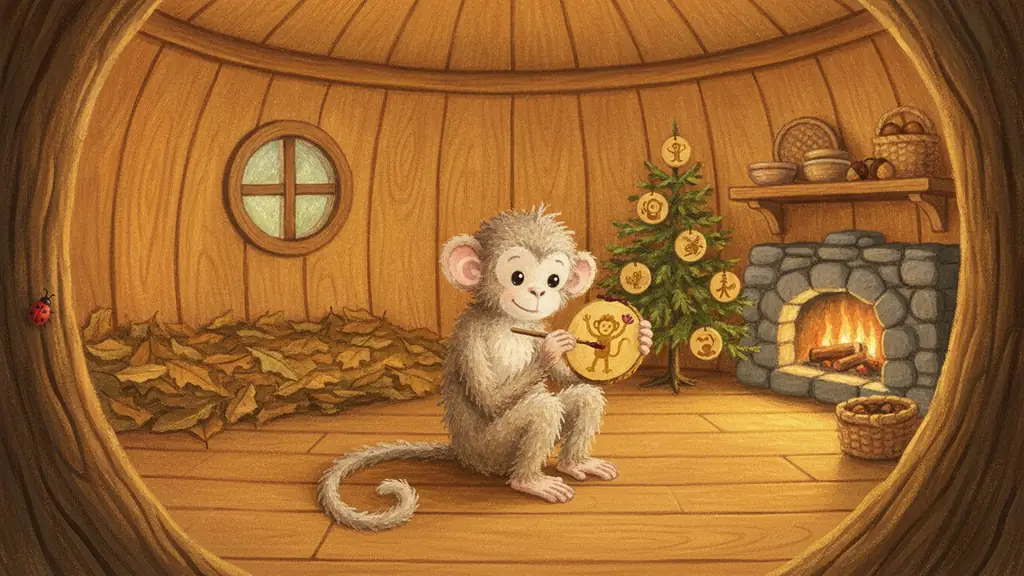
“Paint somebody in your house,” said Mama Moose, “who helped carry the wait with you.”
Mr. Monkey knew right away. He painted Daddy Monkey on the front, with his arms up like a tree. On the back, he painted Lookout Ledge in the dark, and Daddy Monkey bringing the big blankets, and holding him up when he fell asleep standing.
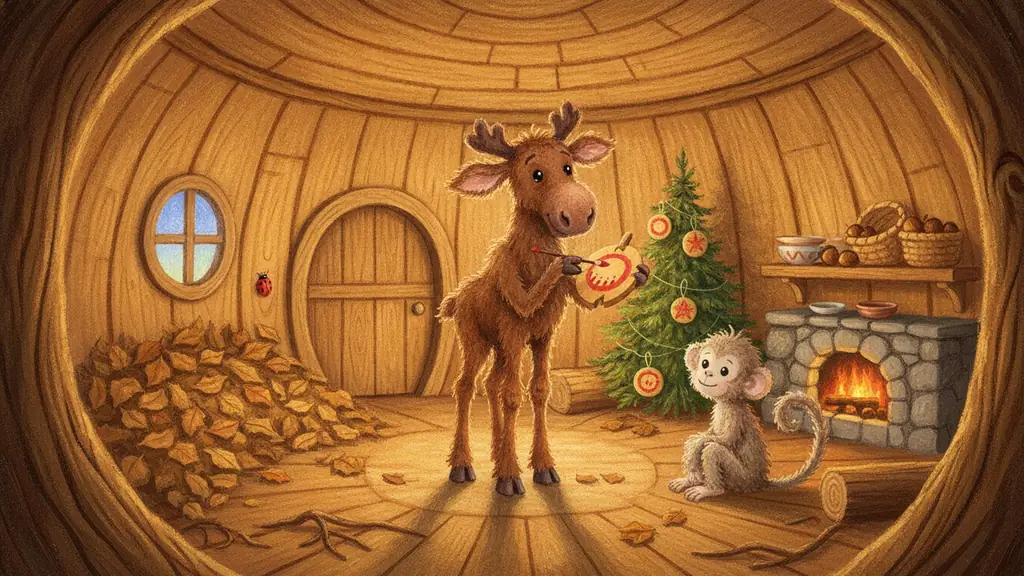
Mr. Moose painted Mama Moose on the front. On the back, he painted a row of new candles, all the ones she had rolled, one after another, every time the old ones burned down.
They hung them on the little green pine by the door, painted side to the trunk, to wait.

“What a day!” said Mr. Monkey, when the sun was going down. “The longest night was over, and I wanted to do a cartwheel, but I sat down in the snow and cried instead.

Daddy Moose showed us the doorway trick. My arms floated, and Daddy turned into a tree, and Mama hugged Mama Moose by accident, and Mr. Moose looked at the clouds with his whole head. Daddy Moose turned into a snow-moose. Then the happy came, and I whooped so loud the icicles shook.”

Mr. Monkey whistled, and Mr. Moose hummed, and together they sang:
We are better together,
Moose and Monkey forever.
And outside the Moose home, the icicles went on dripping in the last of the sun, tink… tink…, as light as anything.