Who in this house spent their time, energy, or attention on me this year?
Who made me feel valued this year?
Last week asked who made your life better. This week asks a deeper question about the same people: what did it cost them? The week is called Important because a cost like that tells you how much you matter to the person who paid it. Another way to put it is that they made you feel valued. For the next seven days, we look back over the last year at the times someone spent something on you that they couldn't get back, and we try to name what it was.
The week runs on the same rhythm as Improvement:
Monday to Wednesday: Saturate. These three days are for receiving. Each day has a short reading and a few minutes of noticing, and the days move through the same three circles: the people in your house (Core) on Monday, the people within your reach (Community) on Tuesday, and the good things no person arranged (Cosmos) on Wednesday.
Thursday: Celebrate. It's Thankful Thursday again. The family adds up some of what people spent on your household this year, traces a favorite dish back to everyone who helped make it, and then prints photos and cuts leaves for the weekend.
Friday to Sunday: Participate. These three days are for giving. You write thank-you notes on paper and photo leaves and hang them beside last week's, working through Core on Friday, Community on Saturday, and Cosmos on Sunday.
Every daily reading has the same three parts: a picture for the heart, a point for the head, and a practice for the hands. By Sunday night, the trunk will carry a second week of leaves.
Imagine a woman in her forties going through a box of her late father's things. Near the bottom she finds a pocket datebook from the year she turned ten. Most of it is work: shift times, a dentist appointment, a car payment due on the fifteenth.
On one Saturday, a single word has been crossed out with one line: "Overtime." Under it, in his blocky handwriting, he wrote "Piano recital, 2:00."
She sits down on the floor with the book open on her knee. She remembers that recital. She played badly. She remembers looking out from the piano and finding him in the third row, still in his work boots, because he had come straight from the morning shift.
It had never once occurred to her that the boots were a decision. She hadn't known there was a Saturday when he could have earned more money and didn't. Whatever he chose that day, he chose instead of something else, but he never said a word about it.
She closes the datebook and keeps it in her lap a while longer.
(Read-aloud option: this one works at the table. Ask the household, "What might someone have crossed out so they could be at your game, your recital, or your bedside?")
Last week's question was what got better and who was behind it. This week's question sits right underneath it: what did it cost them?
Economists have a name for the cost of a choice. They call it opportunity cost: the value of the best thing you gave up in order to do the thing you did. Every hour and every dollar comes with one. When someone spends an evening with you, the cost includes the other evening, the one that never happened.
That brings us to this week's point, the economics of importance. What someone spends on you that they can't get back is one of the clearest signs that you matter to them. The things nobody gets back are simple to list: time, money, energy, and attention. When someone spends one of them on you, they've spent something they could have used anywhere else.
It's a working position, open to argument. In plain words, love and value show up in what a person sets down in order to pick you up. A sign isn't a scale, though. Someone with very little to spare who spends a little of it on you has given as much as anyone, and often more.
Jesus told a story built on exactly that. Luke records it, and most of us know it as the Good Samaritan. A man is robbed, beaten, and left half dead beside a road. A priest comes along and passes by on the other side, and so does a Levite, a temple assistant. To Jesus's listeners, those two were the model of a devout life. Then a Samaritan comes along, from a people most of those listeners looked down on, and he stops. He bandages the man's wounds, pouring on his own oil and wine. He puts him on his own donkey, takes him to an inn, and pays the innkeeper to keep caring for him, with a promise to cover whatever more it costs when he comes back. The story is full of what he spent. (Love week comes back to this story and the question that started it.)
One plain word before the practice begins. Naming what someone gave up for you is an invitation to thank them, and that's all it is. Nobody in your house owes anybody a payment because you finally noticed the price.
Who in your house set something down this past year so they could pick you up, and what was it?
1. The journal line. Finish this sentence as many times as you like:
Instead of ___, ___ ___ for me.
A couple of examples: "Instead of sleeping in, Mom drove me to practice." "Instead of watching the game, Dad sat with me on the bathroom floor when I was sick." Start with the people in your house, and stay within the last year. The "instead of" can be small, but the small ones are often the ones that say the most.
2. The photo hunt. Scroll back through the last year for pictures that show someone showing up: a parent at a game, a spouse at a bedside, a sibling helping with a project. Add them to the digital Thankful Album. Photos that catch someone in the middle of giving are worth looking for, even if nobody was posing.
Kids' story: read "Staying Up All Night" from The Thank-You Adventure in Wanderful Woods together.
Time: 10 to 15 minutes for adults alone, or about 20 if you do it together.
With younger kids: ask, "What did someone stop doing so they could do something with you?"
If money comes up: it's fine to name it. Money is one of the four things nobody gets back, and there's no shame in saying a gift cost something.
If the sentence turns into guilt: the Head has a plain line for this. Naming the price is an invitation to say thank you, and nothing is owed. Say it out loud if you need to.
This week's checklist is shorter, since last week's setup carries over.
The trunk is up and holding last week's leaves, writing to the wall.
The Thankful Album is going.
Paper, tape, and pens are set aside, and you know where you'll print on Thursday.
If you skipped the Improvement days, you haven't fallen behind. Start right here. Remember, No Hurry = No Worry.
Hello, my wonderful story friends! Last week, Mr. Moose and Mr. Monkey found out who made their year better, and they tied thank-you leaves all over the Wishing Tree. On the way home, Mr. Moose started wondering something new: when Daddy stood in the cold brook, was the water cold for him too?
Has anybody ever stayed up late, just for you? Let’s go find out what that’s like.
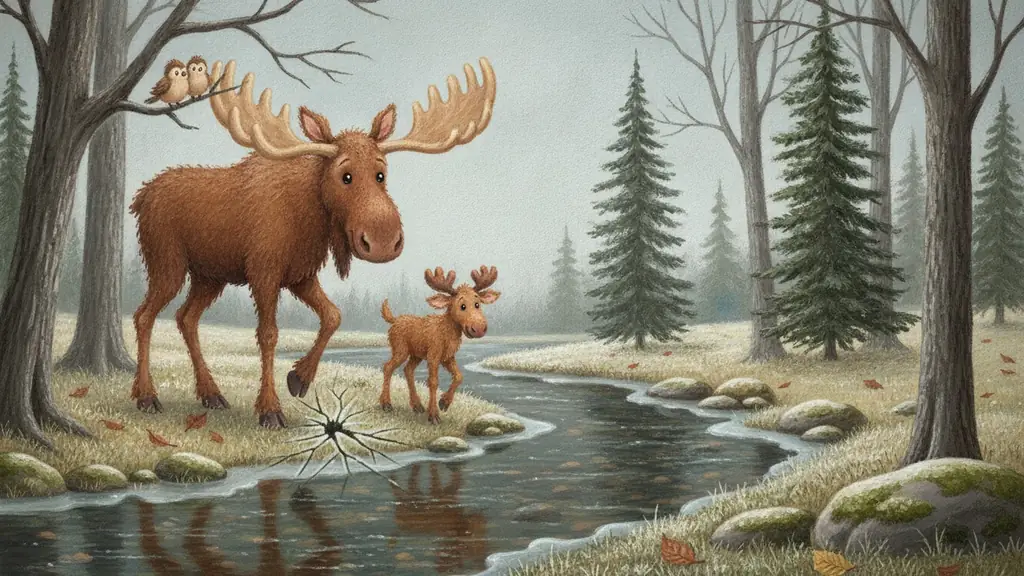
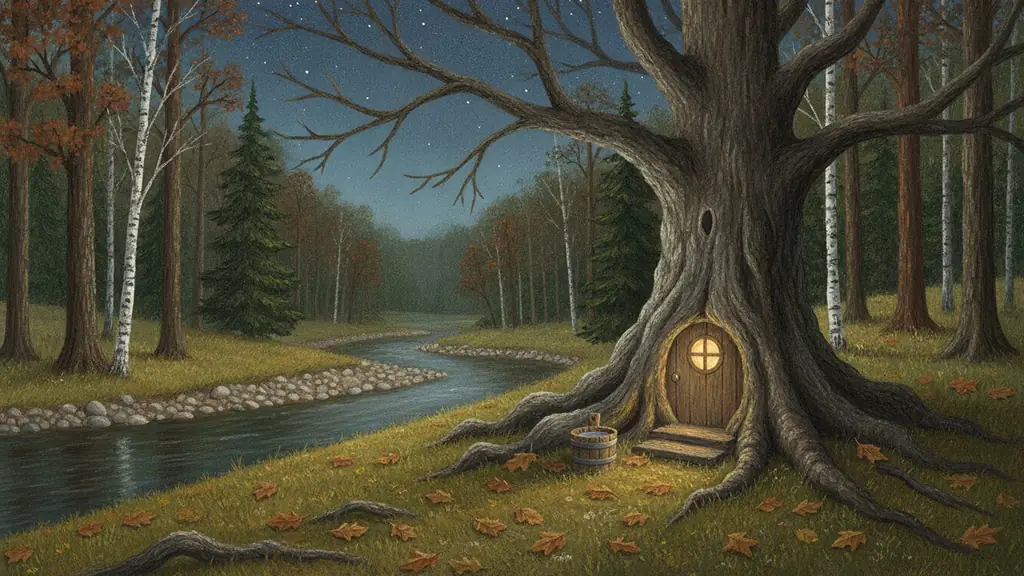
The morning was gray and frosty, and the bare branches of the Wishing Tree were all clicking together in the wind. Tik-tik-tok. Tik-tik-tok.
Mr. Moose found Daddy Moose down at the brook, breaking the thin ice at the edge so the birds could drink.
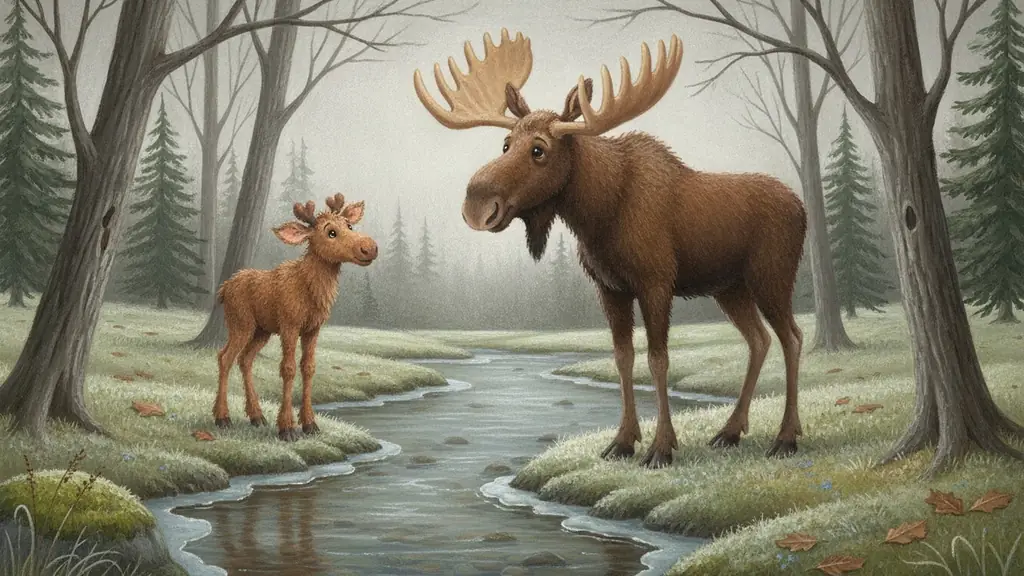
“Daddy,” said Mr. Moose. “When you stood in the brook every morning, while I learned to walk the log… was the water cold?”
Daddy Moose looked at the brook. He looked at the ice. “Very cold,” he said.
“Twenty-two times cold?”
“Twenty-two times cold,” said Daddy Moose. Then he smiled. “I’d do it again.”
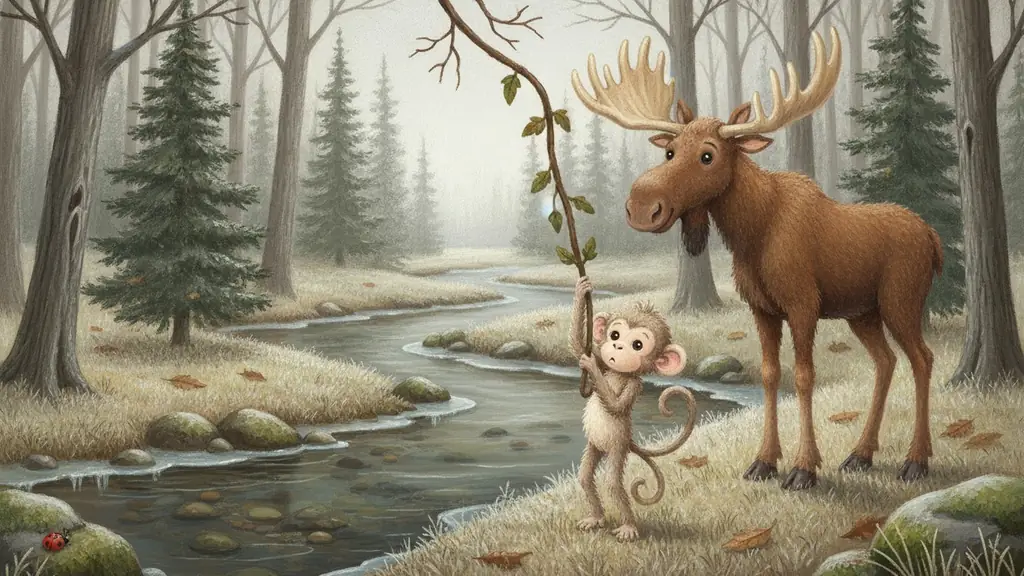
Mr. Moose didn’t know what to say. He had thought the brook was just a thing that happened. He hadn’t thought about it being cold for anybody but himself.
Mr. Monkey came swinging down from the treehouse. “What are you talking about?”
“What it cost,” said Mr. Moose slowly. “Daddy didn’t just help me. He got cold for me. He gave up being warm.”
Mr. Monkey looked at the icy brook. “How cold?”
“Very,” said Daddy Moose.
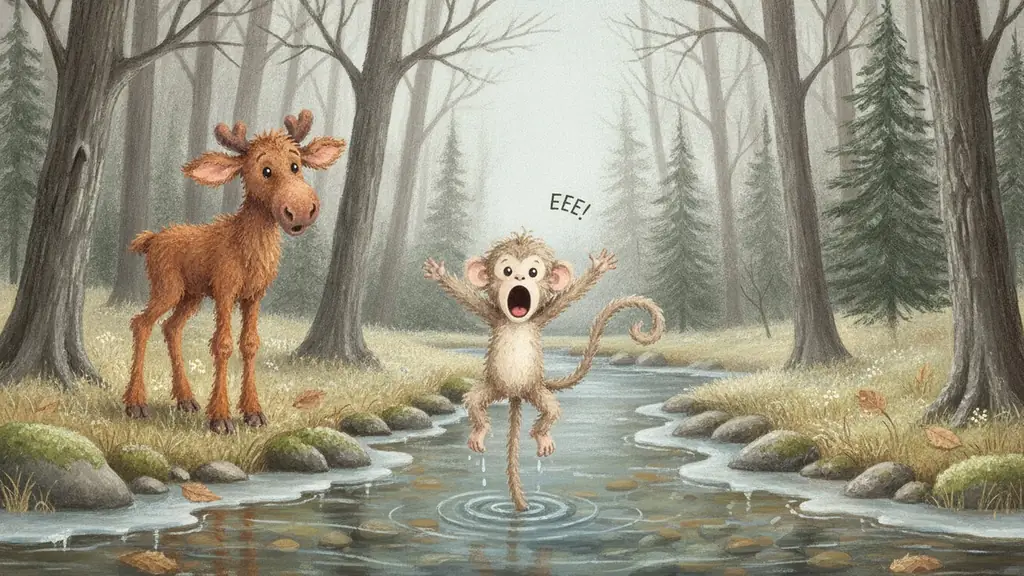
“I want to know HOW cold,” said Mr. Monkey. And before anybody could stop him, he dipped one toe in.
“EEEEEEEEE!”
He shot straight up into the air like a rocket, grabbed the nearest branch, and hung there with his toes curled up tight. His teeth went chikka-chikka-chikka. Even his tail was shivering.
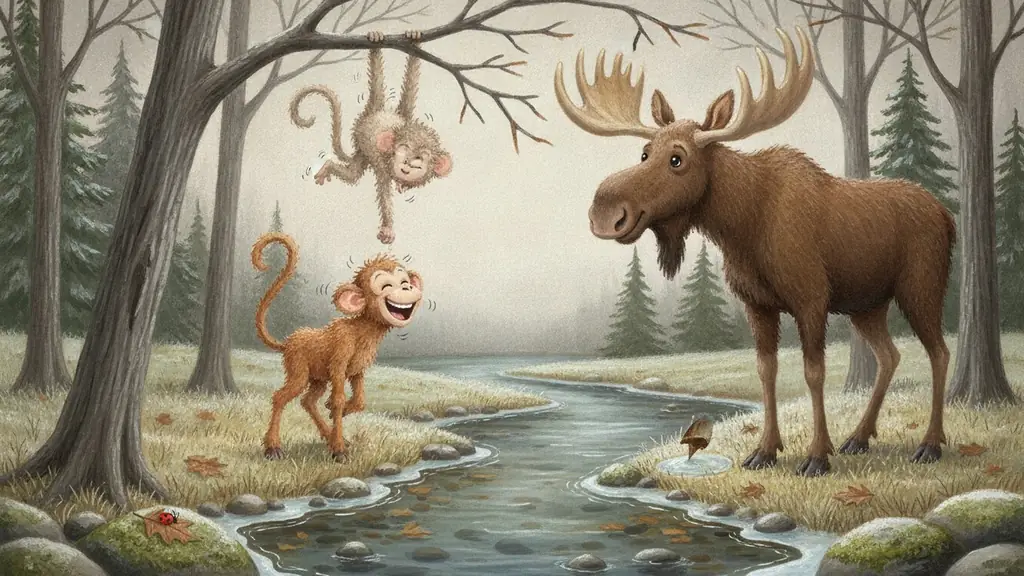
“That’s how cold,” said Mr. Monkey, from up in the tree. “That’s VERY cold.”
“Ha-ha-ha!” laughed Mr. Moose.
“Twenty-two times,” said Mr. Monkey, looking down at Daddy Moose with big, round eyes. “With your WHOLE legs.”
Daddy Moose just smiled and went on breaking the ice.
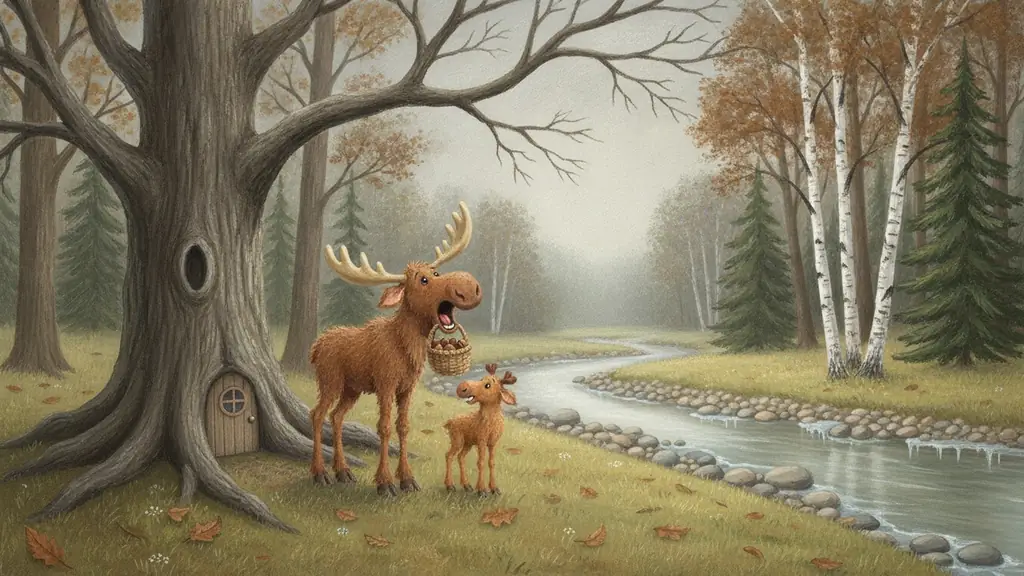
Then Mama Moose came out of the big maple with a basket of acorns, and she yawned. A big, long yawn.
“Mama,” said Mr. Moose. “Why are you so sleepy?”
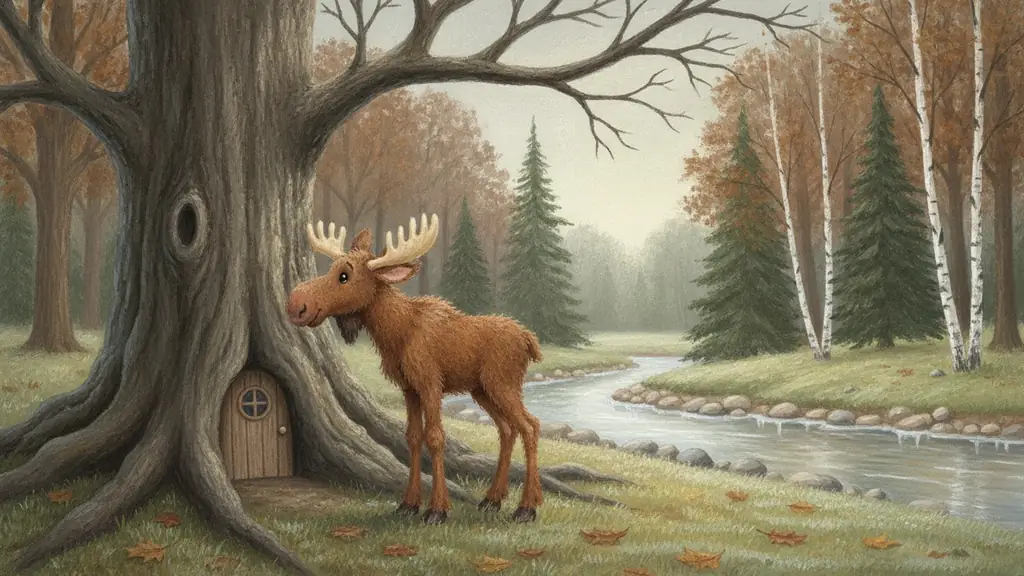
“Oh,” said Mama Moose, “remember last spring, when you had that bad dream about the thunder? You were scared all night. So I sat up with you. All night long, right next to your bed, until the sun came up.”
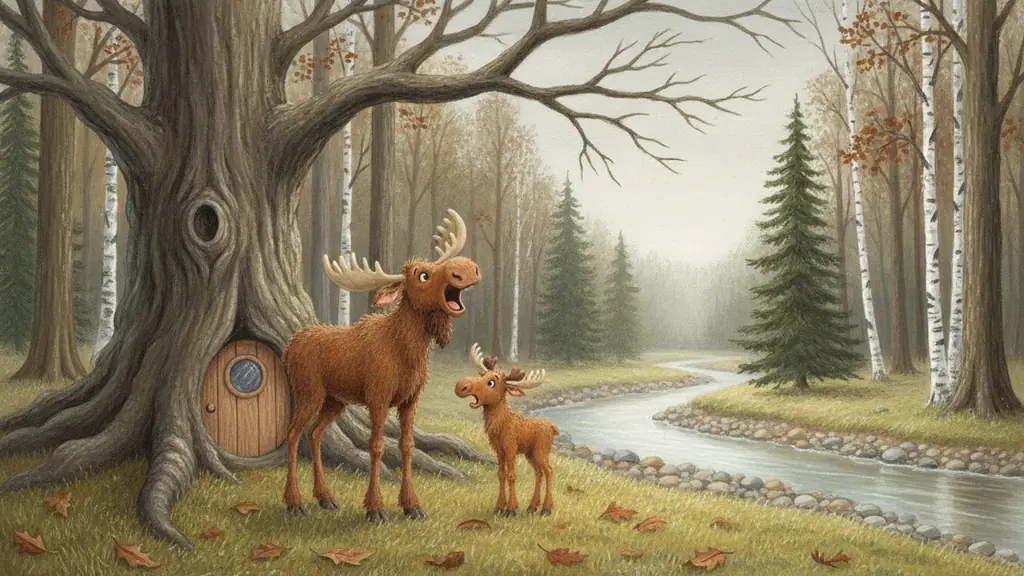
Mr. Moose remembered the thunder. He remembered being scared. He remembered Mama’s voice humming in the dark. But he didn’t remember that she never went to sleep.
“The whole night?” he said.
“The whole night,” said Mama Moose. “I still get sleepy when I think about it.” She yawned again and went back inside.
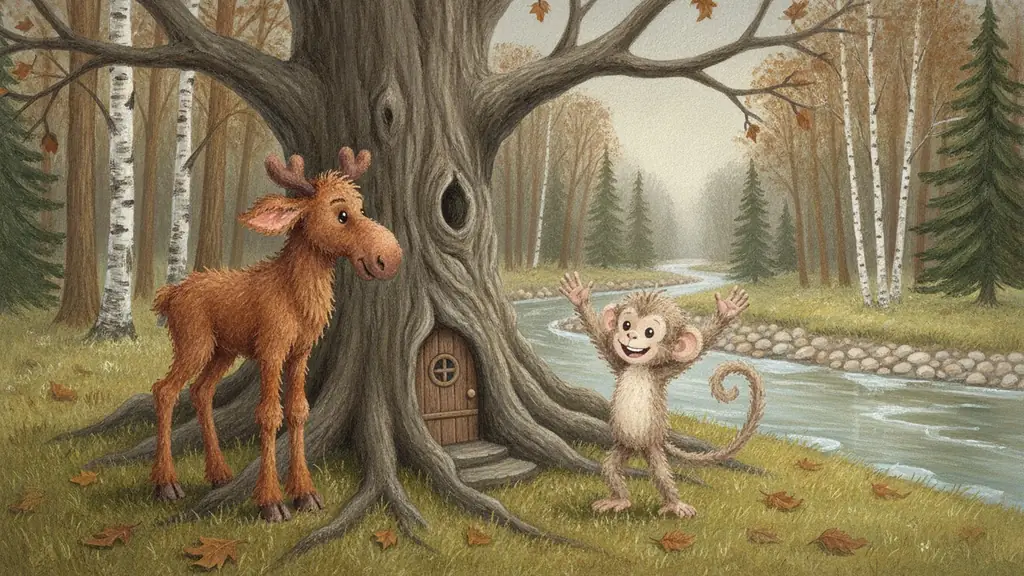
Mr. Moose turned to Mr. Monkey. “We have to find out how long a whole night is.”
“Tonight!” said Mr. Monkey. “We’ll stay up ALL night! Just like Mama Moose!”
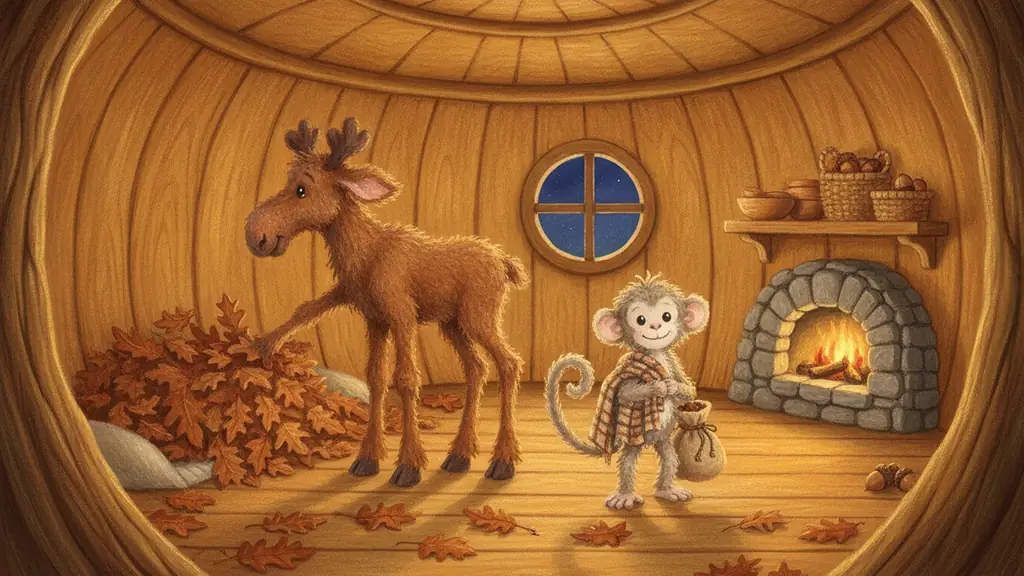
So that evening, Mr. Monkey came down from the treehouse with a blanket and a bag of nuts for snacks. Mr. Moose fluffed up his bed of leaves. Sammy Squirrel heard about it and zipped in to help.
“I’ll keep you awake!” she said. “I’m the best at being awake! I’ll tell you jokes all night! Ready? What do you call a sleeping dinosaur?”
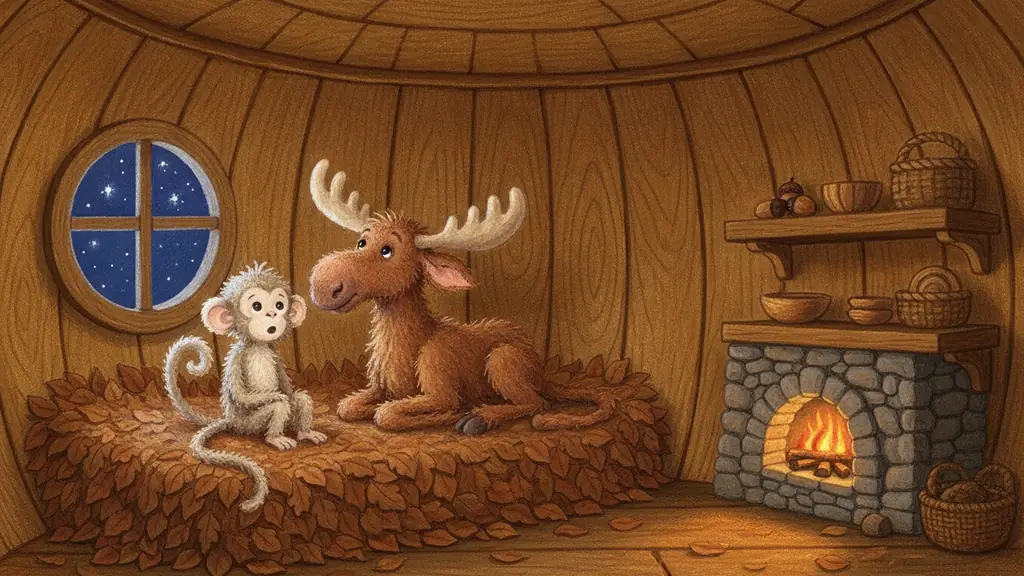
And she zipped out the door before anybody could answer.
Mr. Moose and Mr. Monkey looked at each other.
The sun went down. The stars came out. An owl hooted from Pilgrim Point. Mr. Monkey sat up very straight with his eyes very wide.
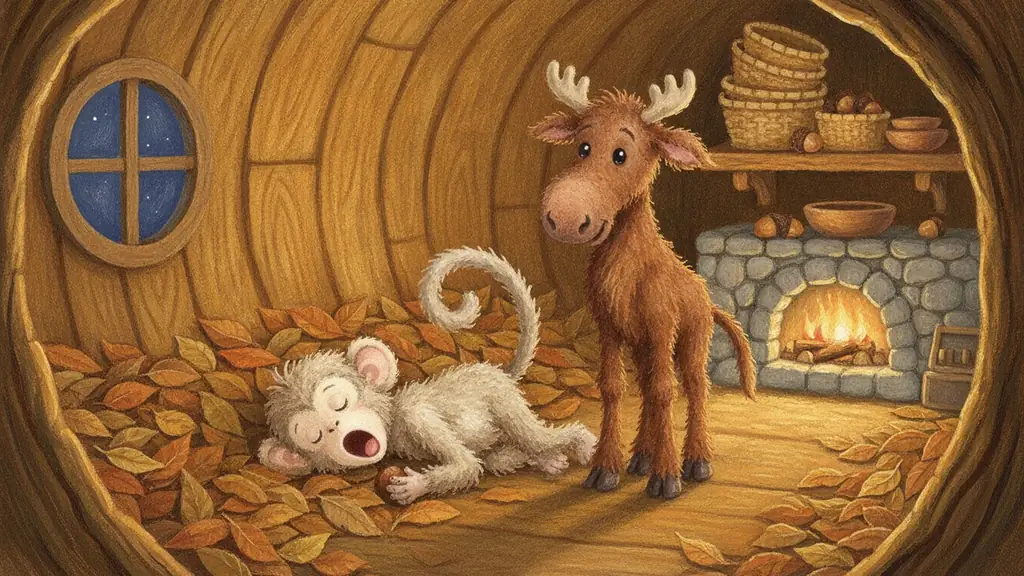
“I’m SO awake,” said Mr. Monkey. “I’m the awakest monkey in the whole—“ And he yawned. His eyes went droopy. His head went nod… nod… nod… and fwump, he fell over sideways into the leaves, already snoring. Hnnnk-shhhh. Hnnnk-shhhh.
Mr. Moose looked at him. “That wasn’t the whole night,” he said. “That was about three snacks.”
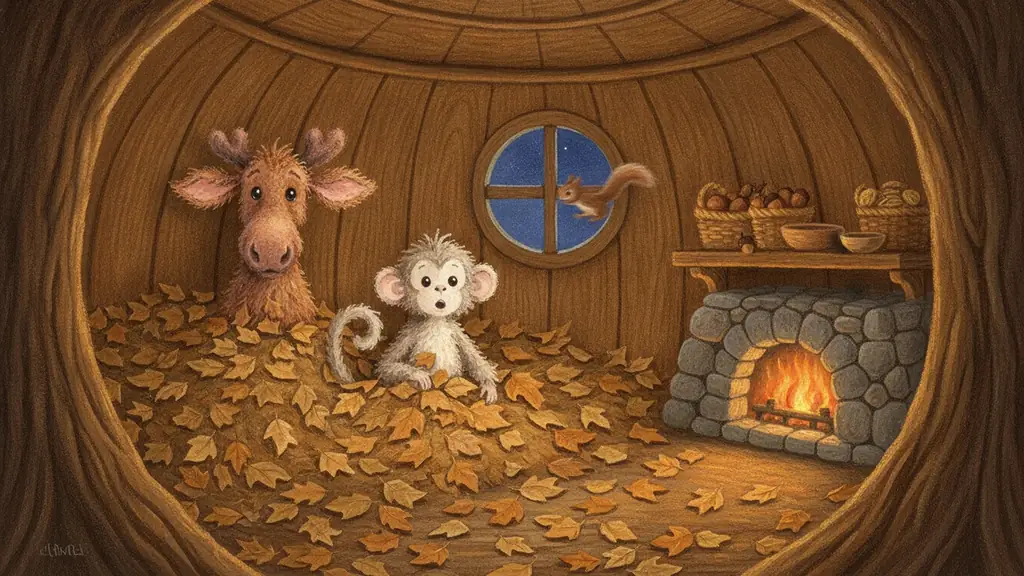
He tried to stay up by himself. He counted the stars through the window. He got to eleven. Then he started counting them again, slower. Six… seven… sev…
From outside the window, very fast, came Sammy’s voice: “A DINO-SNORE!”
Mr. Moose’s head popped up. Mr. Monkey’s head popped up.
“Hee hee hee!” Mr. Monkey sat up with leaves in his fur. “A dino-SNORE!”
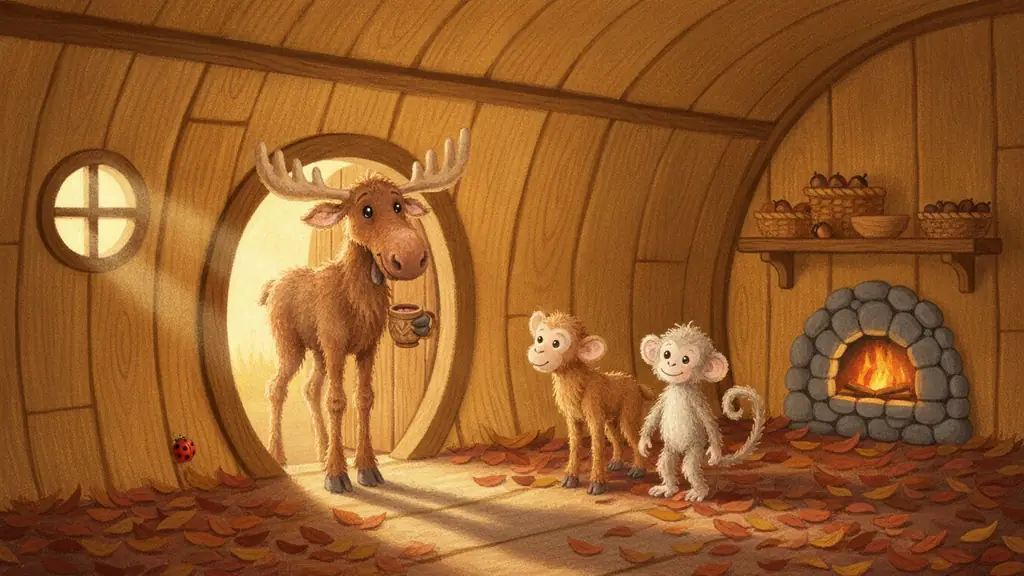
“Ha-ha-ha!” laughed Mr. Moose, and then both of them were asleep again before the next star came out.
When Mr. Moose opened his eyes, the sun was coming in the window, and Mama Moose was standing in the doorway with a cup of warm berry tea, smiling.
“Good morning,” she said. “How long was the whole night?”
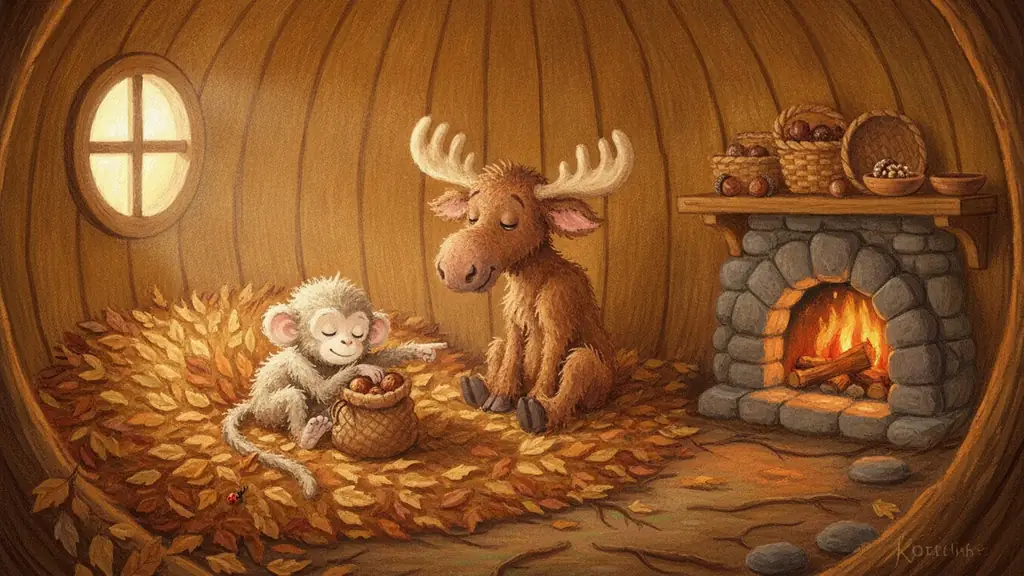
Mr. Moose sat up. “I don’t know,” he said. “I didn’t stay up for it.”
Mr. Monkey was still curled in the leaves, with one foot in the nut bag. “Mr. Snoose,” he mumbled, pointing sleepily at Mr. Moose. “You snored. Like a dino.”
“You snored first,” said Mr. Moose.
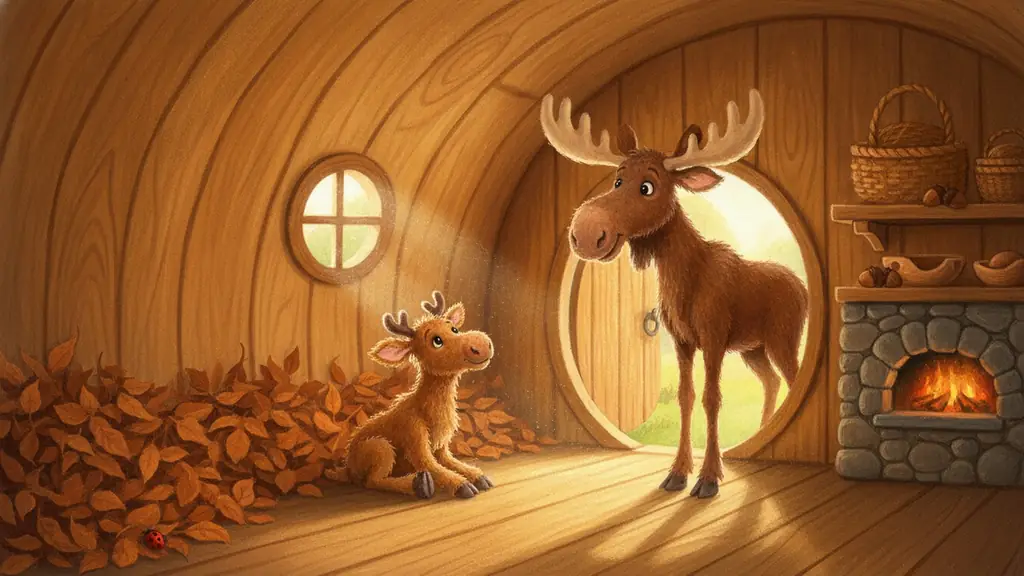
Then Mr. Moose looked at Mama Moose, and he thought about it. They had tried to stay up a whole night, and they couldn’t even stay up a little bit of it. Mama Moose had stayed up the whole thing. Not because she wasn’t sleepy. She was sleepy. She stayed up anyway. For him.
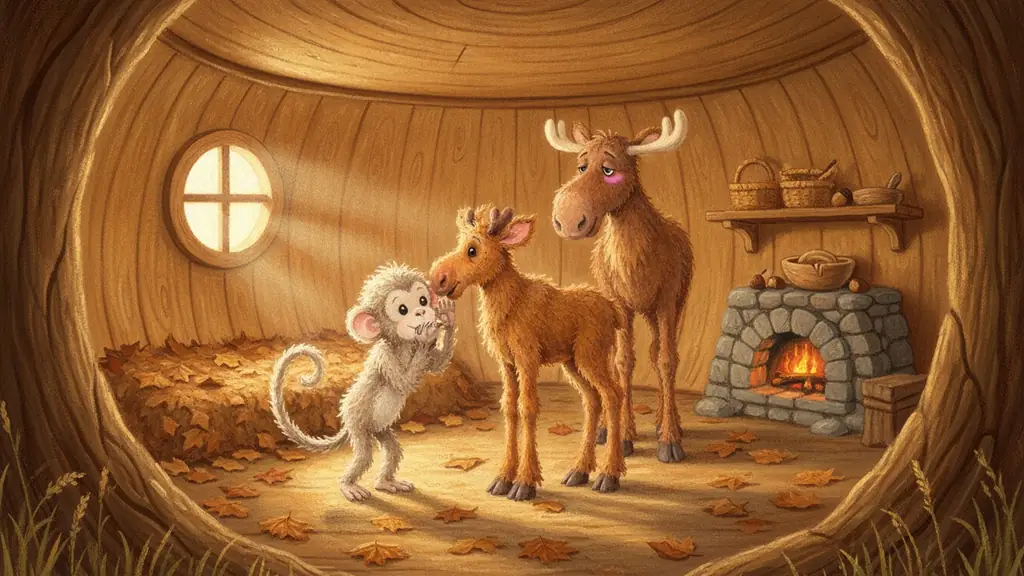
Mr. Monkey sat up and looked at Mama Moose too. He saw the dark, tired circles under her eyes. He felt it, deep in his chest. “Mr. Moose,” he whispered. “She’s still a little tired. From last spring.”
“Then maybe we give her some sleep back,” said Mr. Moose.
“How do you give somebody sleep?”
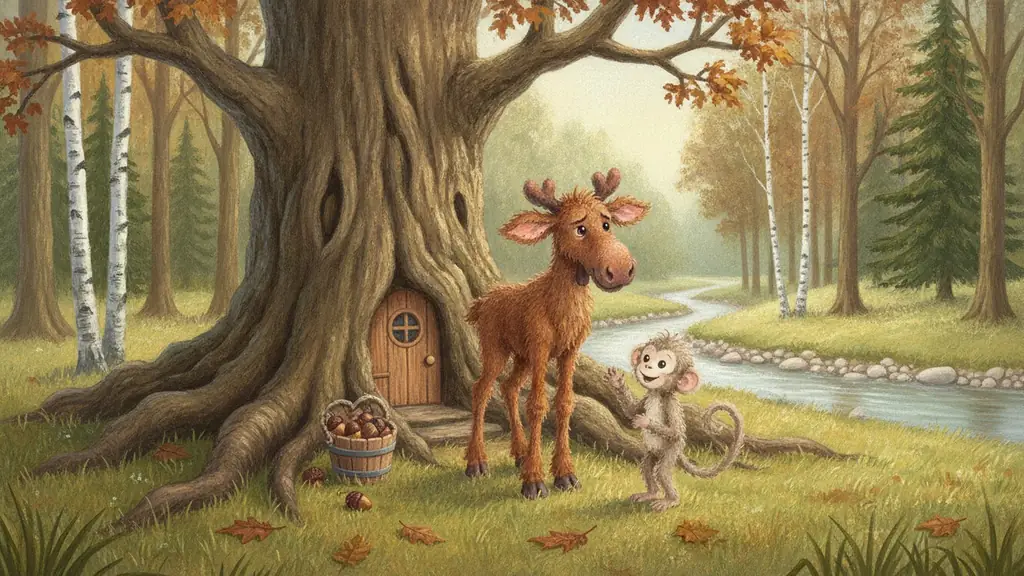
Mr. Moose thought it through. Mama Moose couldn’t sleep if there was work to do. Every morning she gathered acorns, swept the leaves off the doorstep, and brought water up from the brook. If somebody else did all of that, she could rest.
“We do her morning jobs,” said Mr. Moose. “All of them. And she naps.”
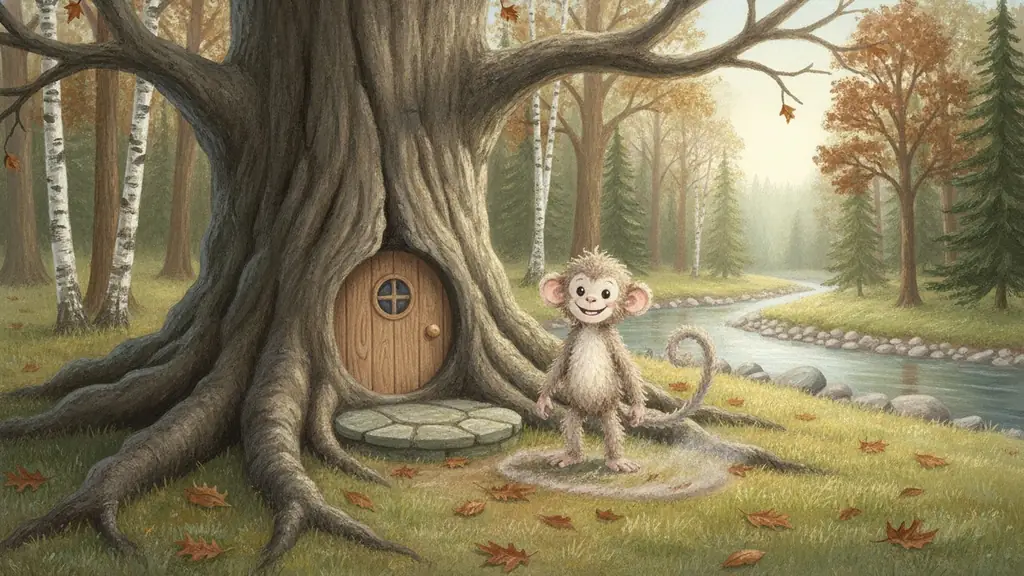
“Even the brook part?” said Mr. Monkey, looking at his toes.
“Even the brook part,” said Mr. Moose.
Mr. Moose tucked Mama Moose into her bed with his own warm blanket. Mr. Monkey swept the doorstep with his tail, swish-swish-swish, until it was the cleanest doorstep in all of Wanderful Woods and his tail was full of dust.
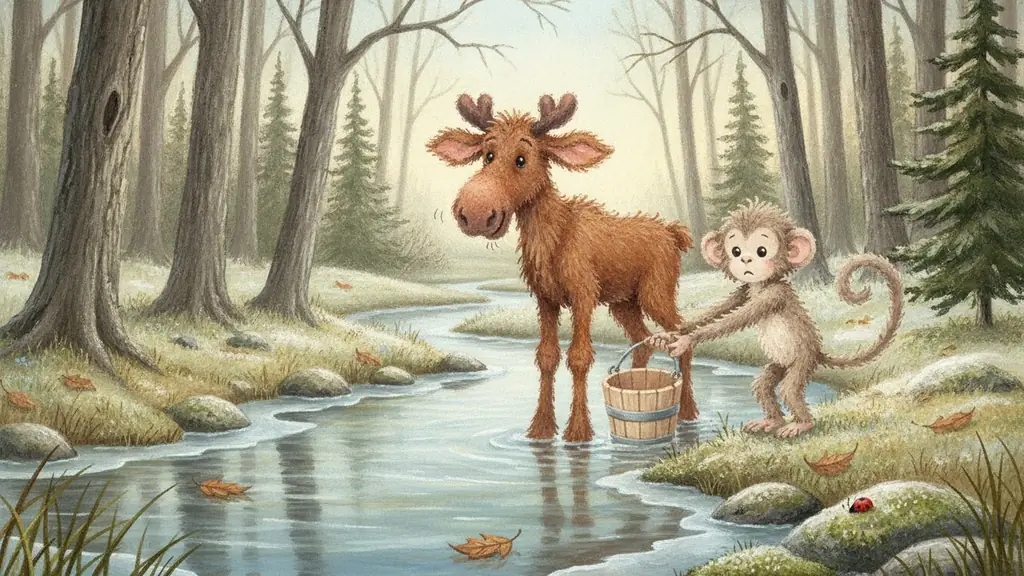
Mr. Moose gathered the acorns, slowly and carefully. And then they carried the water bucket down to the icy brook together, and Mr. Monkey held the bucket while Mr. Moose waded in to fill it.
“Is it cold?” whispered Mr. Monkey.
“Very cold,” said Mr. Moose, with his teeth going chikka-chikka. “I’d do it again.”
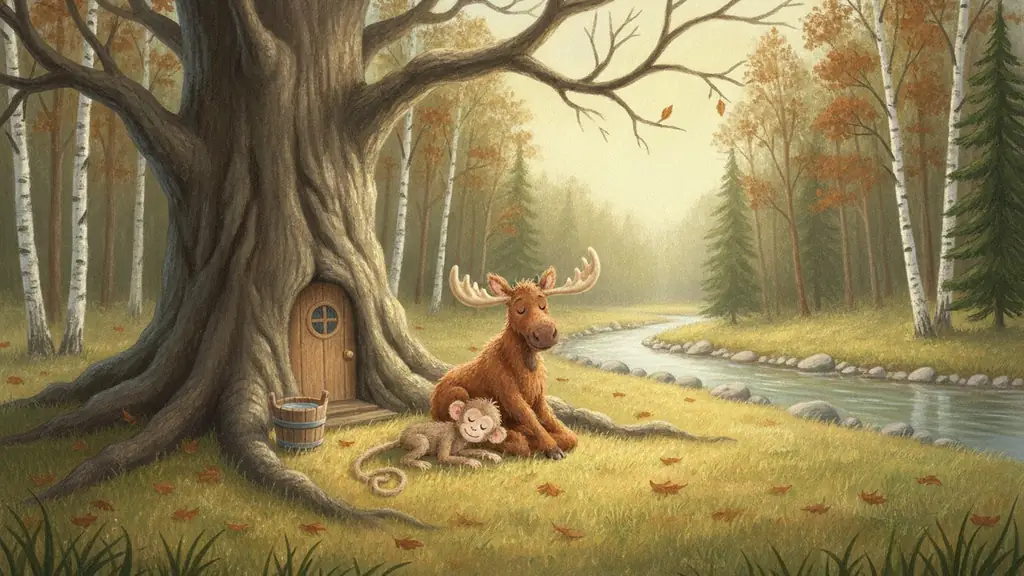
When Mama Moose woke up at lunchtime, everything was done. She looked at the clean doorstep. She looked at the full bucket. She looked at the dusty monkey and the damp moose, both fast asleep on the step in the sunshine.
She didn’t wake them up. She just sat down next to them and let them sleep.
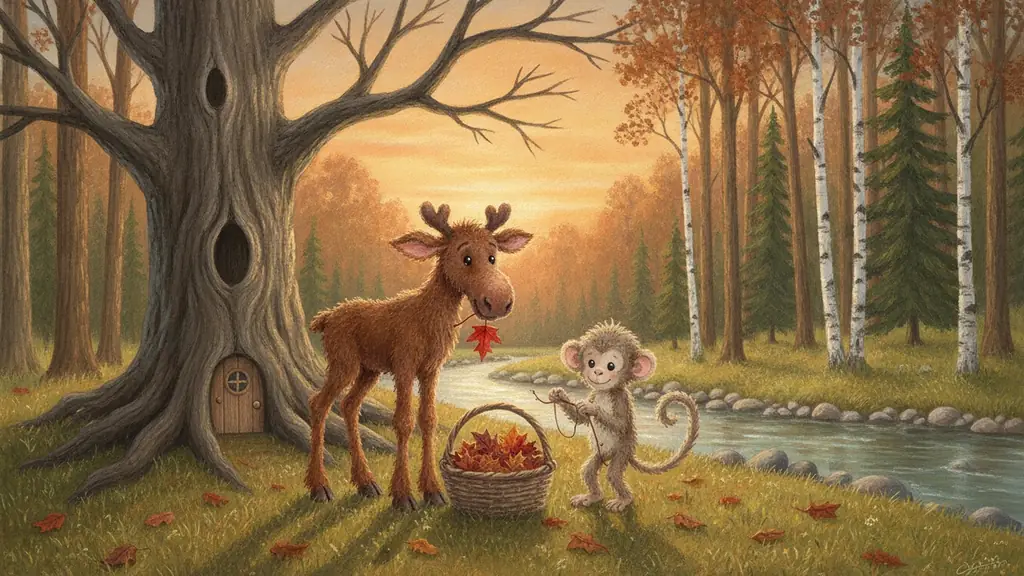
That evening, they put a new leaf in their basket. This time, Mr. Moose had an idea. He tied a tiny twig to the stem, so the leaf had a little stick hanging from it.
“What’s the twig for?” asked Mr. Monkey.
“The twig is what it cost,” said Mr. Moose. “The leaf is the thank-you. The twig is for the whole night Mama didn’t sleep.”
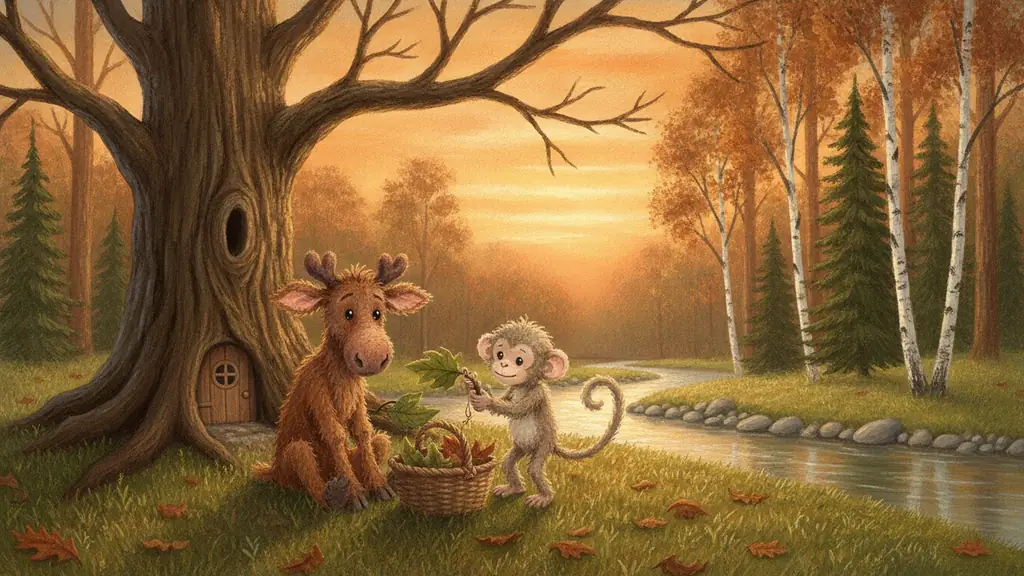
Mr. Monkey picked up a leaf for Daddy Moose and tied a twig to it too. “This twig is the cold water,” he said.
They looked at the two leaves with their little twigs. They looked heavier than the leaves from last week. But they didn’t look sad. They looked important.
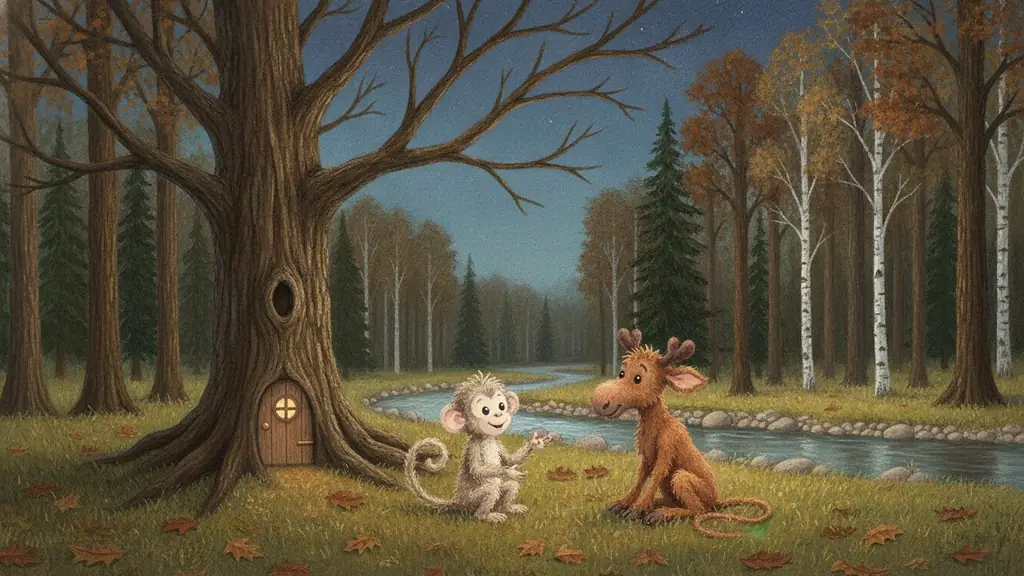
“What a day!” said Mr. Monkey as the stars came out. “My toe went in the brook and I went up the tree. We tried to stay up all night like Mama Moose, and we fell asleep after three snacks. Sammy told a dino-snore joke from outside the window. And we did all of Mama’s morning jobs so she could have her sleep back.”
Mr. Monkey whistled, and Mr. Moose hummed, and together they sang:
We are better together,
Moose and Monkey forever.
And inside the big maple, Mama Moose fell asleep early that night, all the way to morning, with a clean doorstep outside and a full bucket of water by the door.