Whose "maybe" could I help pay for?
Yesterday we gave time. Today's currency is resources: money, or something you own or buy.
Play "O Holy Night" today, any version your family likes.
The song started in France in 1847. A wine merchant and poet named Placide Cappeau, from the small town of Roquemaure, was asked by the town's priest to write a poem for the Christmas Midnight Mass, and the composer Adolphe Adam, best known for the ballet Giselle, set it to music. The English words most of us sing came about eight years later from John Sullivan Dwight, an American minister and music critic. Dwight wrote a loose version rather than a word-for-word translation, so some of the most famous lines are his own:
"Long lay the world in sin and error pining, / Till He appear'd and the soul felt its worth. / A thrill of hope the weary world rejoices, / For yonder breaks a new and glorious morn."
The third verse goes back to Cappeau. He wrote it in 1847, while France was arguing over slavery in its colonies, and on April 27 of the next year, France abolished it. His French already called the slave a brother. Dwight lived through the same argument in his own country. He was against slavery, and he kept that line strong in English a few years before the American Civil War: "Chains shall He break, for the slave is our brother, / And in His name all oppression shall cease."
Listen for the line about a thrill of hope. A thrill of hope is what a tired person feels when something good suddenly seems possible again. Nothing has arrived yet. The morning is only beginning to break, but it's enough to make a weary world sit up.
And listen for the second line, too. In the song, people found out what they were worth when Jesus appeared, before any of them had done anything to earn it. Cappeau and Dwight both took that seriously enough to sing about breaking chains.
A lot of people in a long wait still want the good thing and are still willing to work for it. What stands in the way is the cost of the next step: the application fee, the certification class, the deposit on an apartment, the car repair between someone and a new job, the first month of supplies for a small business. For someone in that spot, a gift of resources can do what the song describes. It can turn "impossible" into "maybe."
What you're paying for is the chance. They still have to walk, and nobody can promise how it ends. Small counts. A modest fee can be the difference between trying and not trying, and that can be enough to give a weary person a thrill of hope.
If you can, give it quietly. Last week's lesson still holds: a gift with no name on it lets the person simply feel cared for.
Today, put money or things behind someone's maybe.
Get out the plan from December 11, if your household made one, and choose the person.
Choose the gift: a fee, a class, a deposit, a set of tools, a first month's supplies, or a gift to a local group that gives people a second start.
Deliver it without your name if you can: a sealed card, a payment made directly, or a gift through someone you trust.
Kids' story: read "Who Left These?" from The Overflow Adventure in Wanderful Woods together.
Time: 20 to 45 minutes, depending on the gift.
With kids: ask, "What's something a friend is working toward that costs money?" A child can add coins from a piggy bank or help pick the supplies.
Good sense: when you don't know the person well, give through a trusted person or organization.
Suggested organizations: if no one's maybe comes to mind, each of these national nonprofits helps people pay for the next step toward something they're hoping for.
Per Scholas (perscholas.org) trains adults for tech jobs for free, so a gift helps pay for someone's first step into a new career.
Scholarship America (scholarshipamerica.org) uses gifts for scholarships and emergency grants that keep students in school when a bill stands in the way.
Family Promise (familypromise.org) helps families with children who are homeless, or close to it, find a home and keep it.
Hello, my wonderful story friends! Last time, the wind blew the lantern out high on the ridge, and the friends had to turn back. Mr. Monkey walked home with Mr. Moose the slow way, the whole way, and Daddy Moose lit the lantern again. Today, Mr. Moose opens his door and finds a surprise.
Has anybody ever helped you with something you really wanted, so much that you were surprised? Let’s go see what’s waiting on Mr. Moose’s doorstep.
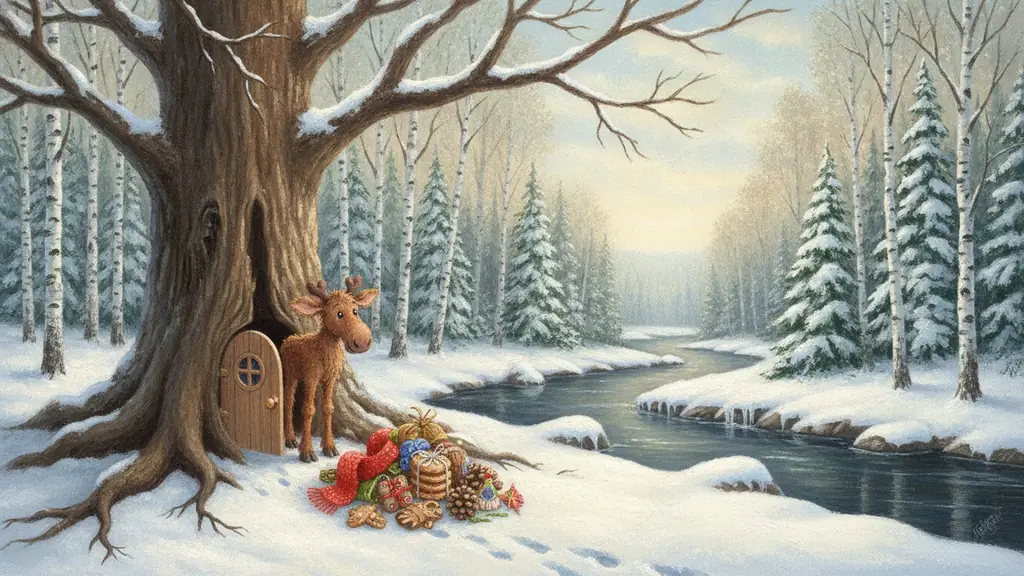
In the morning, the wind had gone quiet. The snow lay smooth and still over Sunny Square, and the only sound was a little bird somewhere, going chip-chip, chip-chip, like it was counting.
Mr. Moose opened his door.
And there, on the doorstep, in the snow, was a pile.
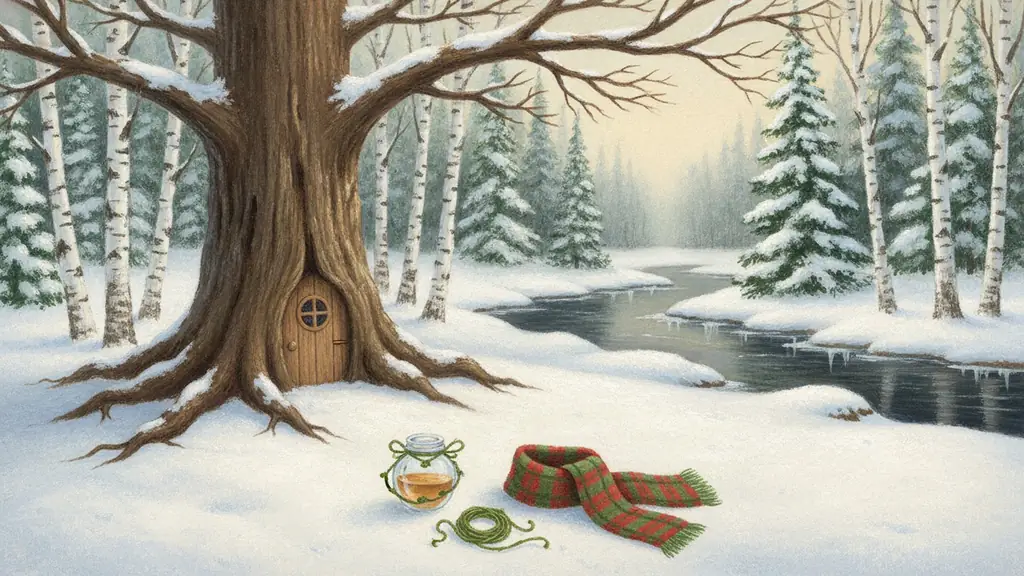
A round glass jar, clear and shiny, with a little handle tied on with vine. A brand-new coil of vine, long and thick and green, with not one fuzzy spot on it. A long, long woolly scarf.
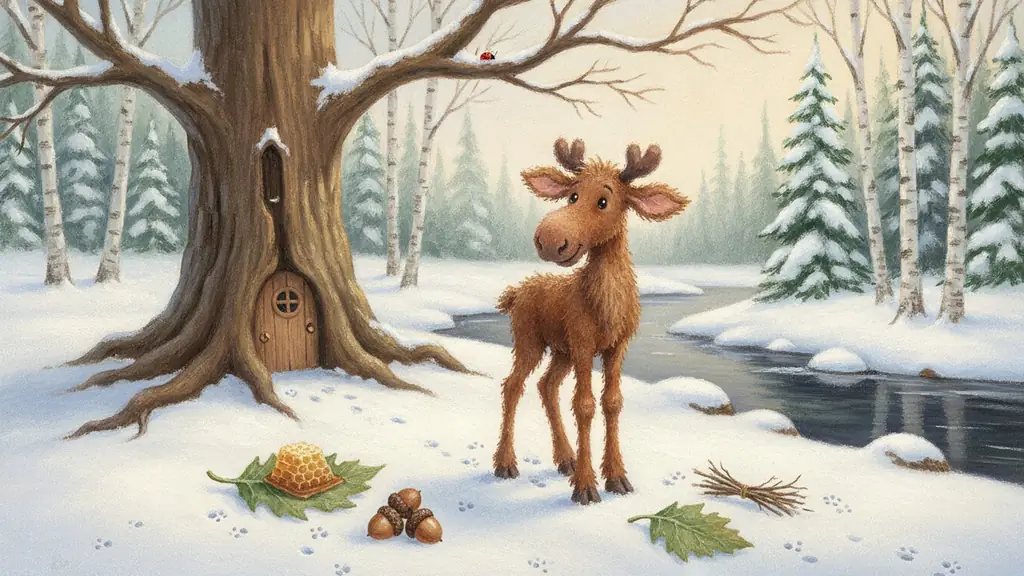
A honeycomb, wrapped in a leaf. A little pile of shiny acorns. And a bundle of dry twigs, tied up tight and tucked inside a big leaf so the snow couldn’t get them wet.
No names. Not one.
Mr. Moose looked left. He looked right. Nobody was there. Just little prints in the snow, all different sizes, going every which way.
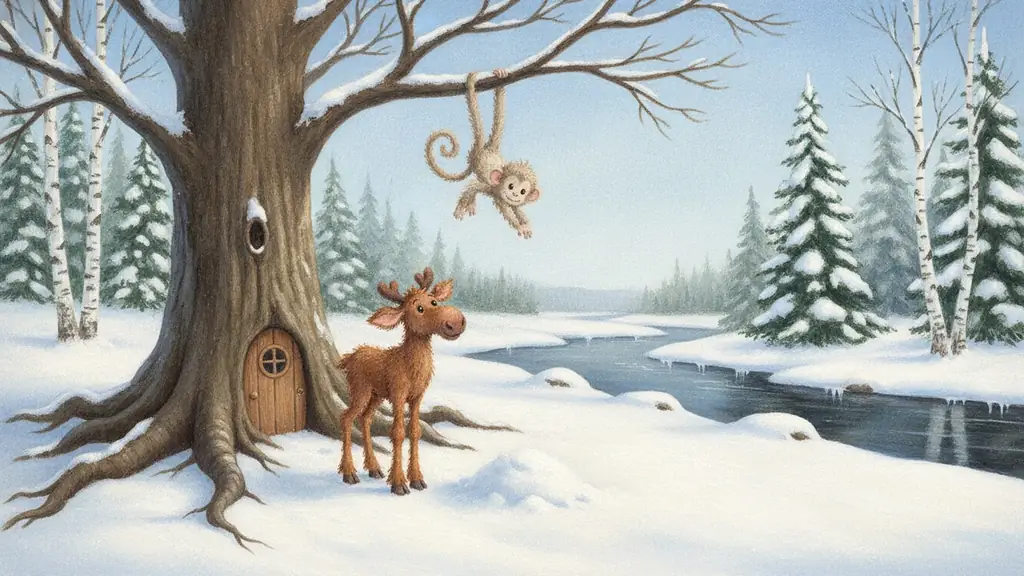
“Mr. Monkey!” he called.
Mr. Monkey came swinging down from the treehouse. “What? What is it?”
“Somebody left these,” said Mr. Moose. “At my door. Maybe they got the wrong door.”
Mr. Monkey looked at the pile. “There’s only one moose on this door,” he said. “It’s you.”
Mr. Moose didn’t know what to do with all of it. So he tried it all on.
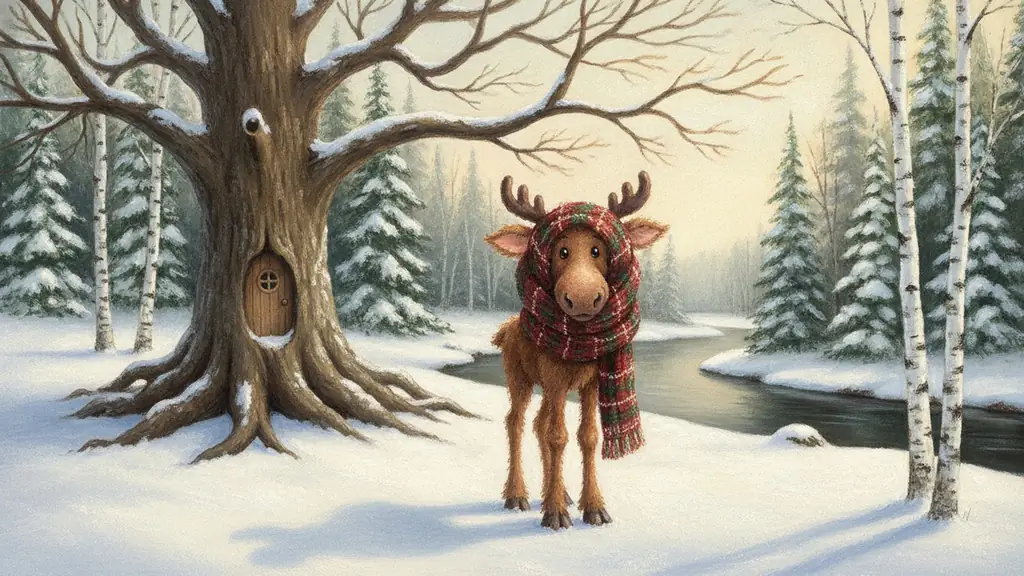
He put on the scarf. It was so long that he wound it around his neck, and around again, and around again, and it kept going, until he had wrapped it around twenty times and his whole head was a big woolly ball with two antlers sticking out the top.
Mr. Moose tried to say something, but all that came out of the wool was “Mmmf.”
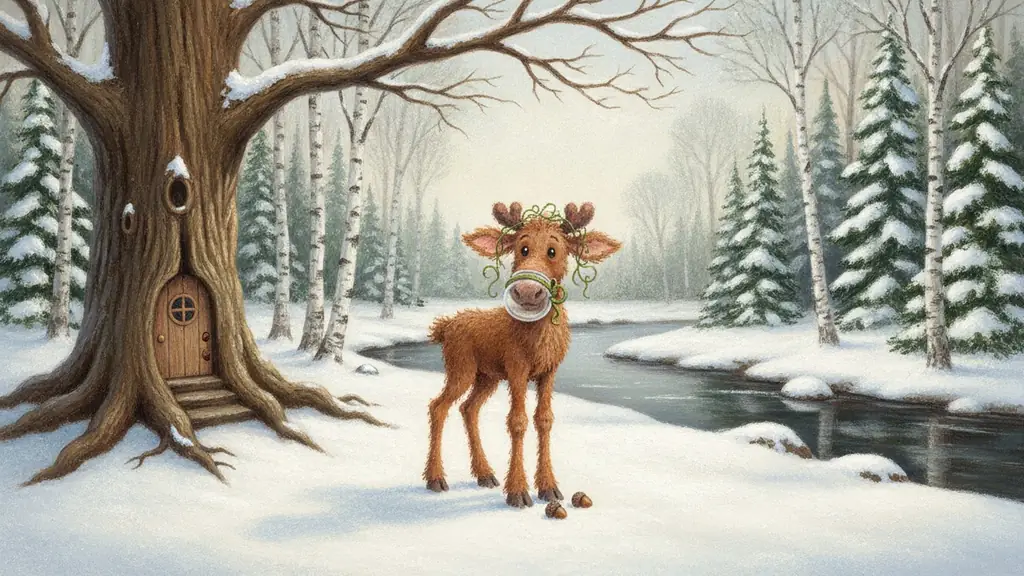
He picked up the vine, and it got tangled in his antlers. He picked up the acorns, and they rolled right off his hoof into the snow, pip-pip-pip-pip. Then he bent down to sniff the glass jar, and his nose went right into it and stuck.
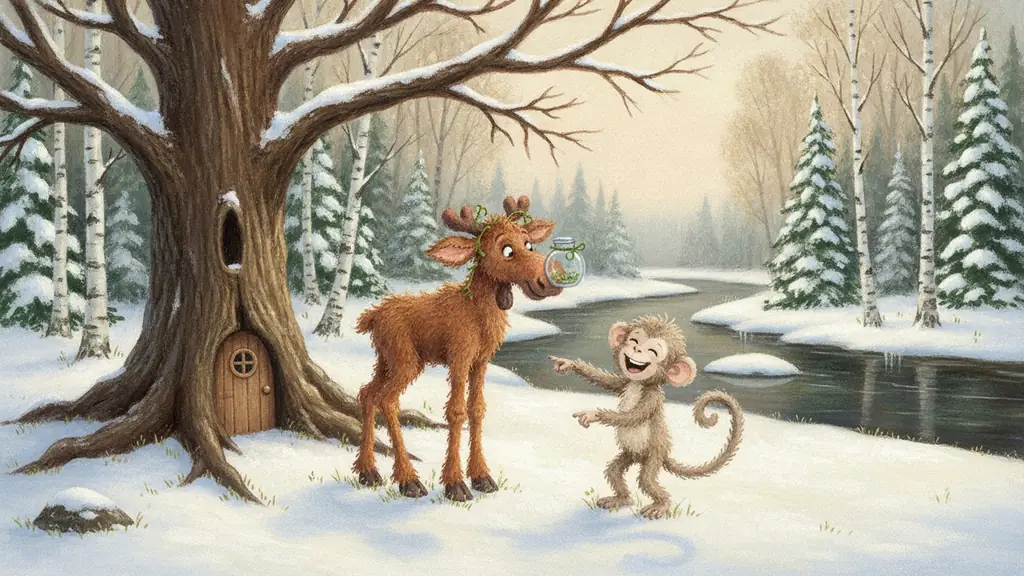
He stood there on his doorstep with a woolly ball for a head, a vine in his antlers, and a jar on his nose.
“Mr. Moose,” said Mr. Monkey. “You look like the Swap pile!”
“Hee hee hee!” went Mr. Monkey.
“Ha-ha-ha,” laughed Mr. Moose, all muffled, and the jar fell off his nose and landed in the snow, ploff.
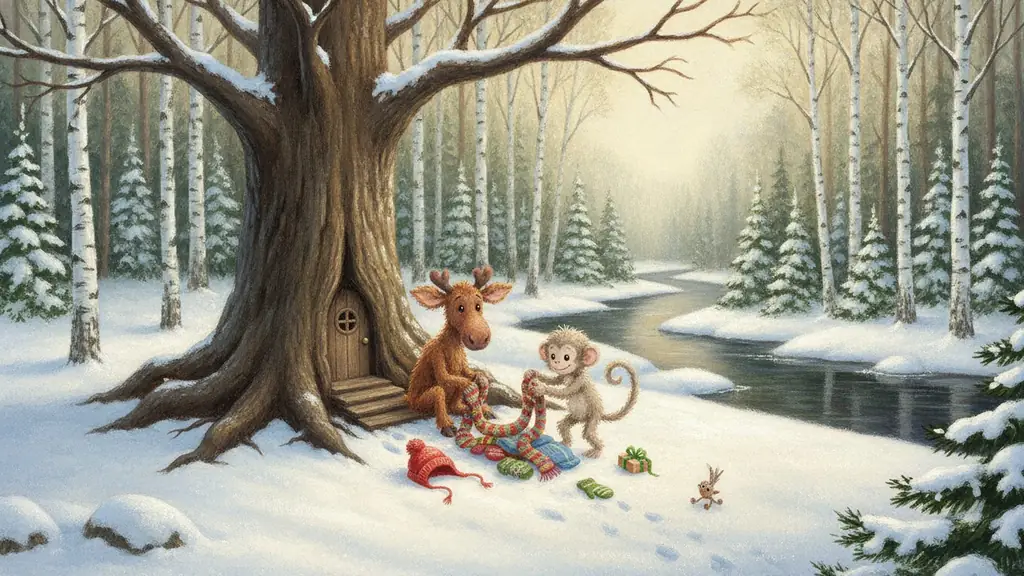
Mr. Monkey helped him unwind the scarf, all twenty times around, until his face came out again, pink and surprised.
Mr. Moose sat down on the doorstep and looked at everything spread out in the snow. “Who would give all this,” he said slowly, “just for me?”
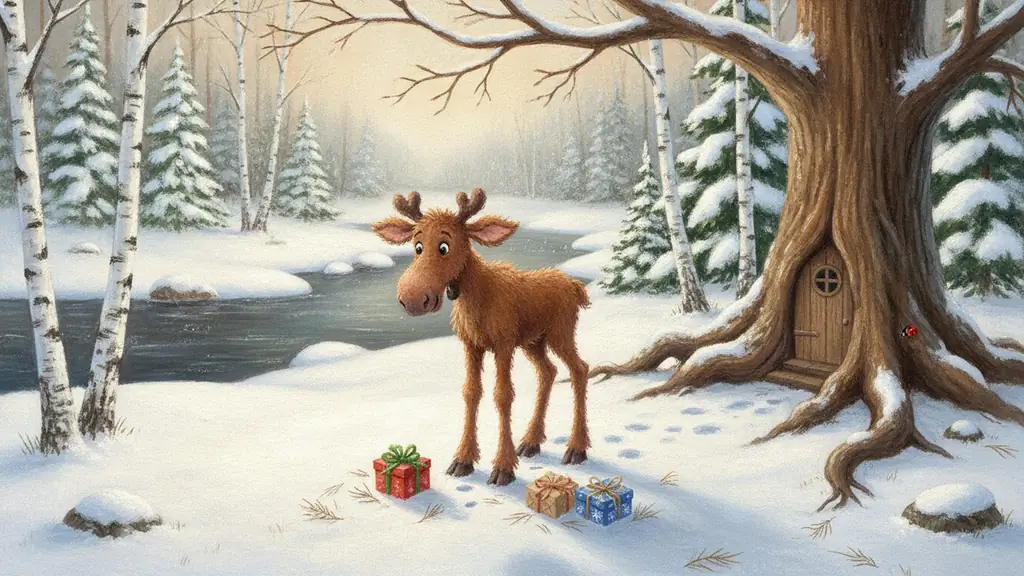
He really didn’t know. It was just his wish. Going up to the top of the cliff was just a thing Mr. Moose wanted. He didn’t think it was something anybody else would give things to.
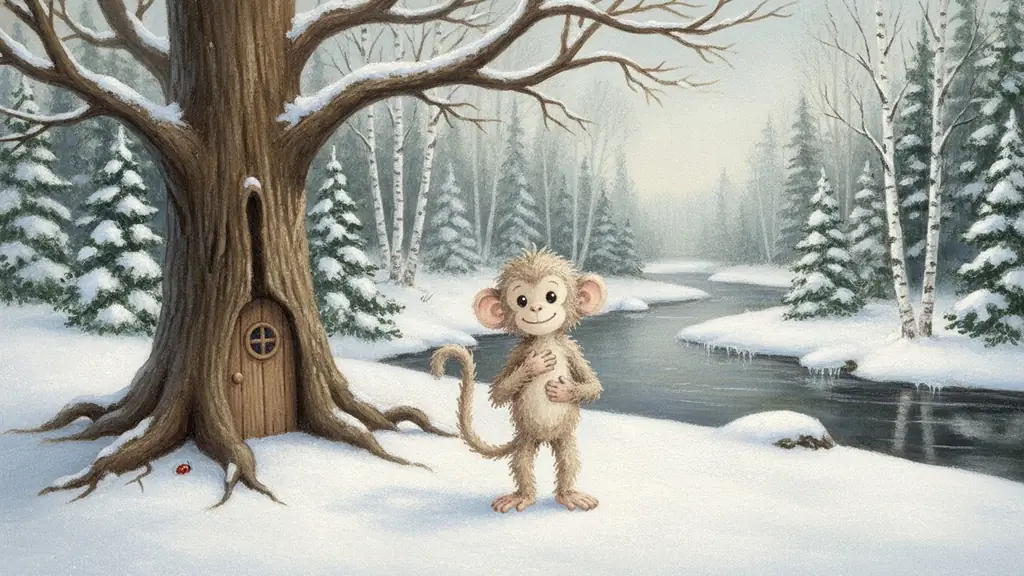
Mr. Monkey looked at Mr. Moose’s surprised face. And he felt something go all warm and tight in his chest, because Mr. Monkey knew something Mr. Moose didn’t know yet. Everybody in the woods had watched him practice on the little hill. Everybody had heard about the frost staircase and the wind and the candle going out. And everybody wanted him to get there.
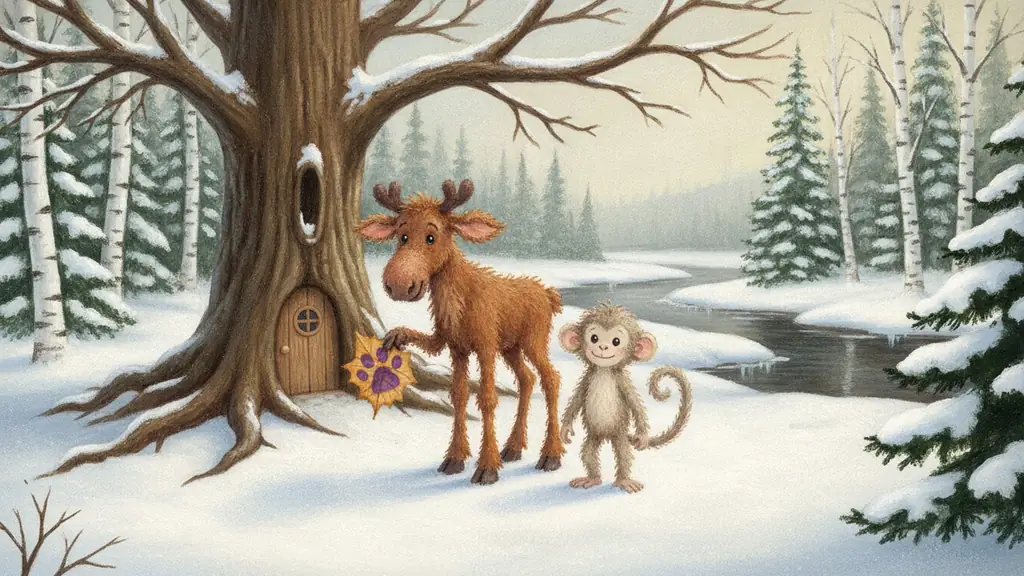
“Let’s figure out who,” said Mr. Monkey. “You’re good at that.”
So Mr. Moose looked. Very slowly. Very carefully. The way he looked at everything.
The honeycomb had a big purple paw print on the leaf. “Bruno,” said Mr. Moose.
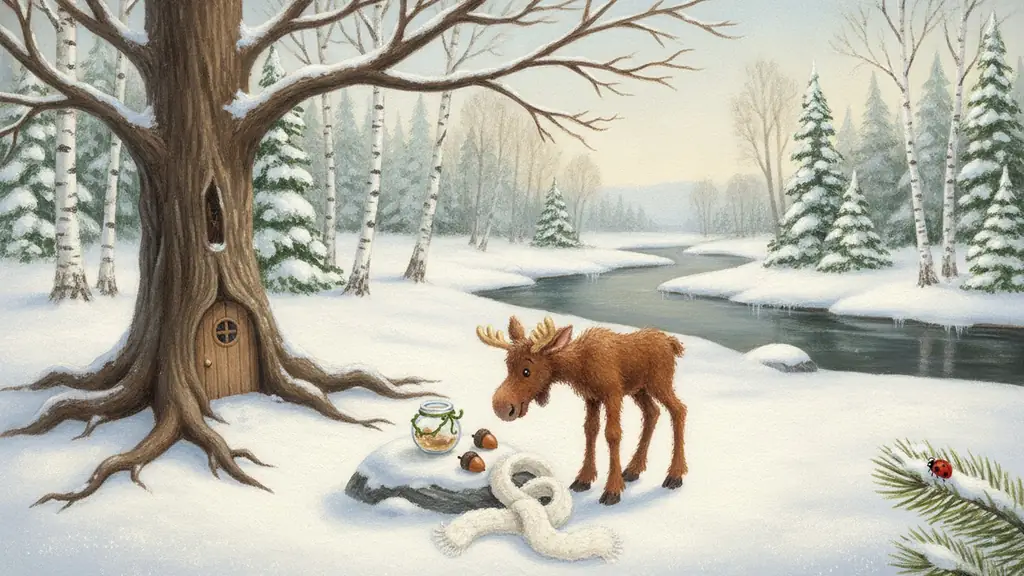
The jar’s little handle was tied on with a knot. Over, under, around, and through. “Ricky’s knot. And Ricky’s jar. It’s the shiniest thing he ever found in the river. He keeps it on his shelf.”
The acorns were the shiniest, roundest, best ones in the whole woods. “Sammy.”
The scarf was soft and curly and smelled a little bit like a sheep. “Shiloh.”
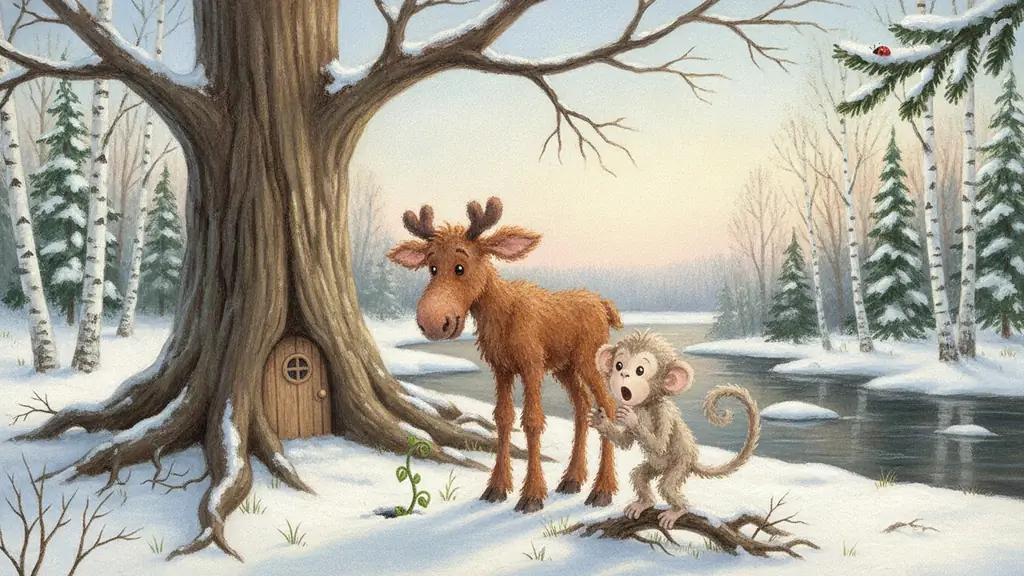
The dry twigs were tied with a big, slow, careful knot. “Daddy,” said Mr. Moose softly.
Then he looked at the coil of brand-new vine. Long and thick and strong and green.
Mr. Monkey looked at it too. And his mouth fell open.
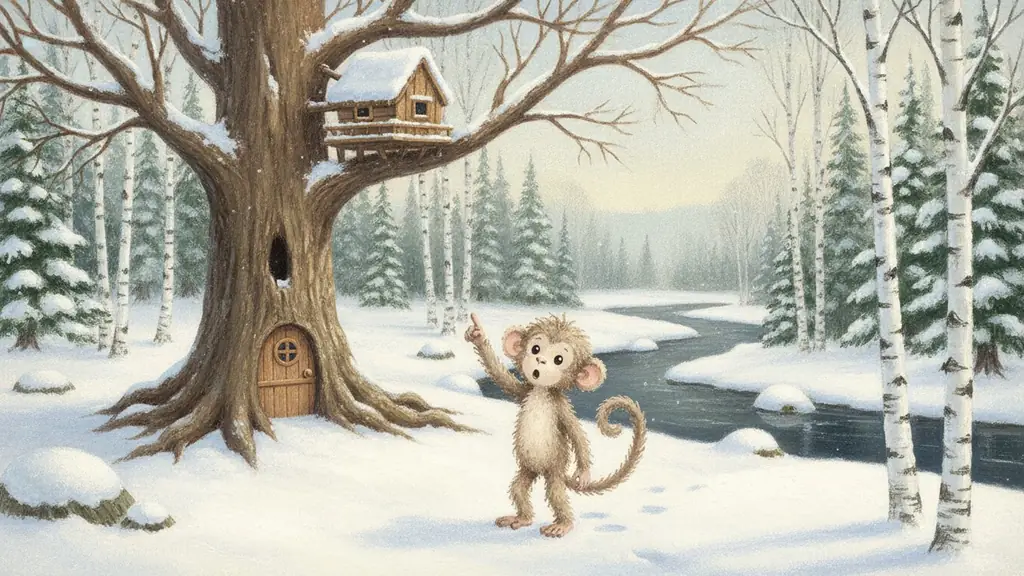
“That’s Daddy’s NEW VINE,” he said. “My daddy’s! He finally made it! He made it yesterday, for himself, so he wouldn’t have to swing on the fuzzy one anymore. It was his wish.” He looked up at the treehouse.
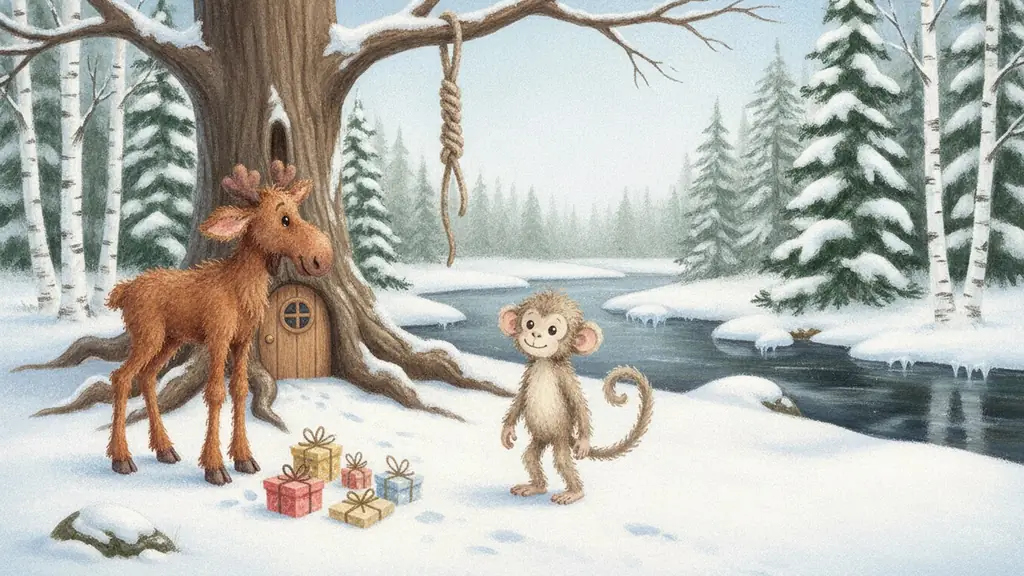
Daddy Monkey’s old fuzzy vine was hanging there, the one with twenty lumpy knots in it. “He gave you his new one. He’s still on the bumpy one.”
Mr. Moose looked at the vine for a long time. He looked at Ricky’s best jar, and Bruno’s honey, and Sammy’s best acorns, and Shiloh’s wool. These weren’t extras. These were everybody’s best things.
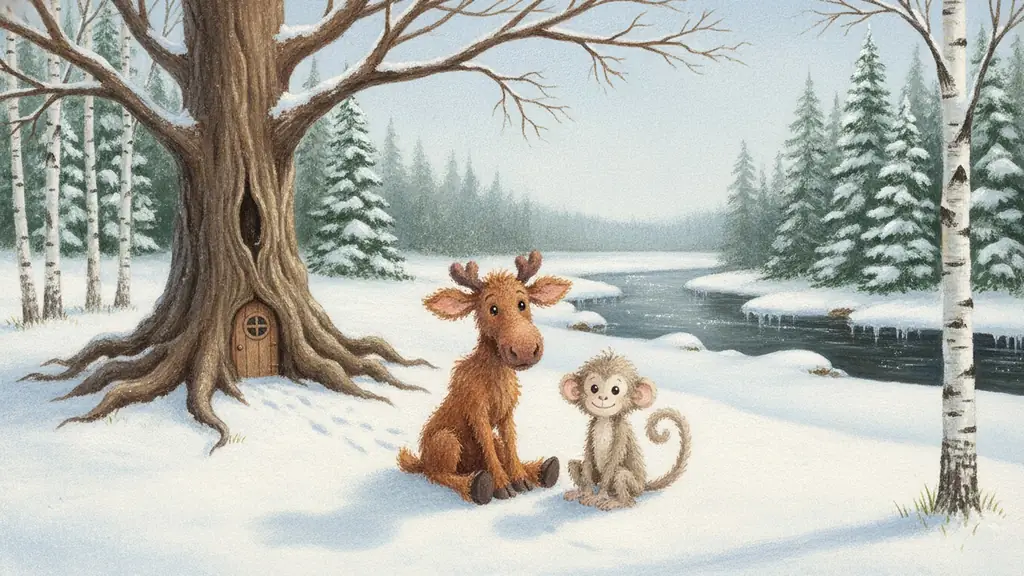
“They all think it’s worth it,” said Mr. Moose very quietly. “Getting the light to the top.”
“They all think YOU’RE worth it,” said Mr. Monkey.
Mr. Moose didn’t say anything. He just sat there in the snow, and his eyes got a little bit wet.
Then he started thinking. Hard. Not about who. About how.
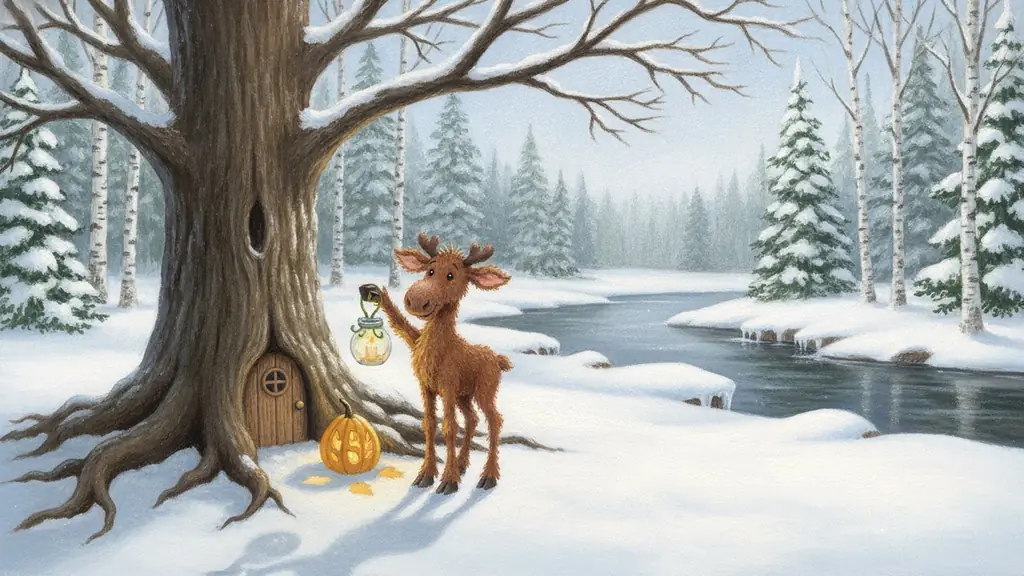
“The candle went out,” he said, “because the wind came through the holes in the squash.” He picked up Ricky’s jar. “But if the candle sits inside the jar, inside the squash, the wind can’t reach it.”
He picked up Daddy’s dry twigs. “And if it does go out anyway, these will start a little fire to light it again. Even up on the ridge.”
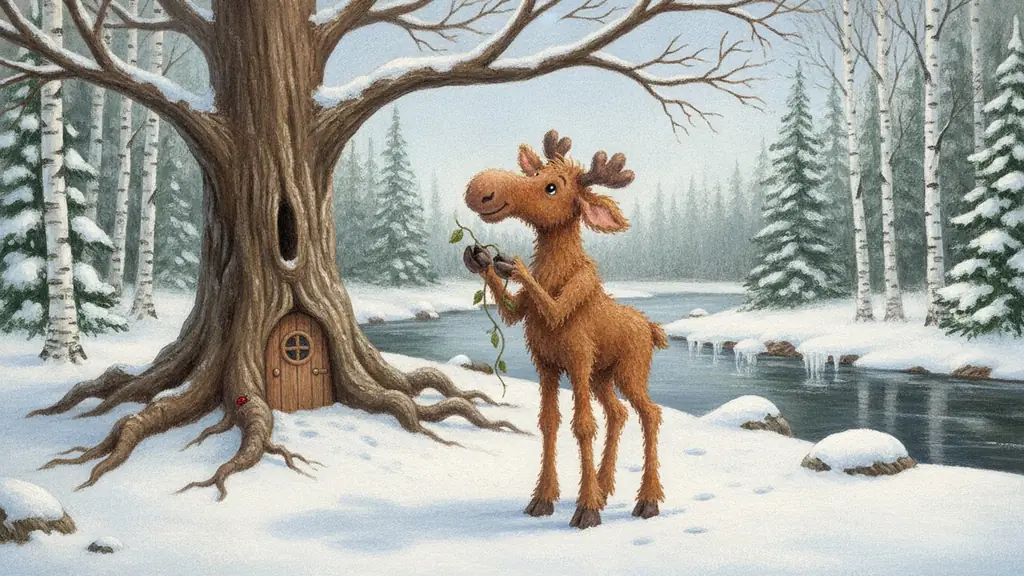
He picked up the new vine. “And this is longer than Bruno’s rope. Long enough for the steep part of the ridge.”
He picked up Shiloh’s scarf and looked at it. Then he looked up at his own antlers, and he smiled. “And this,” he said, “goes around my antlers. So the wind can’t make me a sailboat.”
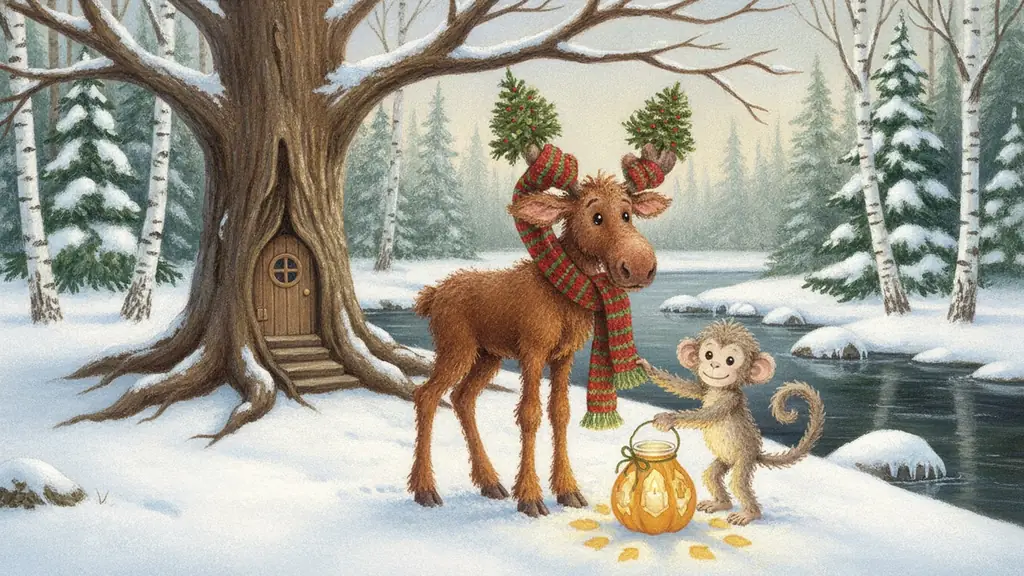
Mr. Moose held the squash lantern steady. Mr. Monkey set Ricky’s jar inside it, with the candle standing in the middle, and lit it. They tucked Daddy’s twigs into the sack, and coiled Daddy Monkey’s new vine on top. And Mr. Monkey wrapped Shiloh’s long scarf around and around Mr. Moose’s antlers, until they looked like two big woolly trees.
“Now we test it,” said Mr. Moose.
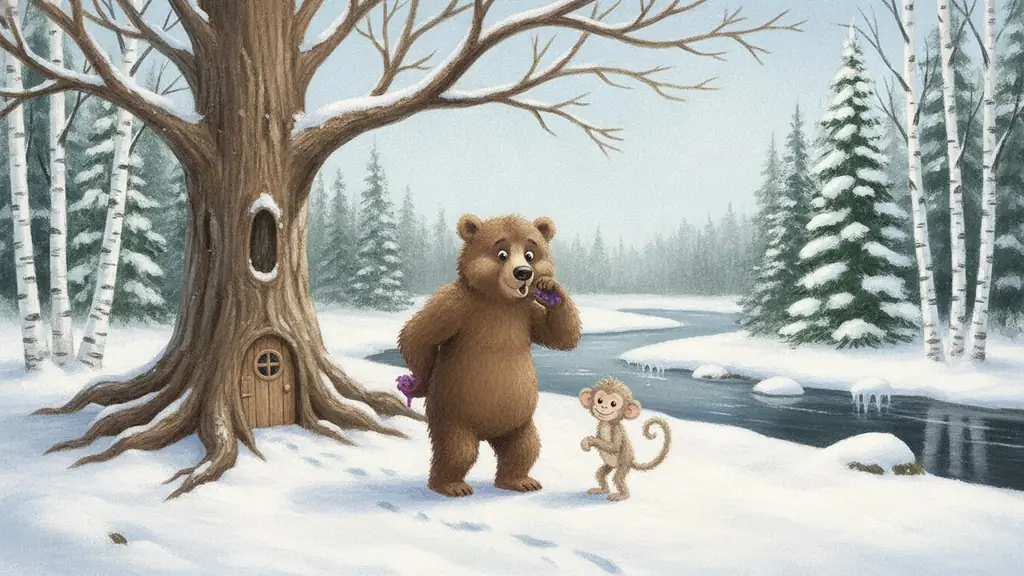
Bruno came walking by, very casually, with his paws behind his back. One of them was sticky and purple.
“Bruno,” said Mr. Monkey, “can you blow as hard as the wind on the ridge?”
Bruno took a huge breath. His cheeks puffed out bigger than two snowballs. And he blew. FWOOOOOOOOOOSH.
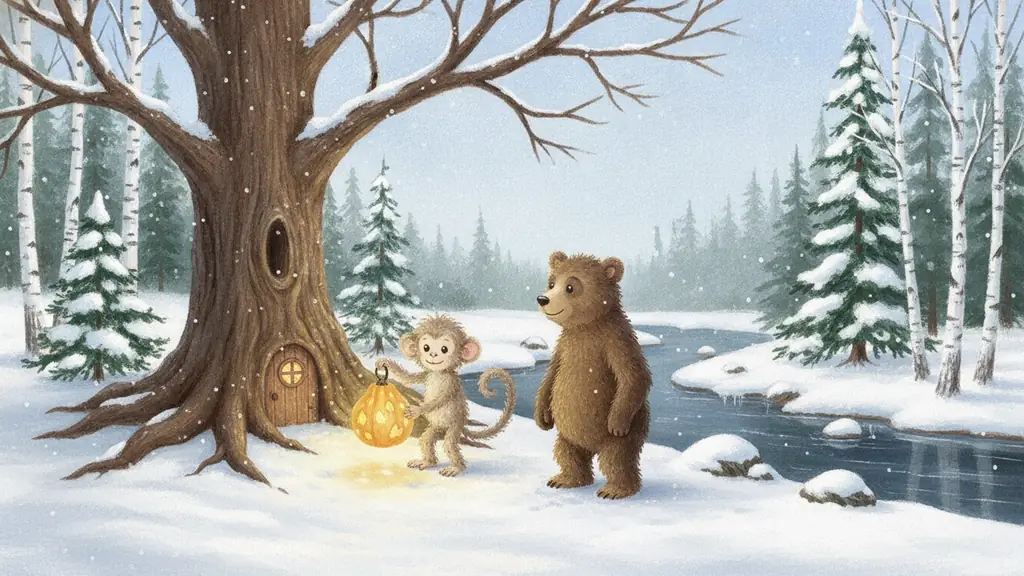
Snow flew off the roof. Mr. Monkey’s fur blew straight back, so his face looked flat. The little green pine by the door bent all the way over.
And inside the jar, inside the squash, the candle didn’t even wiggle.
“Haw haw haw!” went Bruno, out of breath. “I couldn’t blow it out!”
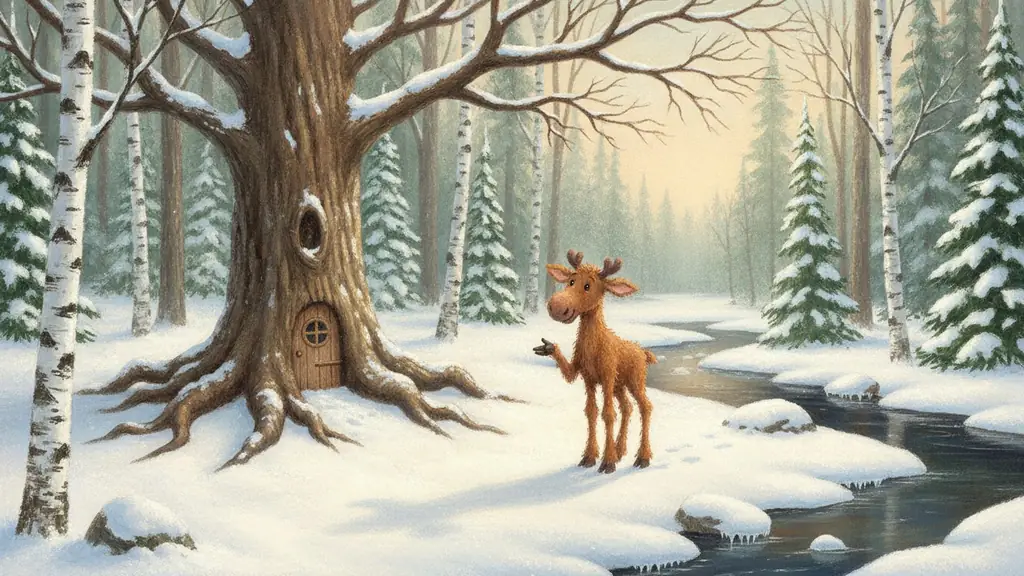
“Hee hee hee!” went Mr. Monkey, with his fur still sticking straight back.
That afternoon, Mr. Moose stood up in Sunny Square, where everybody was. He didn’t know for sure how to thank people who left their names off. So he just said it to everybody, all at once.
“Thank you,” he said. “Whoever you are.”
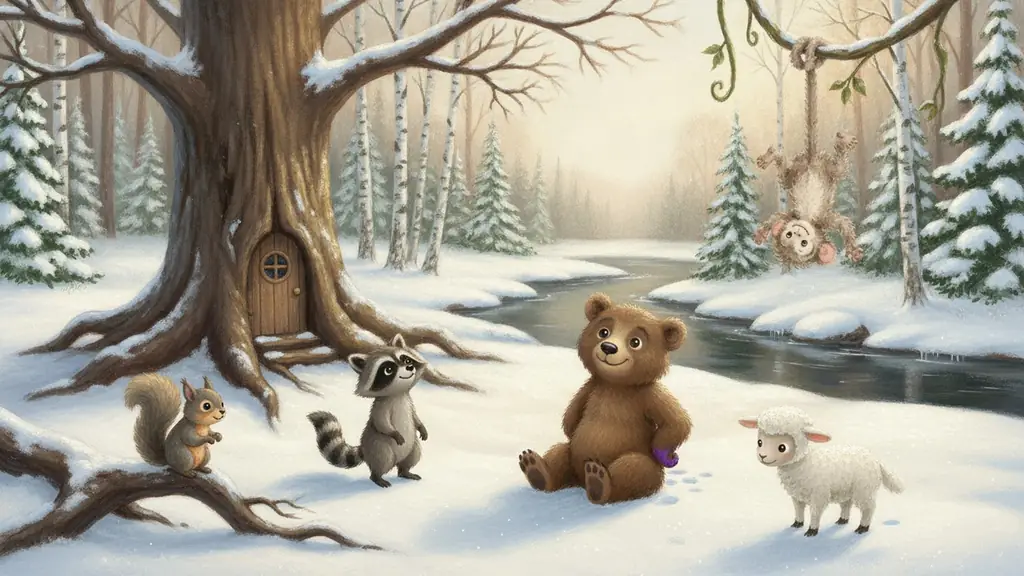
Ricky looked at the sky. Sammy looked at her tail. Shiloh looked at his hooves. Bruno looked at the trees and kept his purple paw behind his back. And Daddy Monkey, up on his old bumpy vine, just smiled.
“Tomorrow,” said Mr. Moose. “We go again.”
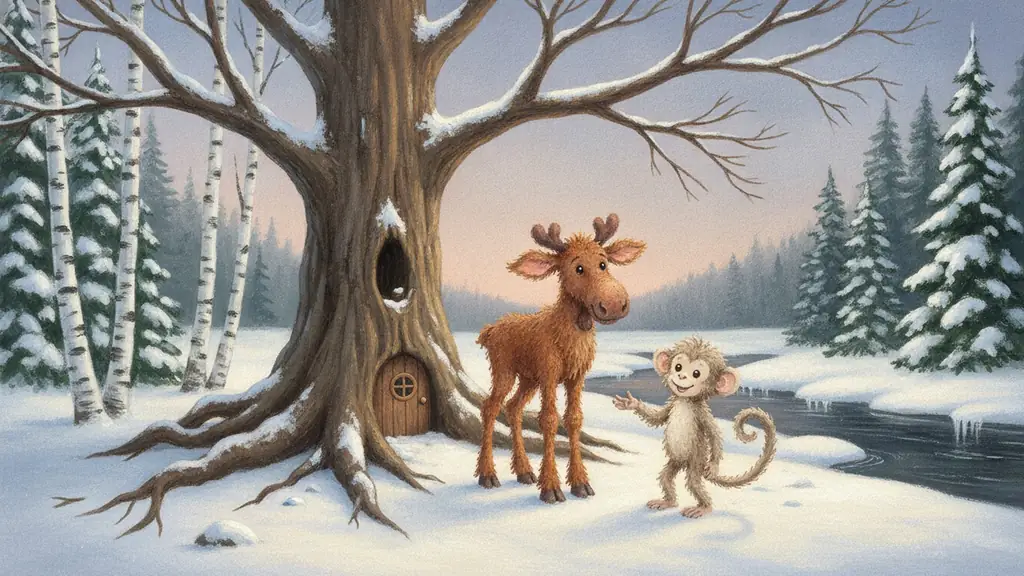
“What a day!” said Mr. Monkey. “Somebody left a whole pile on Mr. Moose’s doorstep. He tried it all on and looked like the Swap pile, with a jar on his nose. Then he figured out who left everything, even my daddy’s new vine. Bruno blew as hard as the wind, and the candle didn’t even wiggle. And tomorrow, we go again.”
Mr. Monkey whistled, and Mr. Moose hummed, and together they sang:
We are better together,
Moose and Monkey forever.
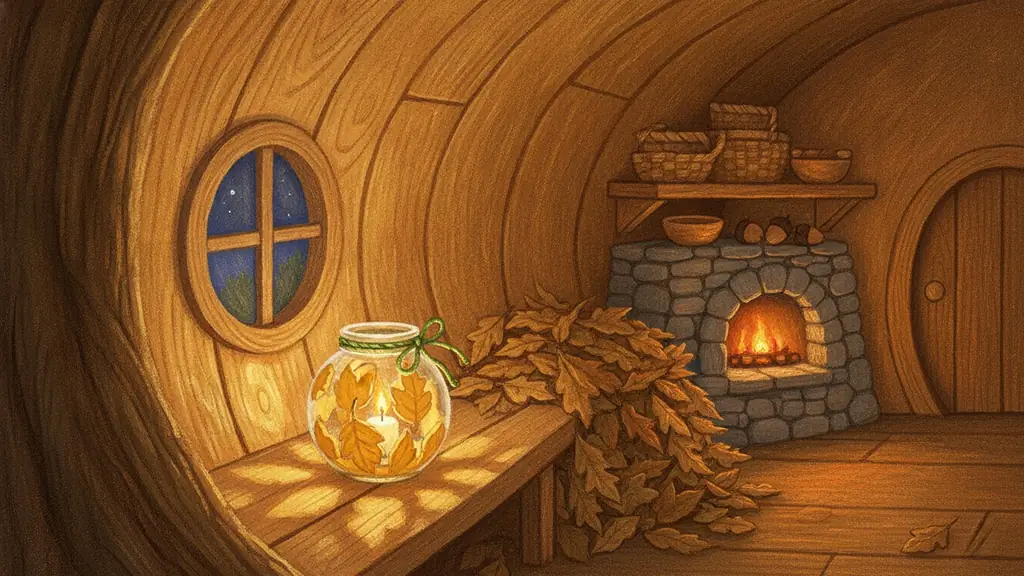
And on the windowsill of the Moose home, the little squash lantern glowed with its candle safe inside Ricky’s jar, steady as a star, ready for the wind.