Generosity · Day 1
Tuesday, December 1, 2026
Receive ItCore
 Today in the WoodsThe Candle That Got Smaller
Who in this house gave something of themselves to me this year?
Who gave me something of themselves this year?
November was for giving thanks, and December is for giving back. It starts with generosity, the widest layer of the Giving Tree, because the rest of the month is built on top of it. For the next seven days, we look at gifts that cost the giver something, beginning with the ones given to you.
December 1 to 3: Saturate. These three days are for receiving. Each one has a short reading and ends with an ornament for one of the three circles: the people in your house (Core) on December 1, the people within your reach (Community) on December 2, and the gifts beyond anyone's grip (Cosmos) on December 3.
December 4: Celebrate. You hear the story of Nicholas, the first candle is lit, and everyone reads the gold ornaments with their own name on them.
December 5 to 7: Participate. These three days are for giving, one currency at a time: time on December 5, resources on December 6 (St. Nicholas Day), and words on December 7.
Every daily reading has three parts: a picture for the heart, a point for the head, and a practice for the hands. On the giving days, the picture is a story, then a song, then a scene from a film.
Here's a made-up story to open December. It's a cold night in early winter, and a family of four is halfway through dinner when the power goes out. The refrigerator stops humming, the furnace clicks off, and the whole house goes dark at once. A phone flashlight comes on, then another, and for a few minutes everyone waves the beams around the ceiling and laughs about it.
Then the phones start running low. Dad digs through the junk drawer and comes out with a fat white candle that has been in there since a birthday nobody remembers. He lights it and sets it on a plate in the middle of the kitchen table, and everyone pulls their chairs in close. They finish dinner by its light. Afterward they play cards around it, and the youngest falls asleep with her head on her arms.
Around ten, the older boy notices the candle is shorter than it was. A pool of melted wax has gathered around the wick, and a drip has run down the side and hardened on the plate. He watches it for a while. Every bit of light they've had tonight came out of that candle. It couldn't light the room and stay the same size.
The only way a candle gives light is by giving itself. The wax has to melt.
On December 4, your family lights the first of five candles. The candle words ask, "What do we pass on?", and the first answer is generosity. This week is about the people who gave you their light, and what it cost them.
Generosity is giving something that's yours to someone else, and real generosity costs the giver something. That cost is what sets it apart from two things that can look a lot like it. In an exchange, what you give mostly comes back to you in the box you get. Giving from a list, the kind of December the Prelude described, is giving because it's expected. Both can be kind. A real gift goes out and doesn't come back.
The most famous giver of the season works differently. In the version most of us grew up with, Santa's gifts cost him nothing. Elves make the toys, magic gets them down the chimney, and he's as jolly as ever by morning. It's a fun story, but nobody at your table has elves, so his kind of giving can't be copied, and it quietly teaches that giving is free. The jolly part is worth keeping, though. The happiest givers most of us know are the ones whose gifts cost them something.
Jesus measured gifts by their cost too. The shortest of the four accounts of his life is credited to Mark, and early tradition says Mark wrote down what he heard Peter, one of Jesus's closest friends, tell about him. Mark describes a day when Jesus sat across from the offering boxes in the temple courts in Jerusalem, the center of Israel's worship, and watched people put in their money. Many rich people put in large amounts. Then a poor widow (in that world, often a woman with no one to support her) put in two very small copper coins. Jesus called his followers over and said, "Truly I tell you, this poor widow has put more into the treasury than all the others. They all gave out of their wealth; but she, out of her poverty, put in everything." Everything, he said, was "all she had to live on." She gave the fewest coins, but by what it cost her, nobody gave more.
Who in your house gave you something this year that cost them more than you knew?
Today the first green layer of the Giving Tree goes up, the widest one, right on top of the stump (the Pivot has the details). Then come the first December ornaments.
Cut a gold or yellow paper circle, about three inches across, for each person in your house other than you. In a house of four, each person makes three.
On the front, write the person's name.
On the back, thank them for something they gave you this year, and name what it cost them: their sleep, their Saturday, their patience, their money, or something they gave up. "Thank you for driving me to swim practice at six every morning, even though you hate mornings."
Tape it to the green layer with the writing toward the wall.
Nobody reads the backs yet. They wait for the first candle on December 4.
Kids' story: read "The Candle That Got Smaller" from The Overflow Adventure in Wanderful Woods together.
Time: 15 to 20 minutes, plus about five to put up the layer.
With kids: ask, "Who in our house gave up something this year so you could have something?" A child who can't write yet can draw that person on the back of the ornament or tell you what to write.
If your kids believe in Santa: nothing has to be settled today. Read the Santa paragraph to the adults later, or skip it, and keep the part kids can use: the gifts that mean the most usually cost somebody something.
If you live alone: use the choice you made for line 6 of your plan in Prepare. If you chose No Core, write today's gold ornaments to your closest people, and leave them on the tree.
Hello, my wonderful story friends! Last time, Tessie finally said her very old thank-you to Orion, and Ricky started a brand-new list with just three words at the top: WHO NEEDS THEM? Now it’s December in Wanderful Woods, and the little squash lantern is still glowing on the Wishing Tree.
Have you ever wondered how a candle makes its light? Let’s go see who has been keeping the lantern lit.
December came to Wanderful Woods with a fresh coat of snow. It sat on every branch like frosting, and when the wind blew, little puffs of it slid off the treetops, fffsh, and sparkled all the way down.
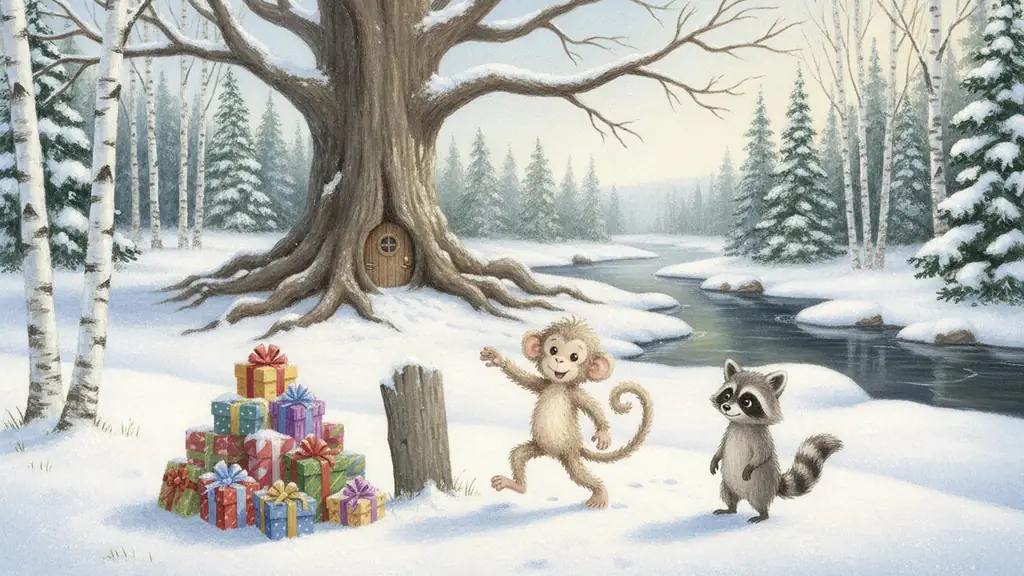
In the middle of Sunny Square sat the Swap pile, neat and tall. Beside it, stuck in the snow, was Ricky’s new piece of bark. At the top it said WHO NEEDS THEM? Underneath, it didn’t say anything at all.
Mr. Monkey couldn’t wait. “I know who needs them!” he said. “Everybody!”
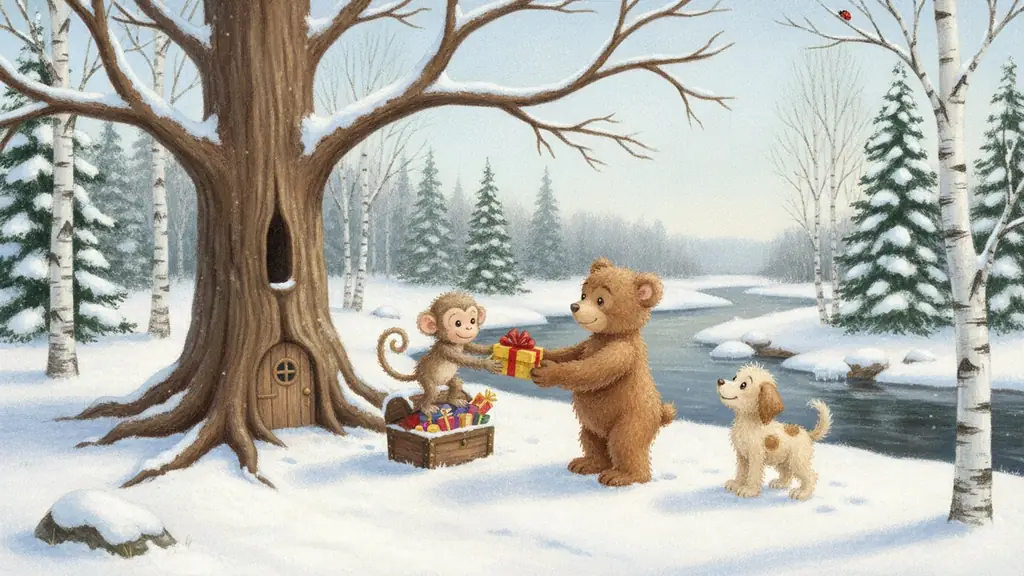
He grabbed a present off the pile and gave it to Bruno. He grabbed another one and gave it to Dottie. He gave one to Hazel and one to Shiloh, as fast as he could.
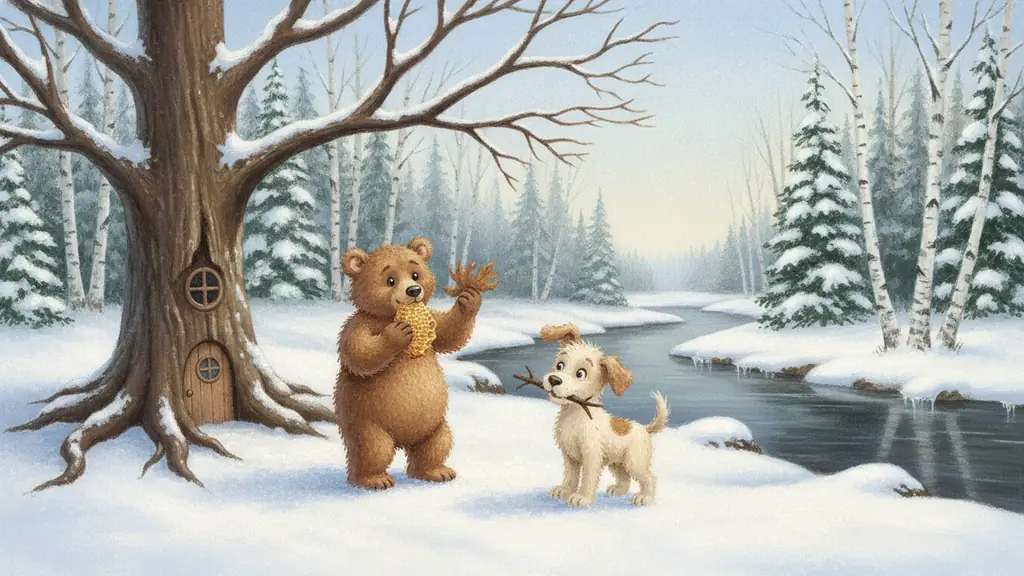
Bruno tore his open. Inside was a honeycomb, wrapped in a leaf. He stared at it. “This is MY honeycomb,” he said. “I wrapped this. I gave this.” He took a big bite. “I love it.”
Dottie opened hers. It was a stick. Her own stick, the one she ran all over the woods to make bigger.
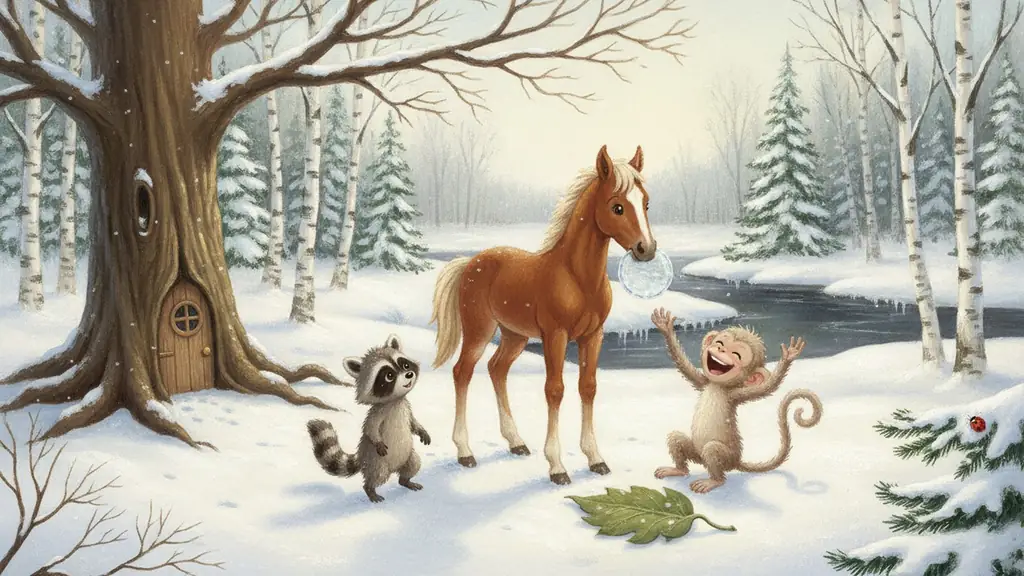
Hazel opened hers. Inside, wrapped very carefully in a big leaf, was a flat, round piece of ice. “My puddle!” she said. “It froze!”
“Haw haw haw!” went Bruno, with honey on his nose.
“Hee hee hee!” went Mr. Monkey. “Everybody got their own present back!”
Ricky looked at all of them, holding their own presents. “That’s a swap again,” he said. “Backward.”
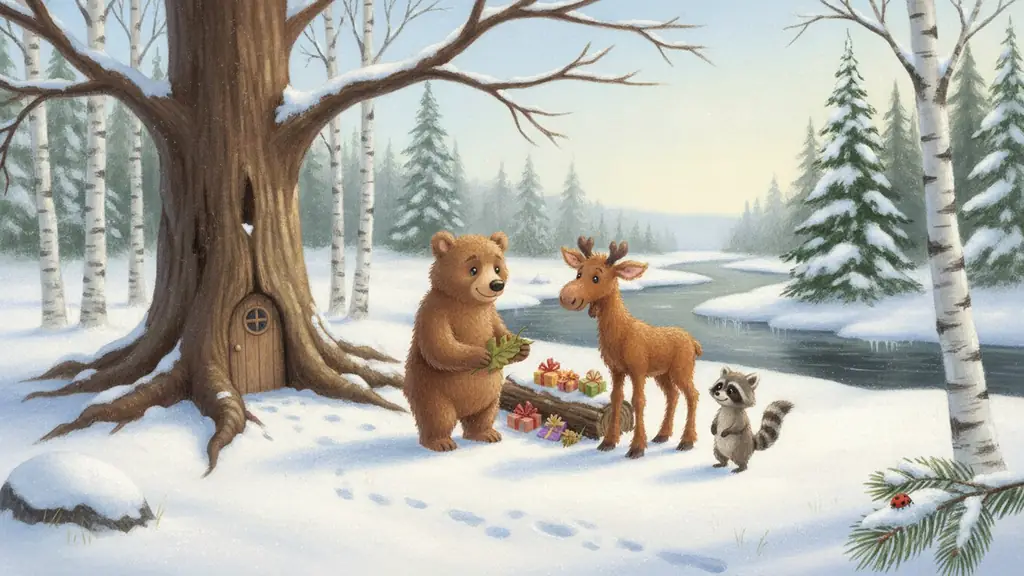
Mr. Moose looked at Ricky’s list. “Who needs them,” he said slowly. “Bruno doesn’t need his own honey.”
“I kind of do,” said Bruno.
But he wrapped it back up, mostly, and put it back on the pile. So did everybody else.
“We’ll find out who really needs them,” said Ricky. “And then we’ll give them. And nobody will even know it was us.”
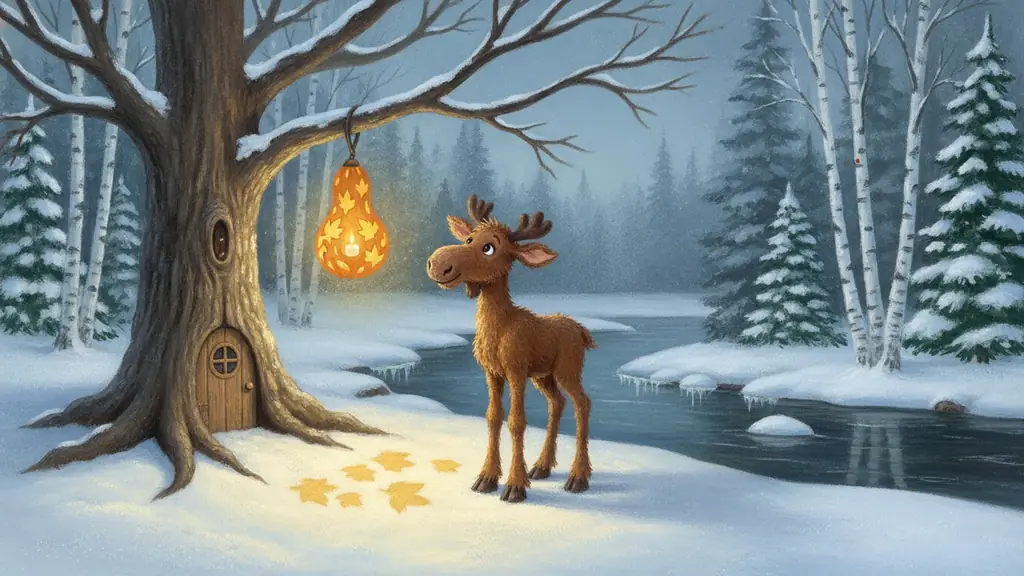
That’s when Mr. Moose noticed the lantern.
It was still glowing on the lowest branch of the Wishing Tree, the same as it had every night since the Thankful Feast. Its little leaf-shaped lights flickered gold on the snow. Mr. Moose looked at it for a long time.
“Mr. Monkey,” he said. “A candle doesn’t last a whole week.”
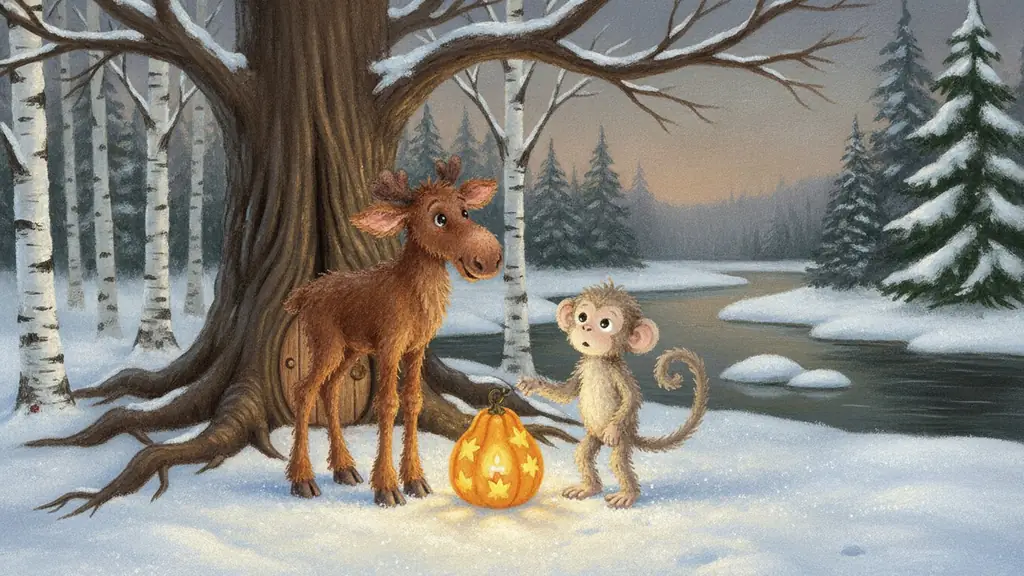
“So?”
“So somebody puts a new one in. Every morning. Before anybody’s awake.”
Mr. Monkey’s eyes went wide. “Who?”
“Let’s find out,” said Mr. Moose.
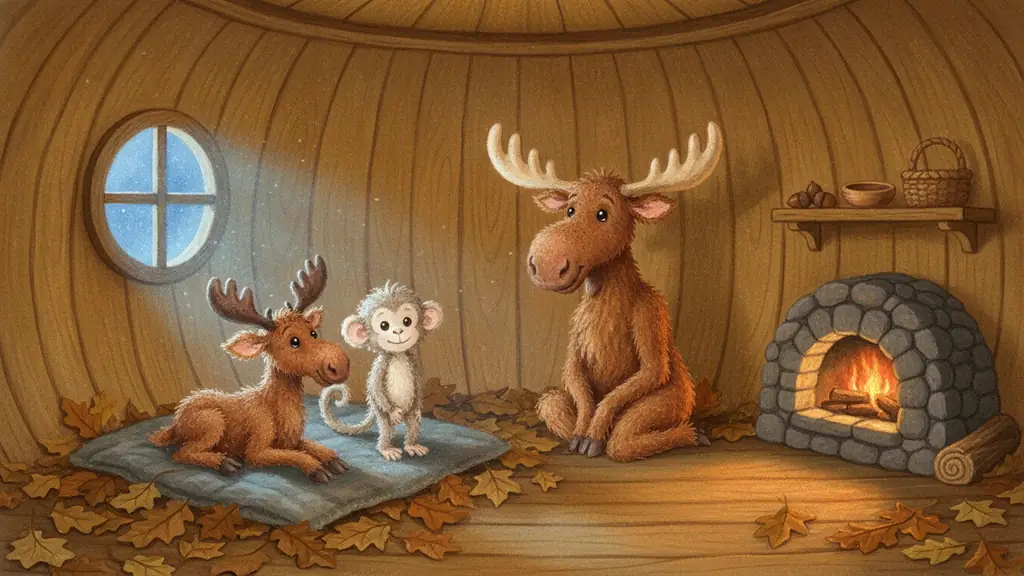
So that night, Mr. Monkey slept over at the Moose home under the big maple. It was a strange, dark night inside. There was no candle on the table, and no candle by the bed. Mama Moose told the bedtime story by moonlight, with the snow glowing blue in the window.
“Mama,” whispered Mr. Moose, “where are our candles?”
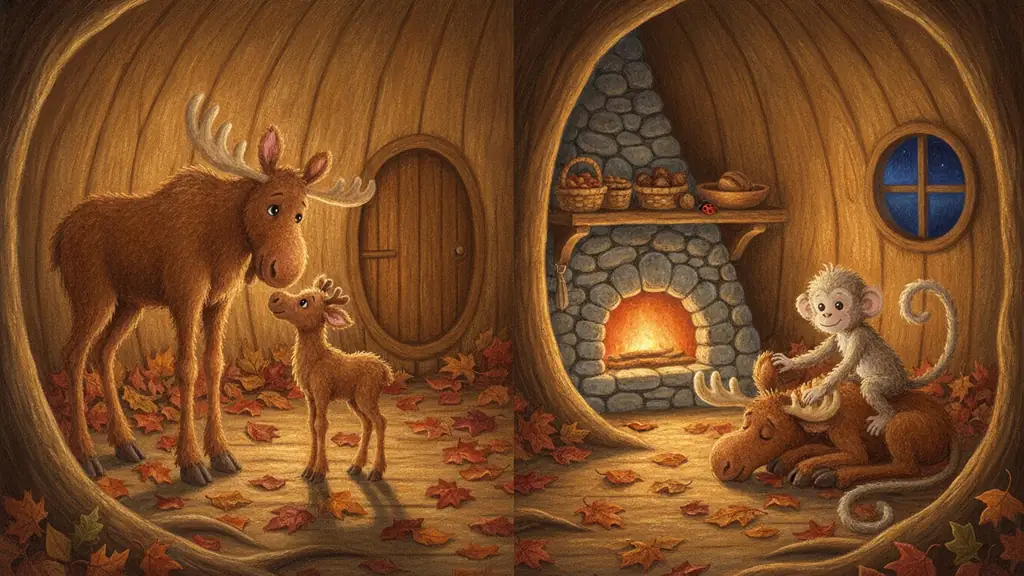
“We’re using them for something,” said Mama Moose, and she kissed him on the nose.
Long before the sun came up, Mr. Monkey poked Mr. Moose. “Now,” he whispered.
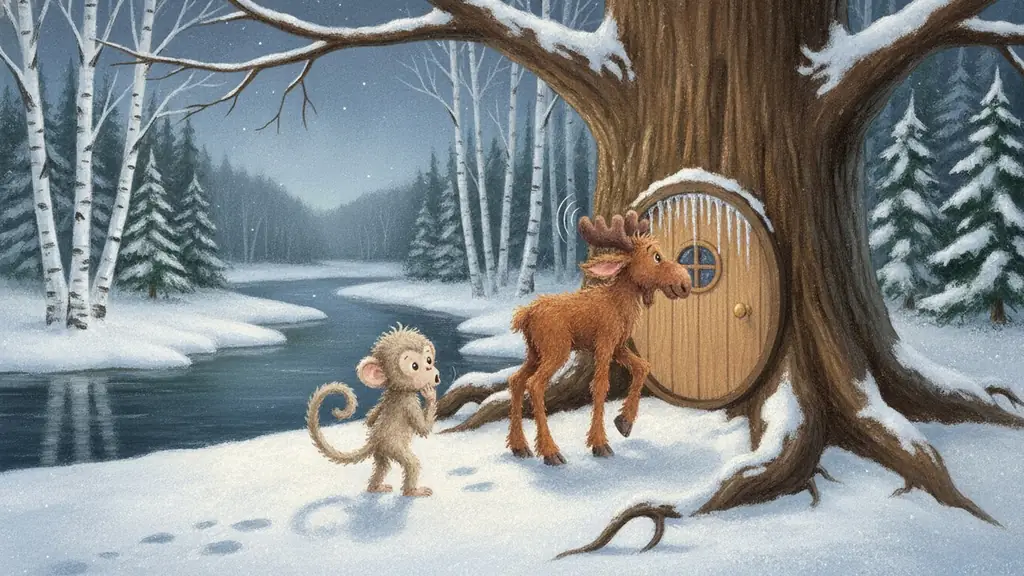
They crept out the door into the cold, dark morning. Mr. Moose tiptoed as carefully as a moose can tiptoe. But icicles were hanging all along the edge of the roof, and his antlers went right through them. Ting-ting-ting-ting-tingle-ting. It sounded like a whole row of tiny bells.
Mr. Monkey stopped. “Mr. Moose. You’re ringing.”
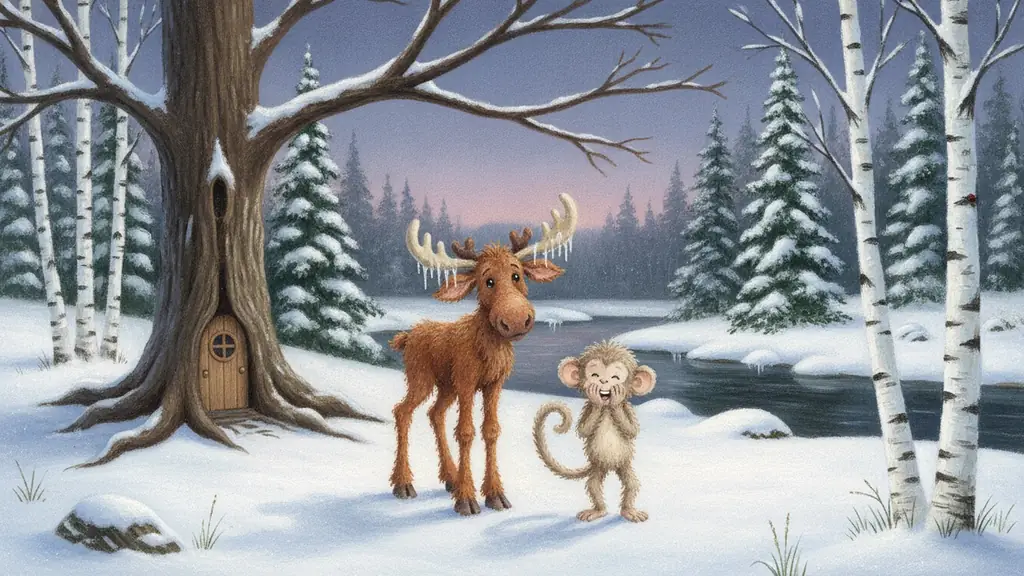
“I’m trying not to,” whispered Mr. Moose, and the icicles went ting-tingle-ting again.
“Hee hee hee!” went Mr. Monkey, into his hands. “You’re a jingle-jangle moose!”
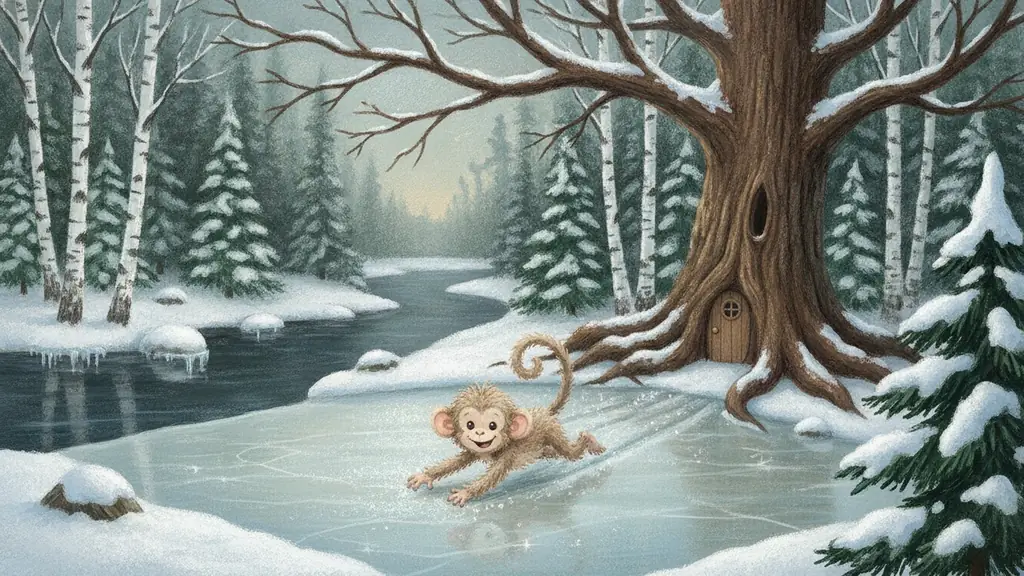
Then Mr. Monkey stepped onto a patch of ice. His feet went one way. His tail went the other way. And he slid on his tummy all the way across Sunny Square, shhhhhhhhooop, spinning slowly around, until he bumped to a stop right at the bottom of the Wishing Tree, between two very big, very hairy legs.
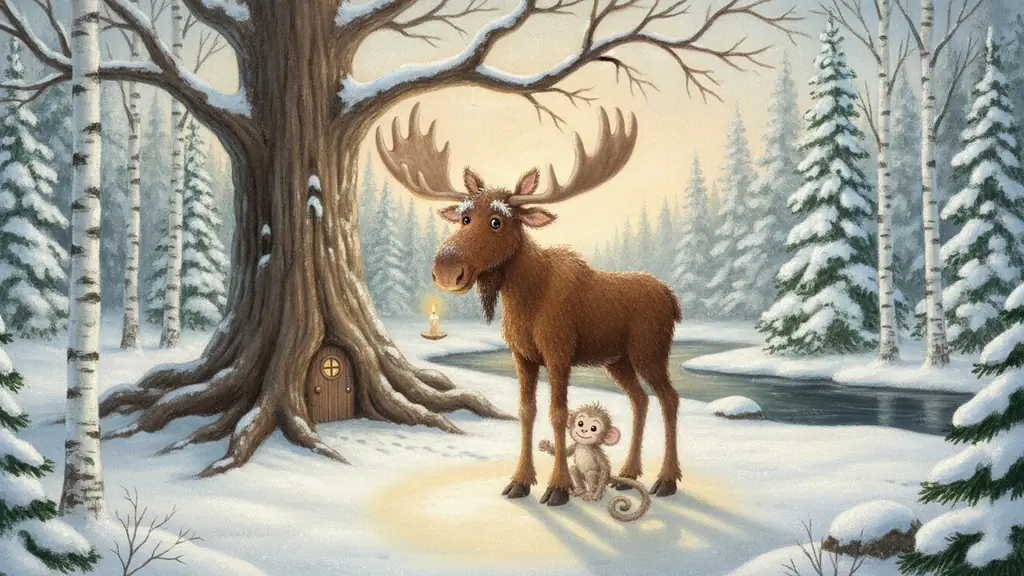
He looked up.
It was Daddy Moose.
Daddy Moose was standing in the snow in the dark, with frost on his eyebrows and little clouds puffing out of his nose. In his mouth was a candle.
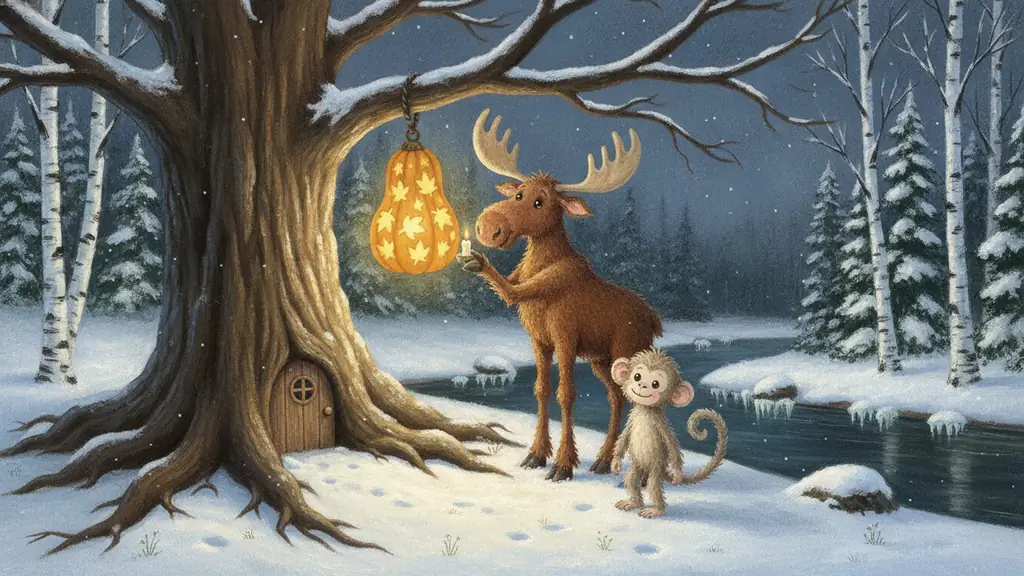
He reached up, very carefully, opened the little squash lantern, and put the new candle in, right next to the old one. Then he lit it from the last flicker of the old one, just before it went out.
He looked down. “Good morning, Mr. Monkey,” he said around the candle.
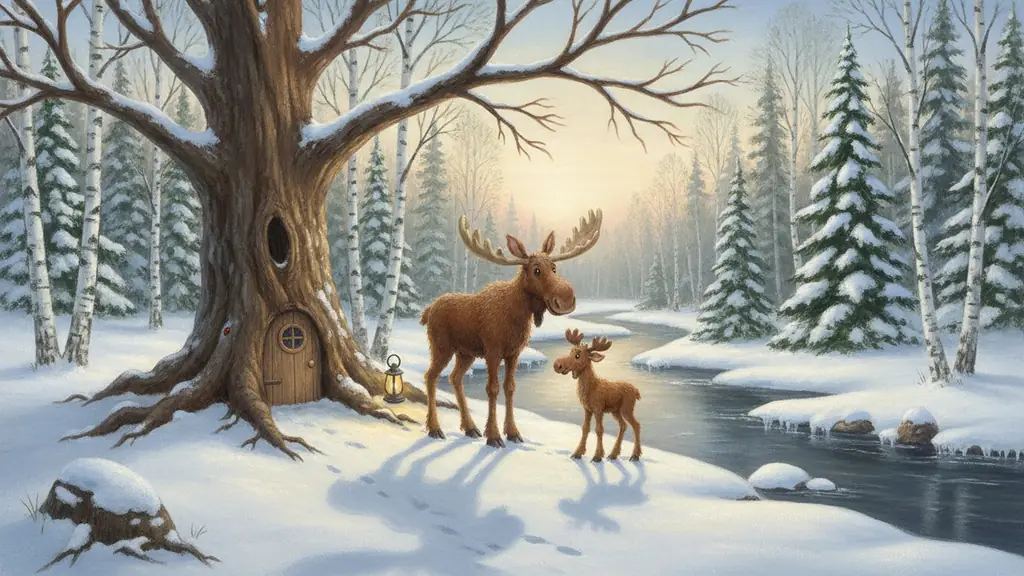
“Ha-ha-ha!” laughed Mr. Moose, coming slowly across the ice behind. Then he saw what his daddy was holding, and he stopped laughing.
“Daddy,” he said. “Is that our candle?”
“It’s the last one,” said Daddy Moose.
“Every morning?”
“Every morning.”
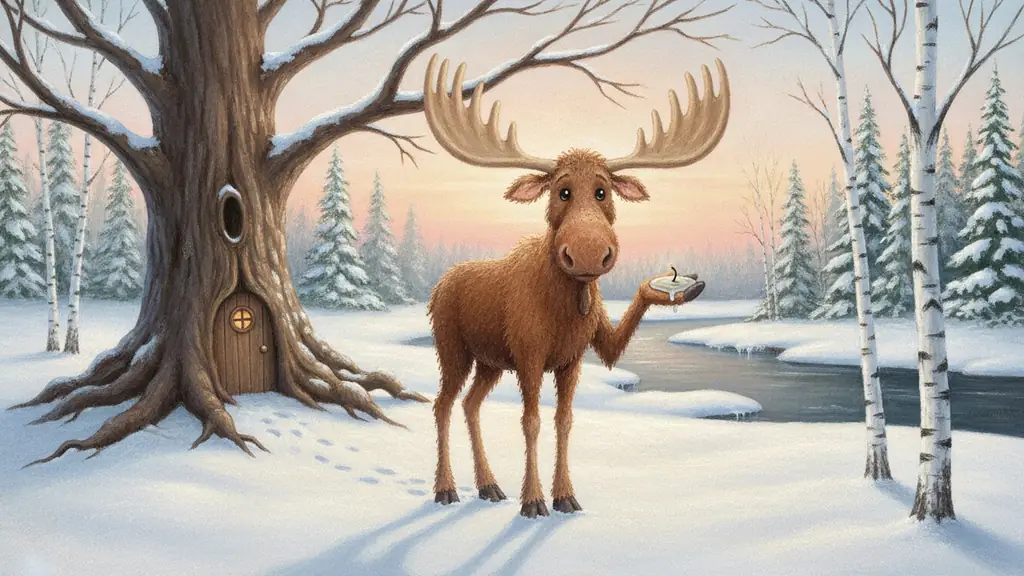
Daddy Moose held out the old candle. It wasn’t really a candle anymore. It was just a little puddle of wax with a tiny black wick in the middle, all melted down flat.
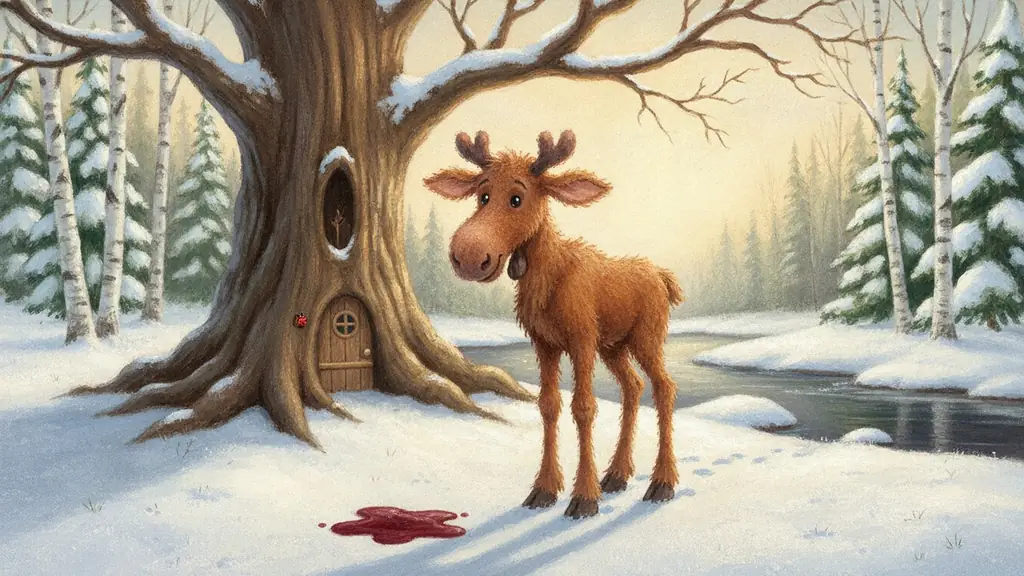
Mr. Moose looked at it for a long time. Yesterday morning it had been a whole candle, tall and smooth. Now there was hardly anything left. All night long, all that light on the snow had come out of this candle. And it couldn’t make the light and stay big, too.
“It got smaller,” said Mr. Moose softly. “It has to melt to make the light.”
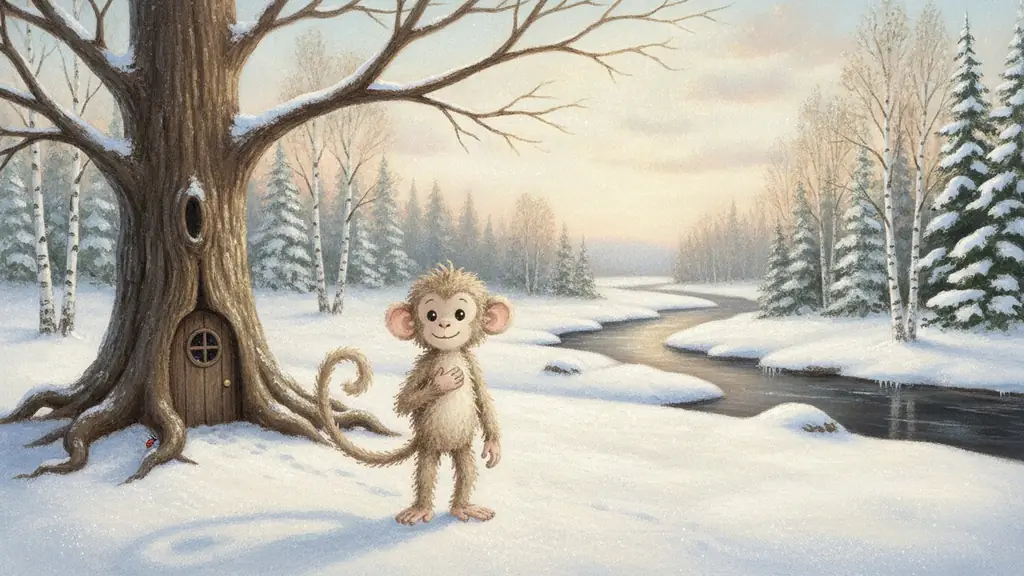
Mr. Monkey’s chest went tight. He thought about Daddy Moose coming out here every single morning in the cold and the dark, while everybody else was asleep. He thought about the Moose home last night, with no candle on the table. Daddy Moose had given away his sleep. He had given away the warm.
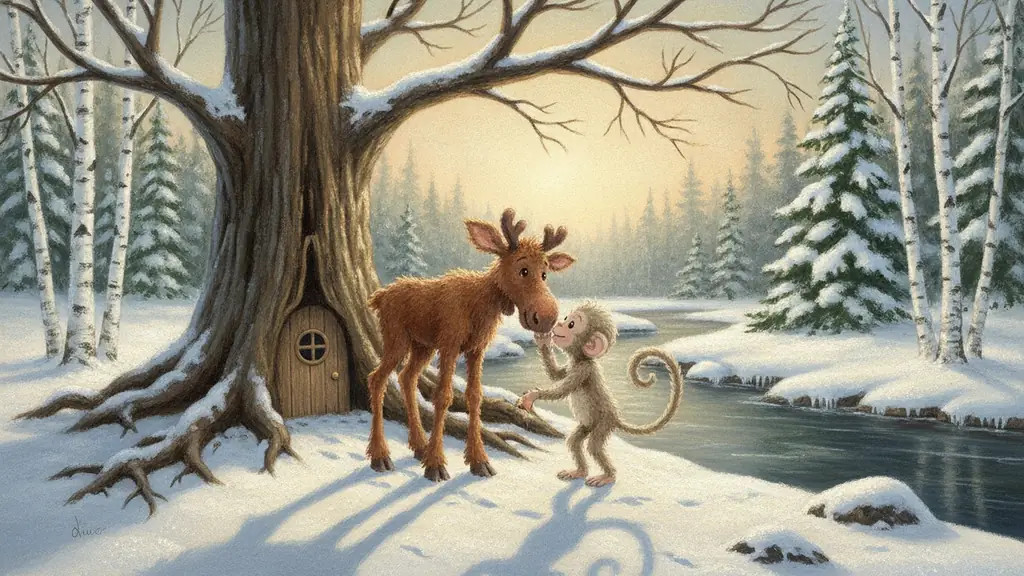
And he had given away his own family’s light, so the lantern could keep shining. And nobody even knew.
“Mr. Moose,” whispered Mr. Monkey. “Your house is dark. Because of the lantern.”
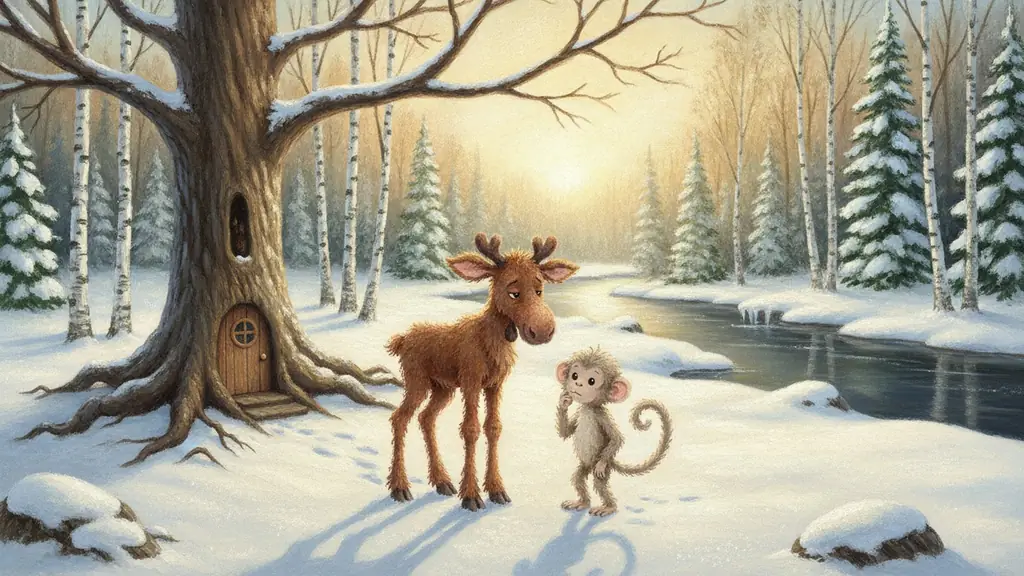
Mr. Moose was thinking. They couldn’t tell Daddy to stop. They’d learned that with the blanket: when somebody gives you something, giving it back stops them from giving. But they could make sure he knew they saw.
“We say thank you,” said Mr. Moose. “And then we give him some light back.”
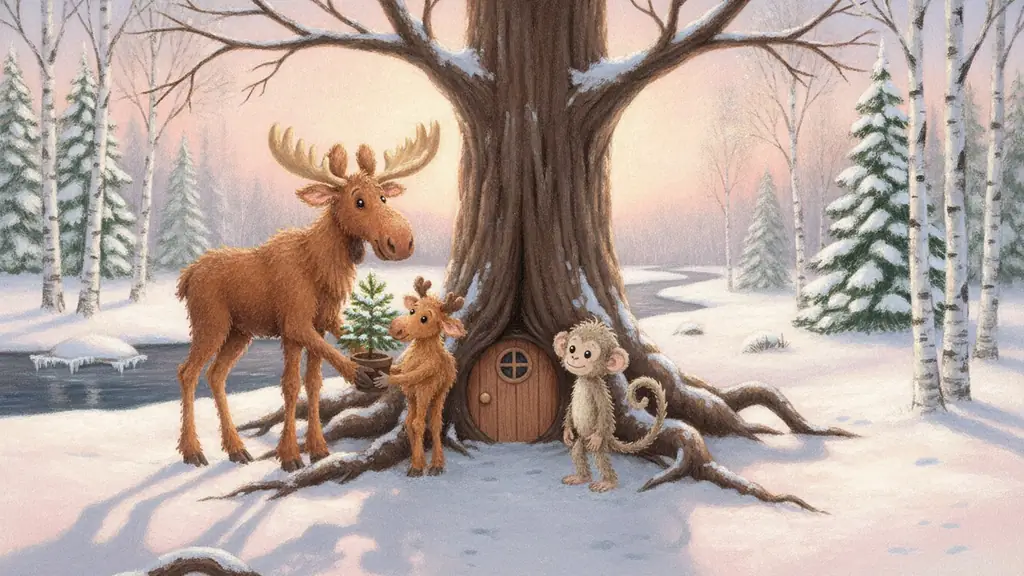
When the sun came up, Mama Moose had something waiting: a little green pine tree in a pot, set right by the door. “In December,” she said, “our thank-yous go on a green tree. Thank-you circles. Paint who it’s for on the front. And on the back, paint what they gave you, and what it cost them.”
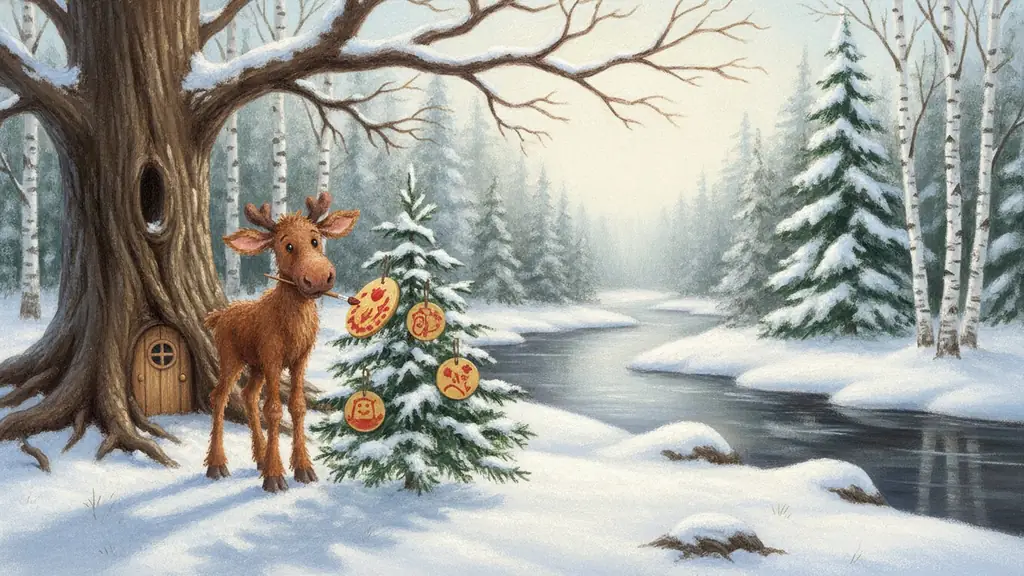
Mr. Moose painted a round gold circle of birch bark. On the front, Daddy’s face, with frost on his eyebrows. On the back, a big moose in the dark snow, with a candle in his mouth and shiver lines all around him, and a dark little house behind him.
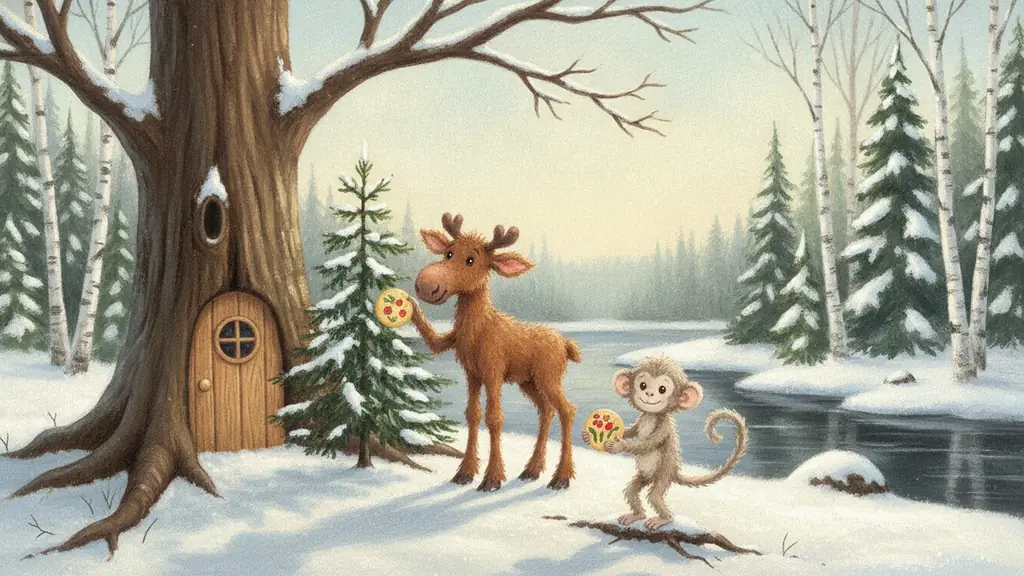
Mr. Monkey painted one for Mama Monkey, for the morning she let him lick the whole honey spoon, even though she had been saving that honey for her tea. They hung them on the little pine with the painted side to the trunk.
Then they went to find Bruno.
“Bruno,” said Mr. Monkey. “We need some honeycomb wax.”
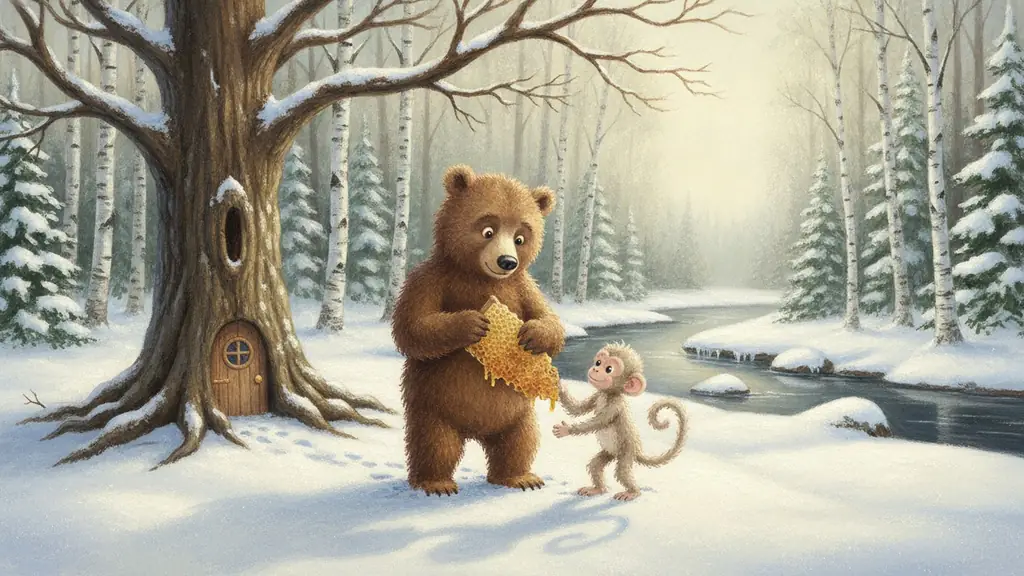
Bruno looked at his honeycomb. He had just unwrapped it again. He looked at it for a long, long time. Then he broke off a big piece of wax. “That’s a lot of wax,” he said. “And not a lot of honey.”
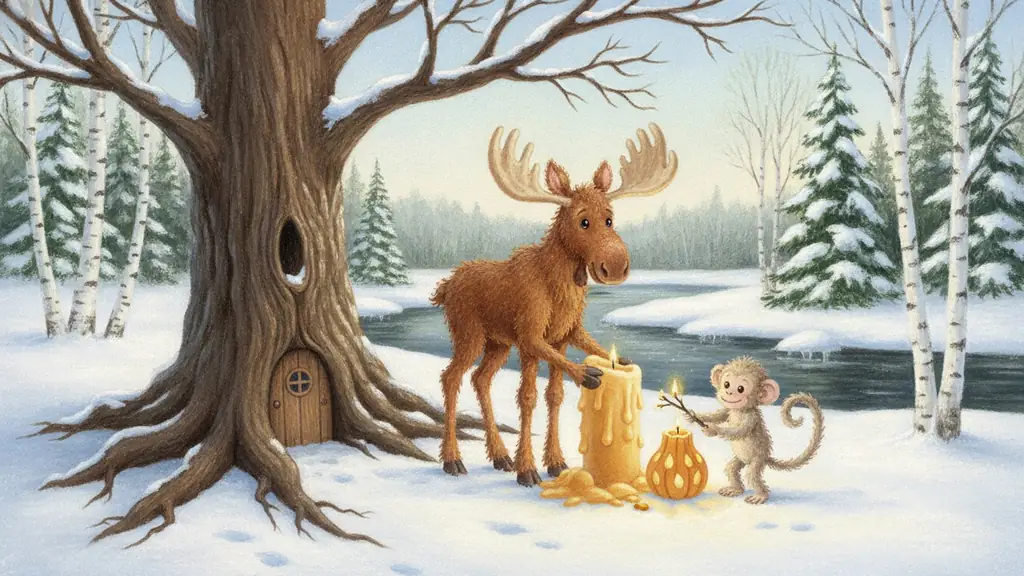
Mama Moose rolled the wax into a fat new candle. “And when this one burns low,” she said, “I’ll roll the next one and light it from this one. Then the light never has to start over.” Mr. Moose held it steady. And Mr. Monkey lit a twig from the squash lantern and, very carefully, lit the candle.
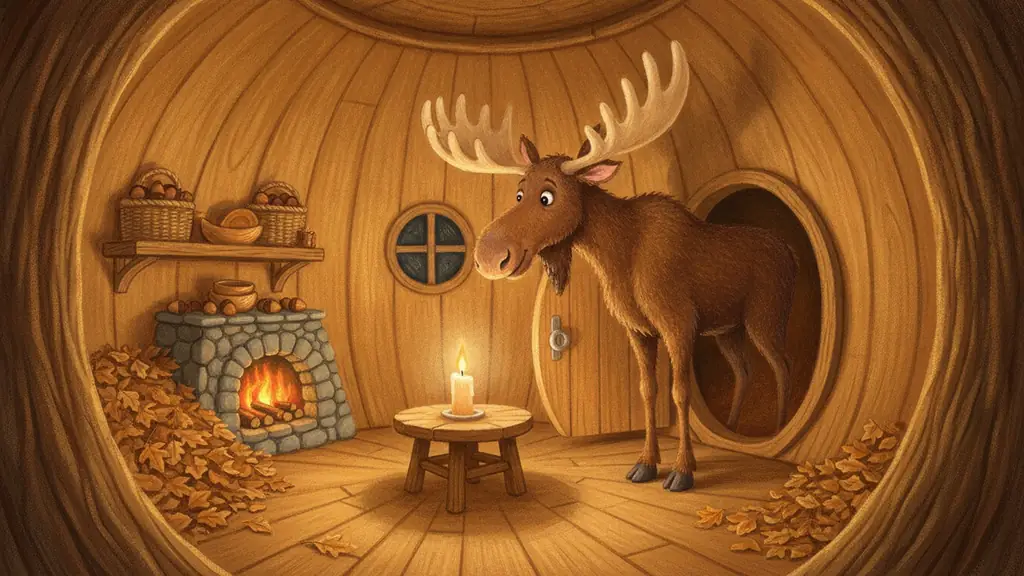
They carried it inside and set it in the middle of the Moose home’s table.
When Daddy Moose came in from the cold, the whole house was glowing gold. He stopped in the doorway. He looked at the candle. Then he looked at the little pine tree by the door, where a gold circle with his own frosty face on it was hanging.
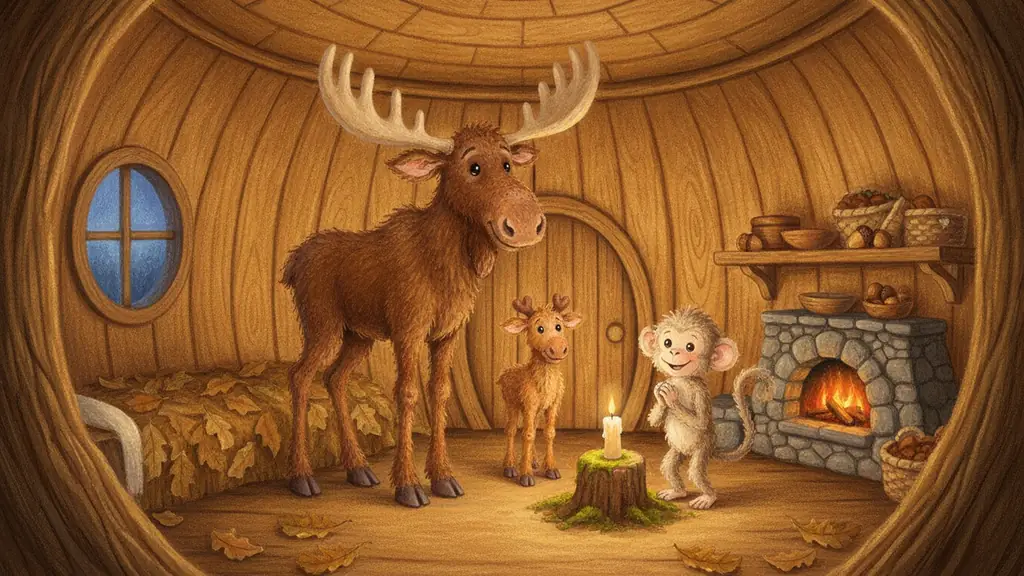
He didn’t peek. He just smiled, slowly, all the way.
“What a day!” said Mr. Monkey. “Everybody got their own present back, and Hazel got a frozen puddle. Mr. Moose rang the icicles like bells. I slid across the ice and found Daddy Moose with a candle in his mouth. The candle melted to make the light. And now the Moose house has light again.”

Mr. Monkey whistled, and Mr. Moose hummed, and together they sang:
We are better together,
Moose and Monkey forever.
And under the big maple, the first home lit from the little lantern glowed warm and gold, while the snow outside turned pink with morning.